When you are looking for technological jobs, you must have come across the terms Data Science and Data Analyst, and thought about the contrast between them. This is one of the most common questions among students and IT professionals in India right now, and the confusion makes complete sense.
Both fields work with data, both pay well, and both are growing fast. But they lead to very different daily jobs, learning timelines, and salary ceilings. This guide will help you understand each path clearly so you can make a confident, informed choice between a comprehensive and structured Data Science with AI training or a Data Analytics course.
Understanding the Difference Between Data Analyst and Data Scientist
India’s data economy is set to reach USD 21 billion by 2030, and both Data Science and Data Analyst careers are growing right at the centre of that boom. So,before you look at salaries or course options, you need to understand the difference between data analyst and data scientist at the most basic level.
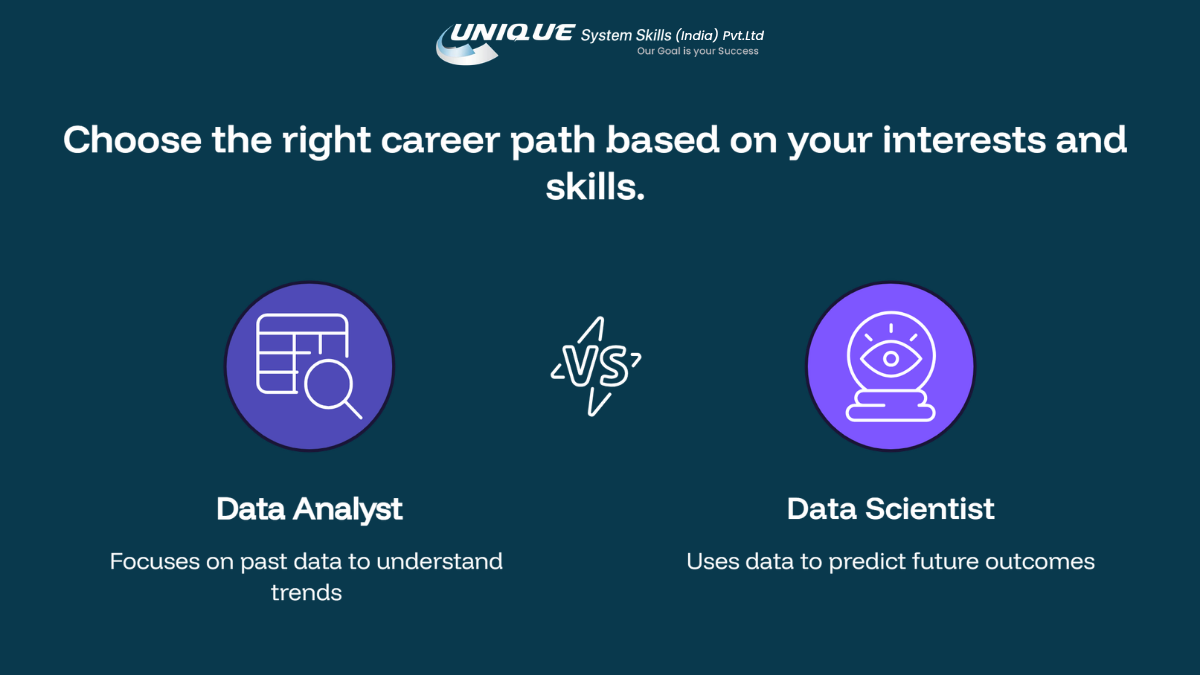
This shapes everything else about the two careers. A Data Analyst works with the past and present. Their responsibilities include converting raw, dirty data into neat, useful information that allows organizations to understand the past and what caused it. On a typical day, a Data Analyst might write SQL queries to pull sales numbers, clean up inconsistent customer records, and build a Power BI dashboard showing which product areas are underperforming.
A Data Science professional starts where the analyst finishes. Instead of explaining what already happened, a Data Scientist builds systems that predict what will happen next. They create automated recommendation systems, anti-fraud solutions, and demand prediction models, which need real-time operation. For this purpose, they should be skilled in Python and have knowledge of machine learning, advanced statistics, and in 2026 be able to work with Generative Artificial Intelligence and Large Language Models.
Data Analyst vs Data Science
The line between the two roles is blurring slightly. The best Data Analysts are now expected to know some Python and understand basic machine learning concepts. The most effective Data Science professionals need to explain their complex findings clearly to non-technical teams. But the entry bar remains different. It normally takes 3-4 months to achieve the analyst level but on the other hand, with the scientist level the training lasts around 6-7 months due to the advanced requirements of mathematics and programming knowledge.
Data Analyst or Data Scientist — Which Path Fits You Better?
The choice between data analyst or data scientist is not about which of the 2 is better. It is about which of the two works best for the learners’ current abilities and preferences in the work they do. For instance, if they like solving business problems, converting complex amounts of data into a story and presenting the results to non-technical people, they will probably choose to become a data analyst. In the other hand, if their priority is to build automated systems, know mathematics and computer languages, and create tools that will function without their help provided to them, they should aim get into Data Science.
Also, the time factor plays an important role in the choice between data analyst and data scientist since a dedicated person is able to become a Data Analyst in just 3-4 months. This starts with SQL and Excel, then learning Power BI or Tableau for visualisation, followed by Python for data manipulation. The Data Science road is longer, typically needing 6-7 months, because it adds a significant mathematical layer on top of the programming foundation, followed by machine learning, deep learning, NLP, and MLOps. Neither timeline is impossible, but knowing the difference helps you plan realistically. And once you understand the time investment each path needs, it is worth looking at what each path actually pays. Another important parts of this decision is understandably the data analyst vs data scientist salary gap.
Data Analyst vs Data Scientist Salary in India — The 2026 Numbers
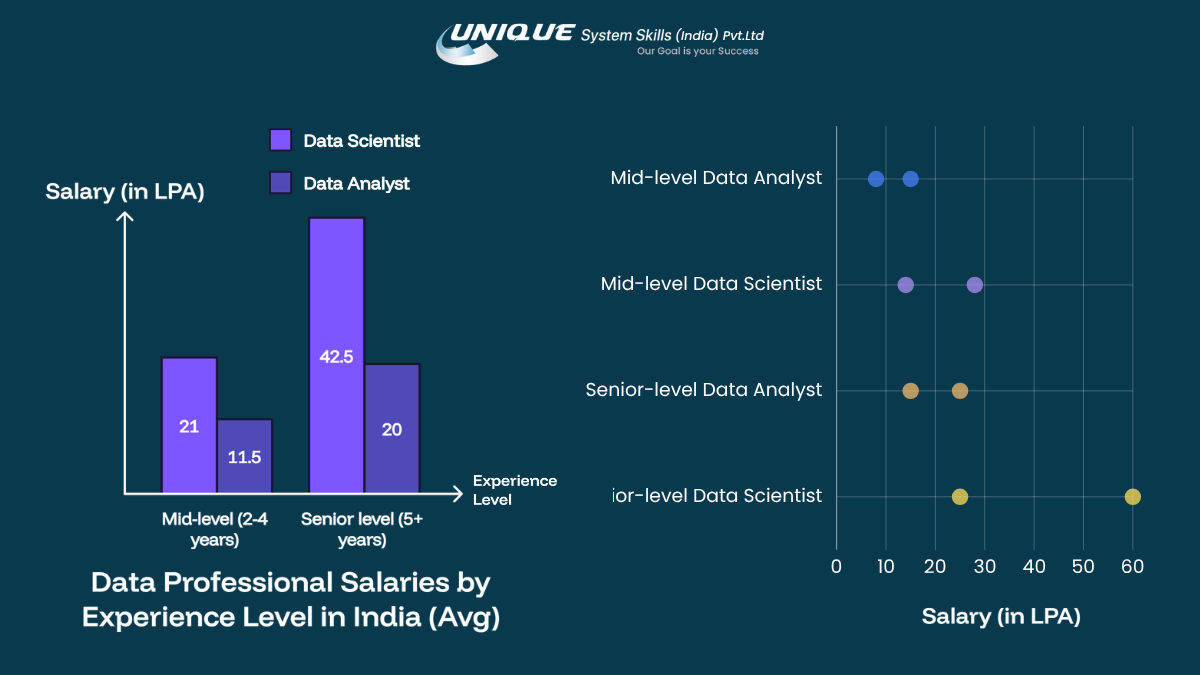
The data analyst vs data scientist salary difference in India in 2026 is real, and it grows larger at every stage of a career. For freshers entering the market with no prior experience, data analyst salary in India typically runs from ₹4 to ₹8 LPA, according to AmbitionBox. A data scientist salary in India for the same experience level starts a bit higher ₹6 and ₹14 LPA because the role demands advanced technical and mathematical skills that fewer candidates possess, as reported by Glassdoor India.
According to Naukri salary insights, things drastically change at the mid (2-4 years of experience) and at the senior level (5 or more years)
Data Scientist and Data Analyst Salary
The arrival of Generative AI has added a premium tier with professionals who genuinely understand LLMs, prompt engineering, and MLOps earn even more than traditional machine learning backgrounds alone command.
One important nuance in the data analyst vs data scientist salary picture is that a skilled senior analyst with deep domain expertise in BFSI or healthcare can earn more than an average mid-level data scientist. Depth of skill often beats a job title. With the national salary picture clear, Pune deserves a separate look because for many professionals, it is the smartest city in India to build a data career right now.
Data Analyst Jobs in Pune and Data Science Jobs — Why the City Is a Smart Career Choice
Data analyst jobs in Pune and data science jobs in the city span a wide range of industries:
- IT services companies in Hinjewadi
- Manufacturing firms in the PCMC corridor
- BFSI organisations near Bund Garden
- Fast-growing Startups across the city
With this unmatchable variety, all actively hire data professionals. In BFSI for example, analysts and scientists build fraud detection models and customer risk profiles. In manufacturing, they use data to improve supply chain efficiency and predict equipment failures before they happen. In healthcare tech, a sector that NASSCOM identifies as one of the fastest-growing data hiring markets in India, data professionals analyse patient outcomes and support drug research.
Pune is one of the best cities in India in terms of hiring for data-related jobs. However, what makes data analyst jobs in Pune even more appealing is that salaries are much easier to get by with, thanks to Pune’s better purchasing power. For instance, data analyst salary in Pune of ₹8 LPA, when compared with the same salary in cities like Mumbai or Bengaluru, proves to be an easier figure to work on because costs of housing and living are lower in Pune than in these two cities. Obviously, this salary advantage plays an important role for the freshers and mid-career professionals willing to make the most out of their lives while they are still working for interesting companies. Data scientist jobs in Pune are similarly well paid, as some of the highest-paying jobs in GCCs and product companies offer at least ₹20-35 LPA for experienced candidates. The city’s infrastructure is well-functioning and integrated into a low-cost economy, making it possible to pursue a successful career in data in such a countryside. Nowadays, the right training can allow for course completion and even quicker employment.
Building the Right Skills — The Technical Roadmap for Both Paths
Understanding the career and salary landscape is only useful if you know what skills to build and in what order. In the first 2 months of the Data Analyst path, the focus is on Excel for data cleaning and SQL for working with databases. These are the skills that appear in virtually every data analyst jobs in Pune listing as non-negotiable requirements. Month 3 adds data visualisation through Power BI or Tableau, where the goal shifts from working with data to telling stories with it. The last stage adds Python for data manipulation with the help of Pandas and NumPy, ultimately resulting in a portfolio full of real-life projects that demonstrate the candidate’s capabilities to the employer. A few examples of the projects may be: a sales dashboard, customer segmentation analysis, or analysis of revenues from different regions.
In their turn, Data Science route starts with the same analytical principles but goes further. After the introduction into SQL basics and Python basics, the next part consists of statistics, probability, and linear algebra study. This mathematics is what machine learning models build on. Next comes the basics of machine learning, such as supervised learning (classification and regression), unsupervised learning (clustering), and model assessment. In 2026, the advanced part should include Deep Learning and basics of NLP and Generative AI, and basic knowledge of MLOps for model deployment should also be acquired. Across both paths, building a GitHub portfolio is not optional.
Employers in 2026 consistently prioritise demonstrated, documented ability over certificates and exam scores alone. The quality of your training programme determines how efficiently you move through this roadmap which is exactly where the right course makes a decisive difference.
Choosing the Best Data Analytics Course in Pune — What to Look For
The market for data analytics courses in Pune and data science course in Pune programmes has grown a lot, and quality varies widely. There are weekend certificate programmes that give surface-level tool familiarity, and there are structured, placement-focused programmes that build the skills companies are actively hiring for. Knowing how to tell the difference is one of the most important decisions you will make in this process.
The most important thing to look for in data analytics courses in Pune is whether you practise on real, live tools or just watch someone else use them. The best data analytics course in Pune will have you writing actual SQL queries against real databases, building genuine Power BI dashboards with messy real-world data, and running Python scripts that solve real business problems. This hands-on approach is what produces graduates who can actually perform in interviews and on the job from day one.
The data analyst course fee for programmes with this level of practical depth is typically higher than for passive video-based options. But the return on that investment is consistently strong. A student who completes a well-structured programme and lands a data analyst jobs in Pune role earning ₹6–8 LPA can recoup the entire data analyst course fee within 2-3 months of starting work.
Likewise, the data science course fee in Pune for comprehensive programmes can be recovered within the first 1-2 months of employment for well-placed graduates. As a consequence, the cost shifts from being considered merely an expense to being viewed as an investment with a relatively short payback period.
The best data analytics course in Pune and the best data science course in Pune should come with a structured mock interview preparation programme covering SQL queries, model design problems, and business case studies. A data analytics course in Pune with placement records is much more credible than a course with unsubstantiated placement percentage claims. Additionally, a data analytics course in Pune with placement support that connects you directly to hiring companies is worth significantly more than the same curriculum without it.
Data science course fees in Pune range from a few thousand for short programmes to a lakh and above for comprehensive, placement-supported options. Evaluating data science course fees against earning potential helps you see the decision clearly: the difference between a short course and a longer, more comprehensive course may be the difference between a ₹5 LPA starting role and a ₹9 LPA one.
Why Unique System Skills Is Pune’s Best Choice for Both Paths
Unique System Skills (USS) with 17+ years of experience, 7,000+ professionals trained, and a placement network spanning 100+ hiring partners offers 2 programmes built specifically for the 2026 Pune market.
This includes a comprehensive Data Science with AI training and a structured Data Analytics course. USS’s training is built around knowing how a tool works and being able to use it independently under interview pressure. Batch sizes are capped at 15 students for individual attention. Trainers are active industry professionals who know what Pune’s hiring panels are currently testing for. Every programme includes mock technical interviews covering SQL queries, model design challenges, and business case studies. This is exactly what builds the confidence to explain complex findings clearly to non-technical stakeholders, which Indian employers consistently highlight as a key differentiator.
For candidates who are not sure whether data analyst or data scientist is the right path for them, USS offers free demo classes and expert one-on-one counselling to help make the decision based on individual background and career goals. View USS placement outcomes and student reviews here. Whether your goal is data analyst jobs in Pune, data science jobs at a product company, or a transition from a non-IT background, USS provides the certifications, the hands-on portfolio, and the hiring connections to get you there.
The Choice That Compounds
The decision between Data Science and Data Analyst careers does not have to be permanent and this is the most important thing most career guides miss.
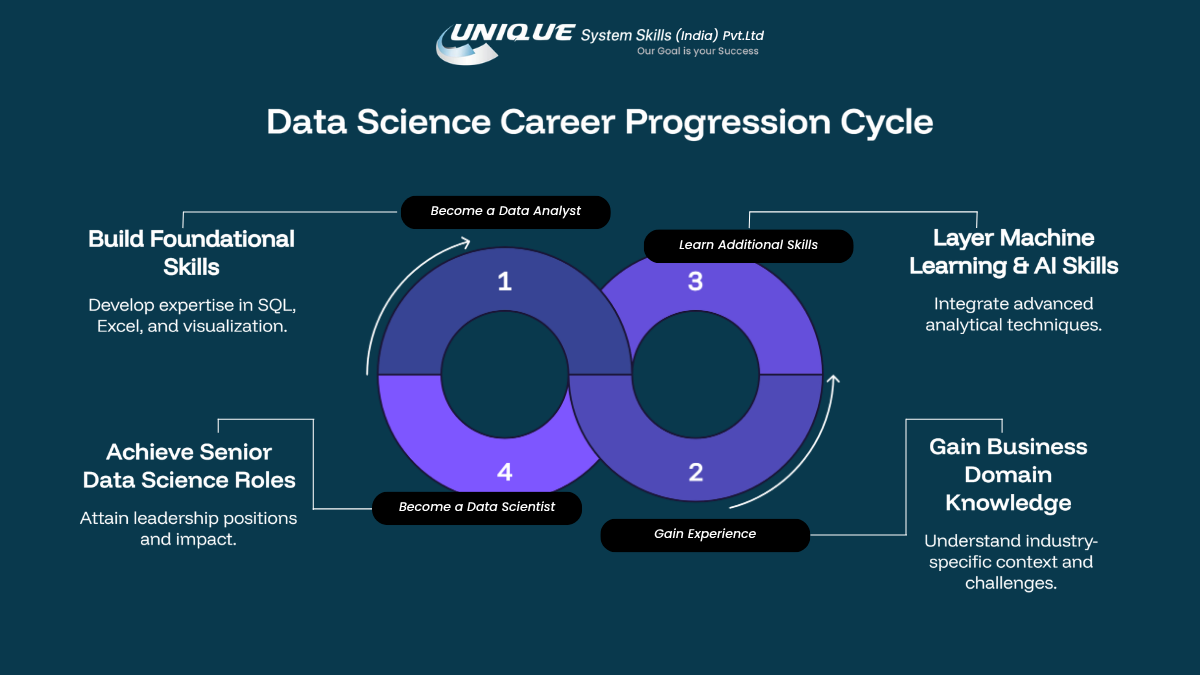
Many of India’s most successful Data Science professionals today started as Data Analysts. They built their SQL, Excel, and visualisation foundations first, developed deep business domain knowledge, and then layered machine learning and AI skills on top.
Data Science Career Progression Cycle
What matters most is starting. India’s data economy is growing at a pace that rewards early movers, and the professionals who begin building documented, practical skills today have compounding advantages over those who keep researching the decision without acting on it. The data analyst vs data scientist salary gap is real, but both career paths lead to rewarding, future-proof work in one of India’s most exciting sectors.
Choose the path that fits your current strengths, commit to a programme that builds real skills with real tools, and trust that the investment will pay back many times over.
FAQ Section
Q1. What is the difference between data analyst and data scientist?
A Data Analyst focuses on the past and present. Their job is to clean, organise, and analyse data that already exists. Then they present that data as clear, visual insights that business teams can use to make decisions. Tools like SQL, Excel, Power BI, and Tableau are at the centre of their work.
A Data Science professional builds on top of this. Rather than explaining what has already happened, they create automated, intelligent systems that predict what will happen next. This work requires Python programming, machine learning algorithms, statistics, and increasingly, Generative AI and Large Language Models.
In short, Data Analysts turn past data into present decisions. Data Science professionals use past data to automate future ones. The tools overlap but, the mindset differs.
Q2. Is data science harder than data analytics?
Yes, Data Science is technically more demanding than Data Analytics.
Data Analytics requires strong SQL skills, Excel proficiency, data visualisation in Power BI or Tableau, and Python basics for data manipulation.
Data Science requires all of those foundations and significantly more on top: advanced Python programming, probability theory, statistics, linear algebra, machine learning algorithms, model evaluation, deep learning, NLP, and in 2026, Generative AI and MLOps for deploying models into production environments.
With the right structured programme, the right trainers, and the right hands-on project work, the Data Science skill set is achievable for motivated learners. The best data science course in Pune programmes, like USS’s Data Science with AI training, are specifically designed to build these skills in a structured, step-by-step way that makes the complexity manageable rather than overwhelming.
Q3. Which career is best for freshers — data analytics or data science?
For most freshers in India in 2026, Data Analytics is the more practical starting point and choosing it does not limit your long-term options in any way. Here is why.
The Data Analyst path has a lower technical entry bar across India with starting salaries of ₹4–8 LPA. A Data Analyst role can build real business domain knowledge and SQL/Python skills which the employee can then layer with Data Science training on top once the analytical foundation is solid.
Q4. Does a data analyst need coding?
Some coding is expected, but you do not need to be a software developer to become a strong Data Analyst.
SQL is the most essential coding skill for any Data Analyst. Every data analyst jobs in Pune listing that requires database work will list SQL as a required skill, and technical interviews for Data Analyst roles consistently include live SQL challenges. Python has moved from nice to have to for this role in 2026. The specific libraries most relevant for analysts are Pandas and NumPy.
Q5. Is data analytics a good career in 2026?
Yes, It is great career choice in today’s digital world. The structural demand for Data Analyst skills in India is driven by organisations’ need to collect data.
Every e-commerce transaction, every hospital visit, every bank transfer, every customer service interaction generates data. Without skilled analysts to clean, structure, and interpret that data, it sits unused.
The demand for people who can turn that raw data into business decisions that actually get made is growing across every sector including BFSI, manufacturing, healthcare, retail, and startups included.
Q6. Can data analysts learn machine learning and move into data science?
Absolutely, this is one of the most well-trodden and reliable career paths in Indian IT right now. Many of India’s senior Data Science professionals today started their careers as Data Analysts, and the transition is both achievable and strategically sensible.
The reason the analyst-to-scientist path works well is that the foundations you build as a Data Analyst re exactly the prerequisites you need to build Machine Learning. This typically needs to add:
- Advanced statistics and probability
- Core machine learning algorithms
- Model evaluation and selection
- Python libraries for ML (Scikit-learn, TensorFlow, or PyTorch)
- Generative AI and MLOps for production deployment
The best data science course in Pune programmes, like USS’s Data Science with AI training, are specifically structured to accommodate learners with analytical backgrounds.
Q7. Which course should I choose — data analytics or data science?
The right answer depends on on you:
Choose a data analytics course if:
- You are new to tech or coming from a non-IT background.
- You are more comfortable with business problems and data visualisation than with heavy mathematics and programming.
- You want strong, stable employment options across a wide range of industries.
Choose a data science course if:
- You are comfortable with Python and mathematics or are willing to invest the time to build that comfort.
- You want to build automated, predictive systems rather than descriptive reports and dashboards.