A simple guide to spring boot vs spring mvc, and to how Spring, Spring MVC and Spring Boot fit together.
Spring Framework is the core toolkit that creates your objects and connects them. Spring MVC is the part of Spring that handles web requests. Spring Boot is a tool on top of both that does the setup for you and runs your app on a built-in server. So spring boot vs spring mvc is not a fight between rivals, because Boot normally includes MVC. The real differences are in setup, dependencies and deployment, and this guide shows each one with code you can try.
Feeling mixed up by these three names is normal. Most people meet Spring Boot first, because a Boot tutorial works in five minutes, and the framework underneath feels like magic. It is worth the effort to understand it. In the 2025 Stack Overflow Developer Survey, 14.7% of all respondents used Spring Boot, and 53.7% of the people who used it want to keep using it. A good answer to the spring boot vs spring mvc question needs you to know what happens under the hood. So let us start at the bottom, with the foundation.
What Is Spring Framework? The Foundation Under Everything
Before Spring, building big Java applications meant working with Enterprise JavaBeans (EJB) and J2EE. These tools needed a lot of extra code and were hard to test. Rod Johnson introduced Spring in 2004 as a lighter option.
So what is Spring Framework? It is a container that creates your objects, sets them up and connects them. It does this with two ideas: Inversion of Control (IoC) and Dependency Injection (DI).
When writing this idea in code, instead of writing new PaymentGateway() inside your class, which locks the two together, you can say what you need and Spring supplies it.
Because OrderService does not build its own gateway, you can give it a fake one in a unit test without touching business code. Spring also has Aspect-Oriented Programming (AOP), which keeps logging, security and transactions out of your business logic, plus modules for data access and security. The project keeps moving. Spring Framework 7 and Spring Boot 4.0 reached general availability in November 2025, as InfoQ’s Spring coverage records. Spring Boot 4.1.0 followed on June 10, 2026, and 4.1.1 on August 20, 2026.
None of this tells Spring how to handle a web request, and that gap is what the next module fills.
What Is Spring MVC Framework? The Web Layer Explained
Spring MVC framework is the web module of Spring. It uses the Model-View-Controller pattern to keep data (Model), screens (View) and request handling (Controller) apart. The View can be HTML made with Thymeleaf, JSP or FreeMarker. The Controller takes the request, calls your services and decides what to send back.
Every request enters through the DispatcherServlet, also called the front controller. This is the path a request takes:
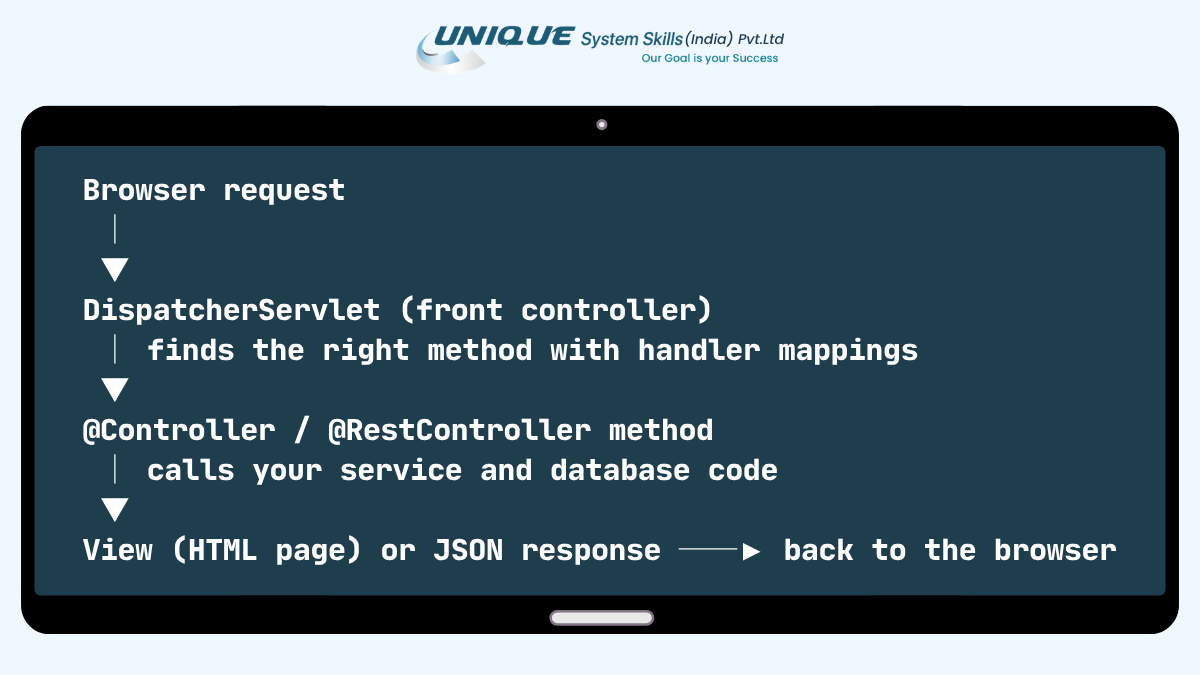
How Spring MVC routes browser requests through DispatcherServlet to a controller and returns an HTML page or JSON response.
You guide this flow with annotations:
- @Controller for pages
- @RestController for JSON or XML APIs
- @RequestMapping, @GetMapping and @PostMapping for routes
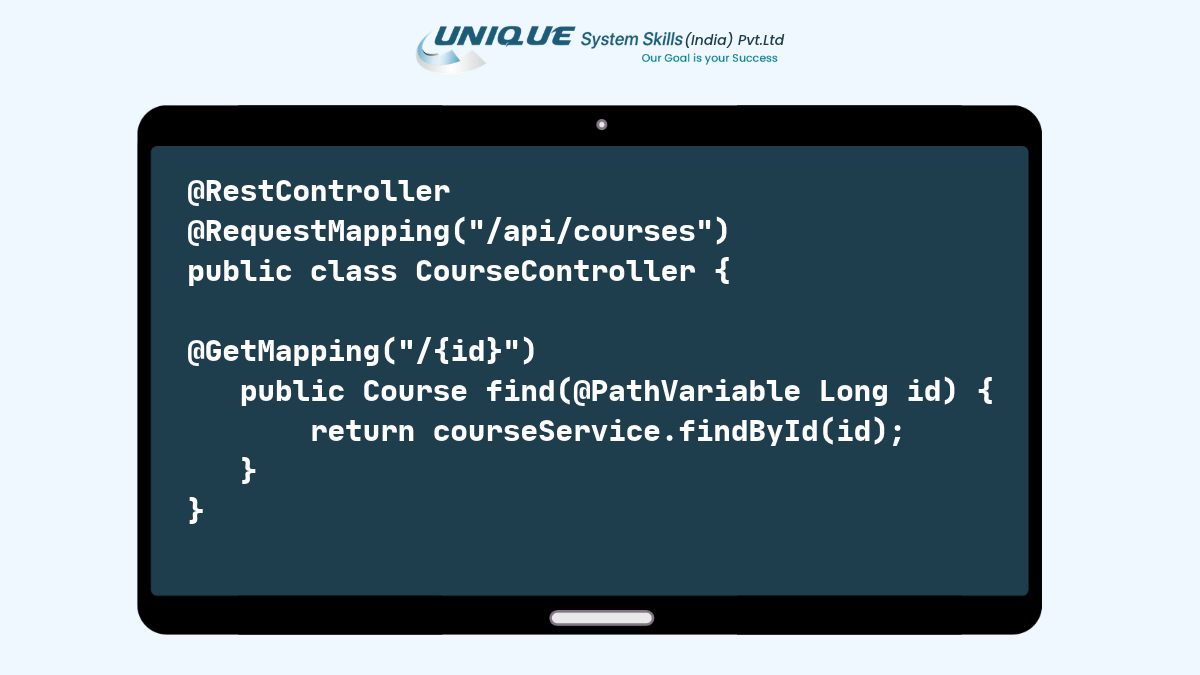
A Spring REST controller maps GET requests to /api/courses/{id} and calls a service to retrieve the requested course.
Notice what MVC does not do. It does not start a server, pick library versions or connect your beans on its own. In its classic form you register the DispatcherServlet in XML or Java configuration, build a WAR file and put it on an outside server such as Tomcat, Jetty or JBoss. That works, but the extra setup is the problem the next tool solves.
Spring vs Spring Boot: Why the Accelerator Arrived
If you have set up a classic Spring project, you know the feeling. Hours go into XML files, library versions that do not match and server settings before you write any business code. Spring Boot 1.0 came out in April 2014 to remove that pain, as this Spring Boot version history shows. In the Spring vs Spring Boot comparison, the main point is that Boot does not replace Spring. It is a layer on top that makes sensible choices for you, and it brings four things:
- Auto-configuration: Boot looks at your classpath and sets up beans to match. Add a database driver and it creates a data source without XML.
- Starters: Ready-made bundles such as spring-boot-starter-web or spring-boot-starter-data-jpa pull in library versions that are tested together.
- Embedded servers: Tomcat, Jetty or Undertow live inside your app, so it runs as one executable JAR.
- Opinionated defaults: @SpringBootApplication joins @Configuration, @EnableAutoConfiguration and @ComponentScan in one line.
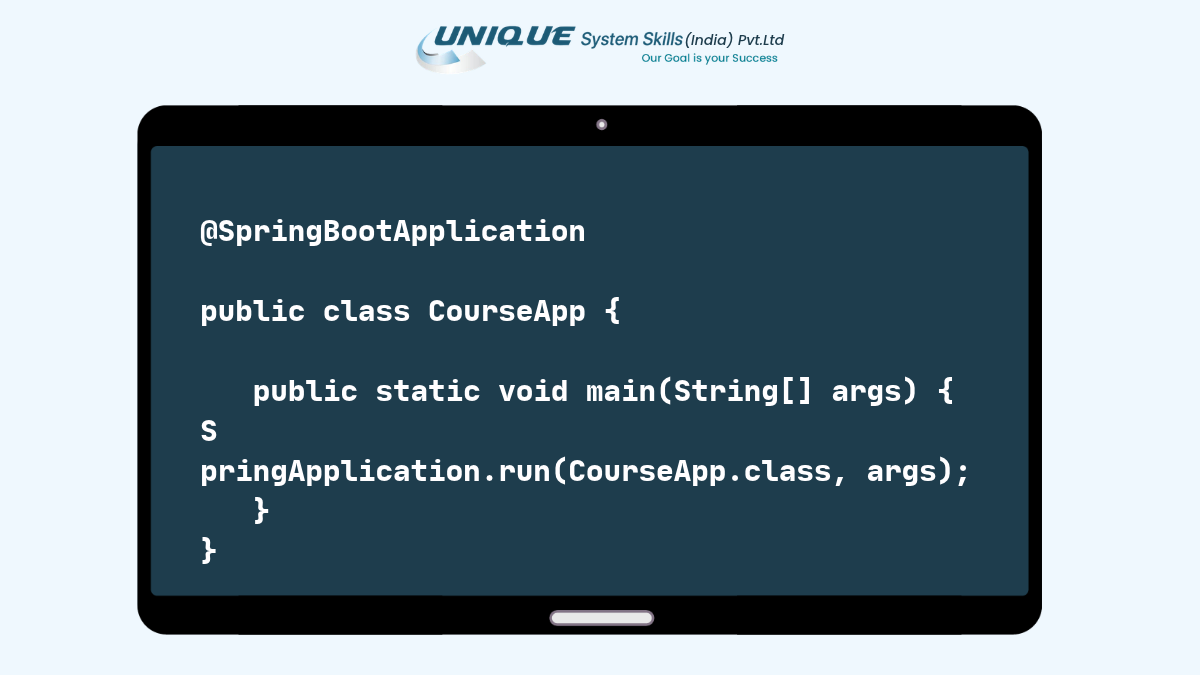
A basic Spring Boot application class using @SpringBootApplication and SpringApplication.run to launch CourseApp.
Run java -jar course-app.jar and the service is live. Compare that with building a WAR, setting up a server and deploying by hand. Now let us put all three tools side by side.
Spring Boot vs Spring Framework: A Side-by-Side Comparison
People often search for spring framework vs spring boot, and a table shows the answer fastest. It adds Spring MVC as a third column.
| Dimension | Spring Framework | Spring MVC | Spring Boot |
| Purpose | Core tools: IoC, DI, AOP | Web module for MVC apps and REST APIs | Accelerator for production-ready apps and microservices |
| Configuration | XML or Java @Configuration | Same, plus web mappings | Auto-configuration and defaults |
| Dependencies | You choose and version them | You add the web libraries | Starters bundle matching versions |
| Server | Outside Tomcat, Jetty or JBoss | Outside server, WAR file | Built-in server, executable JAR |
| Microservices | Possible, with heavy setup | Mostly one big web app | Made with them in mind |
MVC handles web requests, while Boot sets up and runs the app that contains MVC. On configuration, core Spring and MVC expect you to wire beans by hand, while Boot registers them from the classpath. On dependencies, older projects leave version matching to you in Maven or Gradle, and clashes are common. Starters remove that guesswork, and that is the heart of the spring boot vs spring framework gap in daily work. In short, a spring boot vs spring comparison is a comparison of effort: how much setup you want to do yourself.
Spring Boot vs Spring MVC: Clearing Up the Biggest Confusion
Think of Spring MVC as an engine and Spring Boot as the car built around it. Spring MVC is a library for web requests. Spring Boot is not a rival web library. It is a way to assemble and run Spring apps, and spring-boot-starter-web brings Spring MVC along with Jackson and an embedded Tomcat:
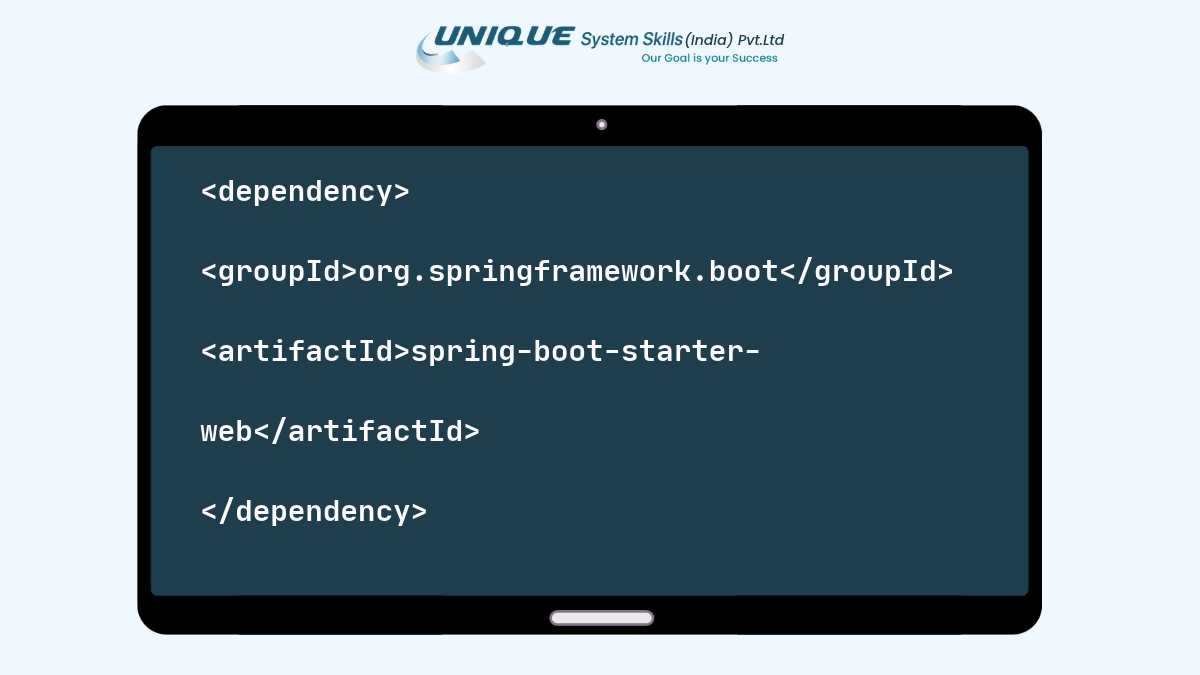
Maven XML configuration for adding the spring-boot-starter-web dependency to a Spring Boot project.
That gives you three real setups. You can run Spring MVC without Boot, with manual setup and an outside server. You can run Boot with MVC, which is the usual choice for REST services. And you can run Boot without MVC at all, for a batch job or a message consumer that serves no web pages. Whether you build pages with Thymeleaf or JSON APIs with @RestController, the MVC part works the same way. The spring boot vs spring mvc choice is really a choice about how much setup you want to own. Once that is clear, deployment is where the gap becomes impossible to miss.
Spring MVC vs Spring Boot for Cloud-Native Deployment
When you compare spring mvc vs spring boot for cloud work, deployment decides most of the argument. A classic MVC app is a WAR file, and someone must install and tune Tomcat or JBoss first. A Boot app is one JAR that carries its own server, so the same file runs on a laptop, in a Docker container or on a cloud platform. That is why Boot is the usual base for microservices, where many small services must start the same way every time.
Boot also gives you extras that standalone MVC makes you add yourself. Spring Boot Actuator adds health checks and metrics for monitoring, and the test starter brings JUnit and Mockito. Annotations like @WebMvcTest let you test one controller alone, while @SpringBootTest starts the whole app for integration checks. In the spring boot vs spring mvc debate for microservices, this built-in tooling often decides the winner. Knowing all this helps most when you can explain it clearly to someone else.
Difference Between Spring and Spring Boot: How to Show You Understand It
Java stays in demand across banking, IT services, product companies and startups, and backend interviews test whether you understand the layers, not just the annotations. A clear spring boot vs spring mvc explanation is one of the easiest ways to show that. Self-study can feel heavy, because IoC, DI, AOP, auto-configuration and JPA all arrive together. A better way is to turn the difference between Spring and Spring Boot into things you can show. With these four steps, you can prove what you know:
- Draw the request flow. Sketch a request moving through DispatcherServlet, handler mapping, controller and view or JSON response.
- Build one endpoint twice. Make it once with classic Spring MVC and once with Boot, and list every file you no longer need.
- Read the auto-configuration report. Start your app with the –debug flag and see which beans Boot set up and why.
- Write tests. Cover one controller with @WebMvcTest and one flow with @SpringBootTest.
Guided practice makes this faster. The Java Full Stack Course in Pune at Unique System Skills covers core Java, HTML, CSS, JavaScript and React, backend work with Spring Boot and Hibernate, MySQL, REST APIs, Git and deployment, plus a module on AI and machine learning concepts. Classes run in classroom and online modes, with batches of up to 15 students. Many Boot services now use AI features, and the AI Fundamentals Course in Pune teaches Python libraries, machine learning, deep learning, NLP and generative AI, including a chatbot built with the OpenAI API. To check the endpoints you build, the Software Testing with Playwright Course in Pune covers API testing, network interception and CI/CD integration.
Conclusion: Clarity Is a Career Skill
Spring gives you the foundation, Spring MVC handles the web layer, and Spring Boot removes the setup work around both. Once you see these layers, the spring boot vs spring mvc question stops being a trap and becomes a chance to show how real applications are built. Imagine answering it with a clear explanation, a diagram and a project you built twice. You can get there, and the surest way is steady, hands-on practice with the code in this guide. Start with one endpoint today, and let each small project build the confidence for the next.
Frequently Asked Questions
What is the difference between Spring and Spring Boot?
Spring is the core framework that manages objects through dependency injection, and you configure and deploy it yourself. Spring Boot sits on top of Spring and adds auto-configuration, starter dependencies and an embedded server, so an app starts with one command. Every Boot app is a Spring app. Practise both in the Java Full Stack Course in Pune.
What is Spring Boot vs Spring MVC?
Spring MVC is Spring’s web module, handling requests through controllers and the Dispatcher Servlet. Spring Boot is not a rival web library. It is a setup-and-run tool that normally includes Spring MVC through spring-boot-starter-web, adds auto-configuration, and runs your app on an embedded server.
What is Spring vs Spring Boot?
Spring vs Spring Boot compares a core toolkit with a faster way to use it. Spring offers dependency injection, AOP and modules, but you wire everything by hand. Spring Boot adds defaults and starters so you write business code first, and most new projects use it.
How to run a Spring Boot application in VS Code?
Install a JDK, then the Extension Pack for Java and the Spring Boot Extension Pack. Open the project and press F5 on the main class, or click Run in the Spring Boot Dashboard. The terminal command ./mvnw spring-boot:run also works. The app starts on port 8080 by default.
What is Spring MVC framework?
Spring MVC is the part of the Spring Framework for building web applications and REST APIs. It follows the Model-View-Controller pattern: models hold data, views show it, and controllers handle requests. Every request passes through the DispatcherServlet, which routes it to the right controller method.