As more companies move their systems to the cloud and automate the way they release software, AWS Cloud Engineer jobs have become one of the safer, better-paid bets in Indian tech. This is not just a trend at big MNCs, but a real hiring priority at mid-size firms too. This means if you’ve been checking job sites and wondering whether cloud computing is really worth switching to, you’re asking the right question.
Behind most of these roles sits DevOps, a way of working that joins software development and IT operations so code can move from a laptop to a live server quickly and safely. Instead of developers writing code and handing it to a separate operations team, DevOps sets up pipelines that test, package, and release software automatically.
AWS DevOps jobs keep growing because companies need people who understand the cloud, and automate it end to end. If you’re not sure where to start, a step-by-step path like the AWS with DevOps Course offered by Unique System Skills can save you the trial and error of working out the right order to learn things in.
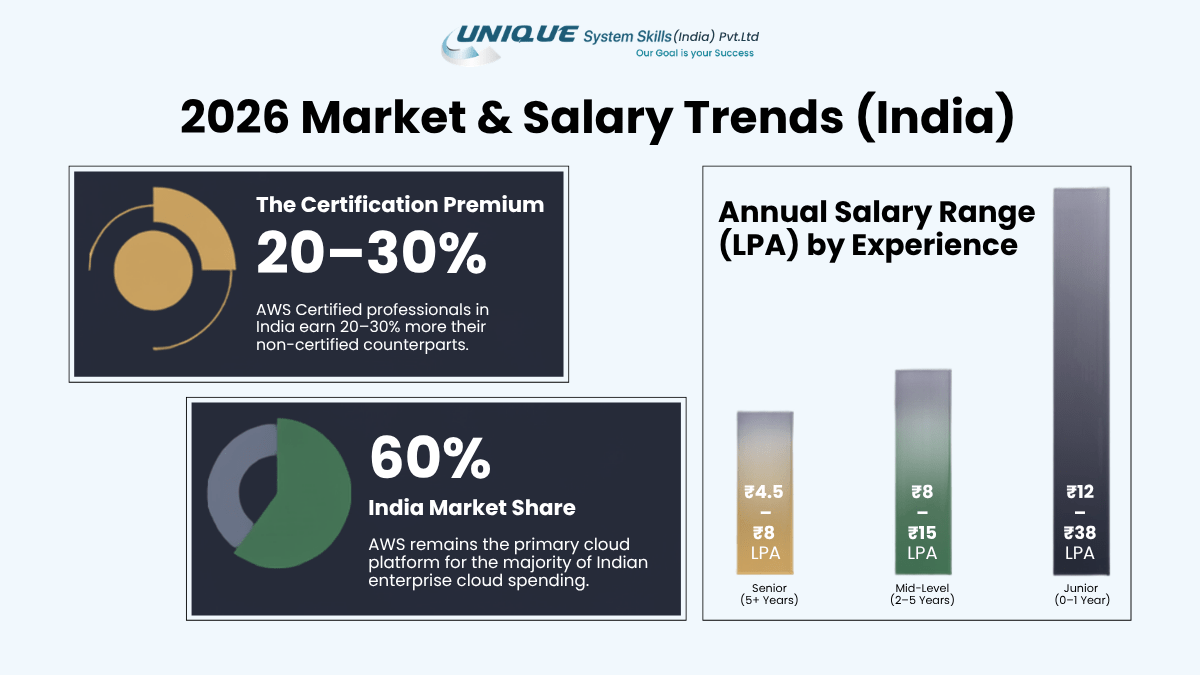
AWS-certified professionals in India earn a reported 20–30% salary premium, while AWS holds a 60% share of enterprise cloud spending.
The Skills You Need for These Roles
The tool list for DevOps roles can look intimidating at first, but the core skill set is smaller than it seems. Linux is estimated to run around 85% of cloud servers worldwide, so being comfortable with the command line, basic networking (DNS, HTTP, SSH), and scripting in Bash or Python is step one. From there, most AWS DevOps jobs expect working knowledge of core AWS services:
- EC2 for computing power
- S3 for storage
- VPC for networking
- IAM for access control
- RDS or DynamoDB for databases
Once the basics are solid, the next layer is automation. Docker packages applications so they run the same way everywhere, and Kubernetes manages those applications at scale. Jenkins and GitHub Actions handle the CI/CD pipelines that most DevOps engineer jobs are actually built around, and Terraform lets engineers set up entire server environments through code instead of clicking through menus by hand.
Once the basics are in place, pairing them with a nearby specialization such as the Artificial Intelligence Fundamental Course or the Cyber Security Course makes a resume stand out.
Certifications can help a resume get past the first filter, especially for someone with less than 2 years of experience. The 2 that come up most often in Indian hiring conversations include:
- AWS Certified Solutions Architect – Associate – proves you can design workloads on AWS
- AWS Certified DevOps Engineer – Professional – aimed at people already running pipelines in production.
A Certified Kubernetes Administrator badge is also useful once you’re past the basics.
How DevOps Engineer Salary Grows in India
AWS Cloud Engineer jobs are growing fast in India because Amazon Web Services now handles close to 60% of India’s enterprise cloud spending, based on current market-share estimates.
Despite the demand, it’s fair to be skeptical of salary numbers floating around online, so here’s a grounded picture based on current listings and compensation data reported across major Indian job portals. DevOps engineer salary for freshers typically starts between ₹4 LPA and ₹8 LPA, with some entry-level programs in cities like Pune reporting starting offers closer to ₹3.5–6 LPA. That’s a modest starting point, but it tends to move quickly. Engineers with 1 to 5 years of experience who can independently run CI/CD pipelines and write Infrastructure as Code usually earn ₹6–20 LPA, and top product companies sometimes push this closer to ₹30 LPA.
Past that point, DevOps engineer salary growth steepens further. Senior engineers, Platform Engineers, and Site Reliability Engineers with 5+ years of experience report ₹12–38 LPA, while Cloud Architects and DevOps Leads with eight or more years of experience earn anywhere from ₹20 LPA to ₹50 LPA or more, with the most senior architects at large firms going beyond that. Specific tools act like direct pay multipliers, according to recruiter-reported figures: Kubernetes skills are commonly linked to a ₹4–7 LPA bump, AWS expertise to ₹3–6 LPA, and Terraform to ₹2–4 LPA.
Your ceiling in AWS Cloud Engineer jobs isn’t set by your first offer, it’s set by how deliberately you add skills afterward, which is exactly what pulls people toward more specialized, better-paid roles down the line.
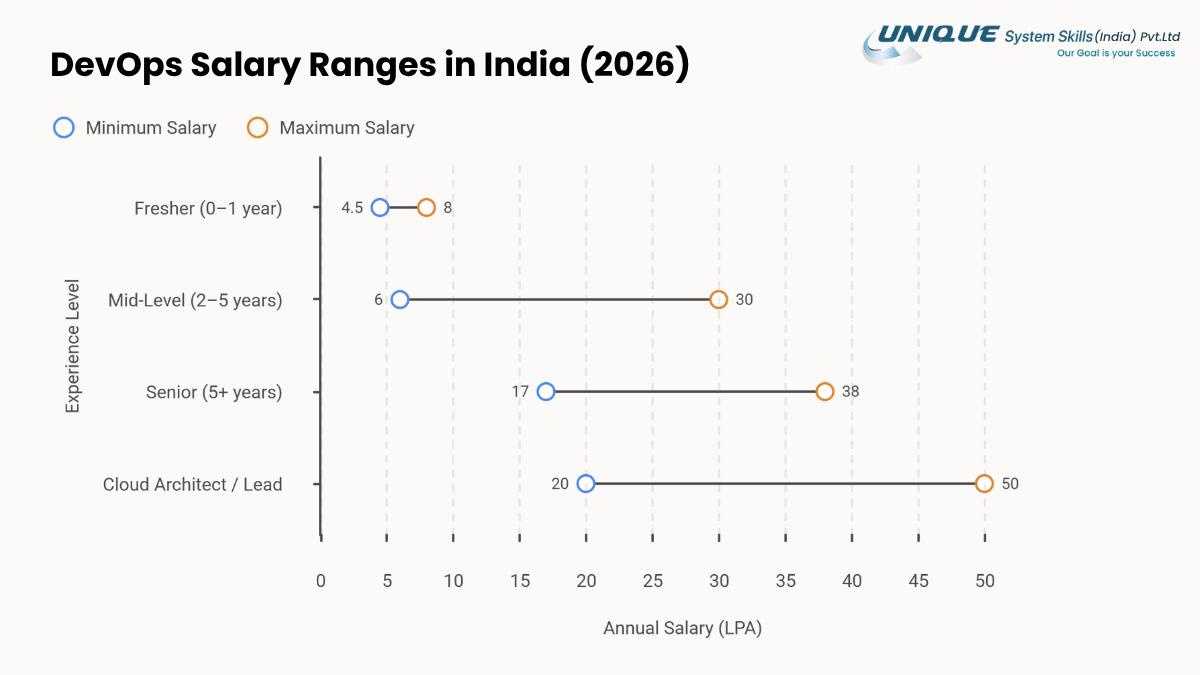
DevOps salaries in India range from ₹4.5–8 LPA for freshers to ₹20–50 LPA for cloud architects and leads in 2026.
Moving Into AWS Data Engineer Jobs and Platform Roles
DevOps isn’t really one job, it’s a starting point that branches in several directions. Once the core cloud and automation skills are in place, a few related paths open up.
Site Reliability Engineering and Platform Engineering: focus on keeping large systems stable and easy for other teams to use.
DevSecOps: focus on building security checks directly into the release pipeline instead of adding them at the end.
For people who lean toward data rather than pure infrastructure, AWS data engineer jobs are a natural next step, since managing data pipelines on AWS uses many of the same S3, IAM, and automation skills a DevOps engineer already has.
Cross-training pays off here. Professionals who add the Data Analytics Course to a DevOps background often qualify for hybrid data-and-infrastructure roles that single-track specialists can’t fill. Those who add full-stack development through the Java Full Stack Course become more flexible on smaller teams where one person covers several jobs at once. When it comes to the skills behind AWS Cloud Engineer jobs, the branching goes far.
Where to Find AWS Cloud Engineer Jobs Near Pune
If you’re based in or near Maharashtra, Pune deserves a closer look. It has quietly become one of India’s leading cloud and DevOps hiring hubs, alongside Bengaluru, Hyderabad, Mumbai, and Chennai. Employers actively posting AWS jobs in Pune include large IT services companies such as Accenture, Capgemini, and TCS, along with product-focused firms like Persistent Systems and KPIT Technologies, all competing for certified cloud talent. Local job boards, company career pages, and campus placement drives tend to surface a steady stream of AWS jobs in Pune throughout the year.
What makes AWS cloud engineer jobs in Pune worth watching is the mix of established companies offering a clear career ladder, and startups offering faster growth and broader hands-on exposure. Whether you’re applying for your first role or considering a move, the pattern across Pune’s employers matches what’s happening nationally. The demand is growing faster than the supply of certified, hands-on talent. For someone just starting out, that gap is good news, because getting hired depends more on proof of skill than years on a resume.
Breaking Into DevOps Fresher Jobs With No Experience
If every listing you see asks for “2+ years’ experience,” it’s easy to feel stuck before you begin. But hiring managers today, would rather see a working GitHub project than a pile of certificates with nothing behind them. This means that landing a DevOps fresher jobs isn’t about knowing every tool, it’s about showing you can build, break, and fix something real.
This is also where nearby skills can set you apart early. Freshers who pair deployment knowledge with testing automation, through something like the Software Testing Playwright Course, often stand out simply because most applicants show up with one narrow skill instead of two connected ones. It’s a small edge, but in a crowded fresher market, small edges are often what get a resume shortlisted for DevOps engineer jobs.
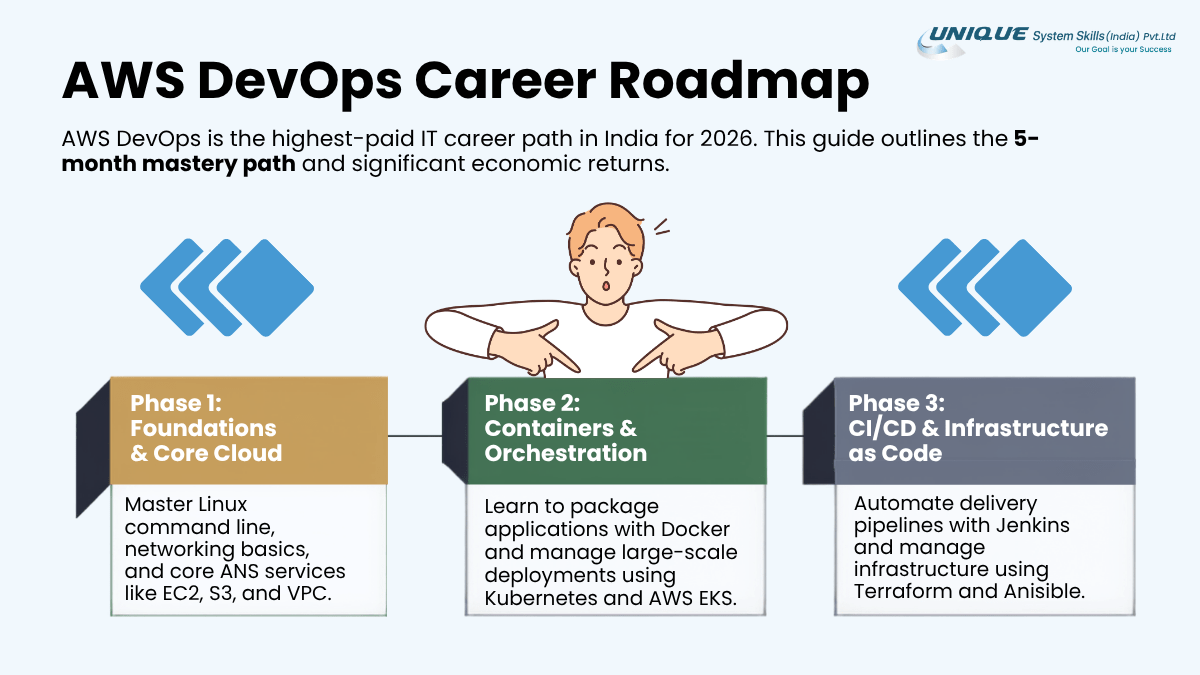
A three-phase AWS DevOps roadmap covering Linux and AWS fundamentals, Docker and Kubernetes, and automated delivery with Jenkins, Terraform, and Ansible.
Why Structured Training Helps You Land DevOps Engineer Jobs
Most people struggle to land AWS Cloud Engineer jobs because self-study rarely matches what a real production environment demands. Hiring managers commonly point to the same 3 gaps:
- Learning tools only in theory without building anything live
- Spreading effort across too many tools instead of going deep on a few
- Studying ideas like Terraform state locking or Kubernetes access rules from slides instead of actually breaking and fixing a live system.
It’s simply what happens when training doesn’t mirror how the job is really done.
That’s the gap structured, hands-on training is meant to close. A program like the AWS with DevOps Course at Unique System Skills moves learners from Linux basics and shell scripting through AWS services, Docker, Kubernetes, CI/CD pipelines, and Terraform in the same order employers expect, using live lab environments instead of slide decks. Learners come out with an actual GitHub portfolio of deployed projects, along with resume help, mock interviews, and placement support connecting them to hiring partners across Pune and the wider Indian IT market. This kind of practical backing when applying for AWS Cloud Engineer jobs can give you an edge at every experience level.
The Path Forward
What actually matters is starting with the fundamentals, building something real instead of only collecting certificates, and staying open to the nearby skills that make your resume harder to skip past.
AWS Cloud Engineer jobs in India aren’t slowing down any time soon and the current gap between demand and genuinely job-ready talent is exactly the opening that rewards people who train with intent instead of drifting through tutorials.
With a clear path, a project you can actually explain in an interview, and the persistence to keep building, breaking into DevOps jobs, and growing steadily inside them, is far more within reach than a random job listing can makes it feel.
Frequently Asked Questions
1. What is the average DevOps Engineer salary?
In India, DevOps engineer salary varies mainly by experience. Freshers typically start at ₹4–8 LPA, engineers with 1-5 years of experience earn ₹6–20 LPA (up to ₹30 LPA at top product companies), and senior engineers with five-plus years of experience report ₹12–38 LPA. Cloud Architects and DevOps Leads with 8+ years of experience often earn ₹20–50 LPA or more.
2. What qualifications are needed for AWS Data Engineer jobs?
For AWS data engineer jobs, you need a working handle on core AWS services (S3, IAM, RDS/DynamoDB), scripting in Python or SQL for building data pipelines, and the same automation habits DevOps engineers rely on
Since these roles branch out of a DevOps foundation, most people qualify by adding data-focused skills, such as those covered in the Data Analytics Course, on top of core cloud fundamentals rather than starting from zero.
3. Is AWS certification required for DevOps Engineer jobs?
No, it’s not strictly required, but it helps. Many DevOps engineer jobs are won on the strength of a demonstrated project portfolio alone. That said, certifications can make a resume stand out faster in a competitive applicant pool, so they’re worth pursuing once your hands-on skills are solid. A course such as the AWS with DevOps Course is structured to prepare you for both certifications while building the parallel project portfolio hiring managers want.
4. What is the career growth potential for AWS Cloud Engineers?
AWS Cloud Engineer jobs typically progress from junior or fresher roles into mid-level engineering, then into senior, Platform Engineering, or Site Reliability Engineering roles, and eventually into Cloud Architect or DevOps Lead positions earning ₹50 LPA or more. Branching into adjacent specializations like data engineering, cybersecurity, or AI-assisted operations can open additional paths beyond the traditional engineering ladder.
5. How much does a fresher DevOps Engineer earn?
Fresher pay for DevOps fresher jobs generally falls between ₹4 LPA and ₹8 LPA nationally, Actual offers depend heavily on whether the candidate has a demonstrated project portfolio versus certificates alone. Investing in hands-on training such as the AWS with DevOps Course tends to push freshers toward the higher end of this range.
6. What is the difference between AWS Cloud Engineer and DevOps Engineer roles?
The 2 overlap heavily but aren’t identical. An AWS Cloud Engineer role tends to focus more narrowly on designing, deploying, and maintaining infrastructure on AWS itself. A DevOps Engineer role includes that infrastructure work but places equal weight on the automation layer: CI/CD pipelines, release processes, and the collaboration between development and operations teams.