India isn’t watching AI adoption happen from a distance. In 2026, it’s living through one of the fastest shifts its economy has seen in decades. AI literacy has become an inherent part of IT Courses that are Industry aligned.
This has led to millions of IT professionals and students across India going towards this career shift. But AI is known to be a bubble which hasn’t burst yet, which often leads to questions like: is this a risk to prepare for, or a chance to grab.
The honest answer is both, and which one it turns out to be for you depends almost entirely on how you respond right now. Understanding the real shape of Artificial Intelligence Growth in India is the first, most useful step toward turning that worry into a plan, along with understanding where it’s heading, who it’s opening doors for, and what it takes to be one of them.
Global Artificial Intelligence Market Growth and Future Scope
The Fast-Paced Horizon of Artificial Intelligence Growth in India
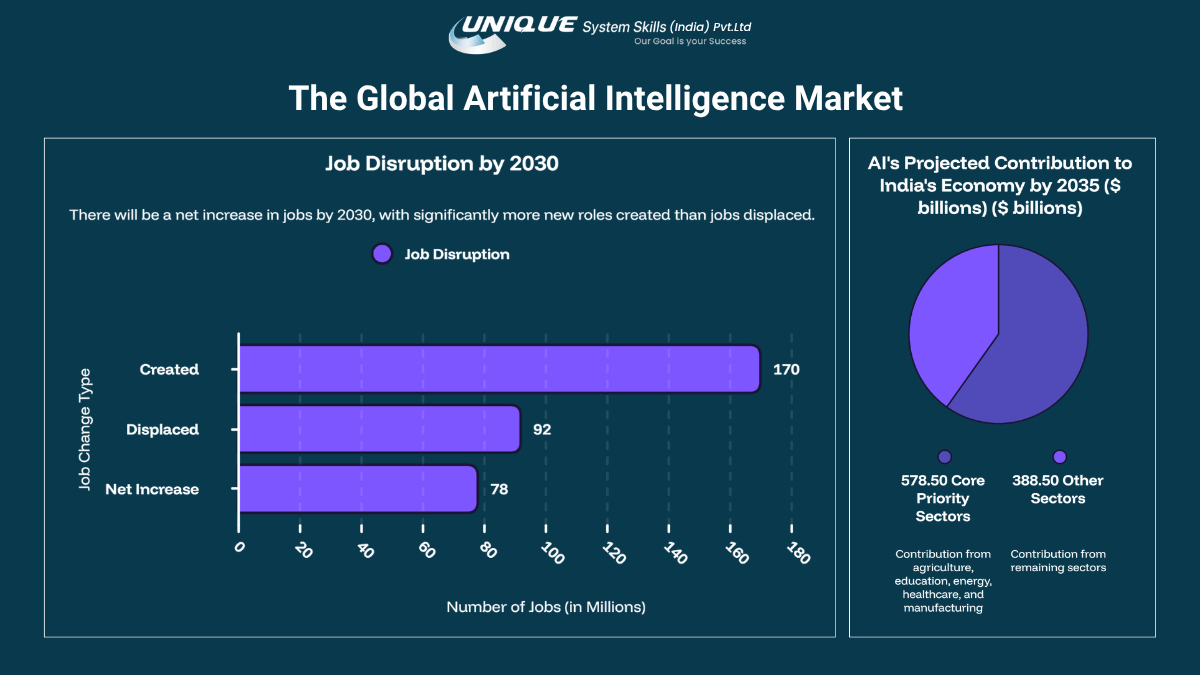
Artificial Intelligence Growth here is a real change in how work gets done, moving from simple, repeatable tasks toward systems that can reason, decide, and act with real independence. A PwC estimate puts AI’s potential contribution to India’s economy at close to $967 billion by 2035. The World Economic Forum, looking at the jobs side of this shift, projects that AI could help create up to 170 million new jobs in India by 2030.
These are large, sometimes competing estimates from different organizations rather than one single agreed number, and that’s worth knowing going in, but even the more cautious ones describe a shift measured in the hundreds of billions of dollars. That scale of change, naturally raises a bigger question about what does the artificial intelligence future in India mean for the industry you already work in.
The Artificial Intelligence Future of India’s IT Sector
For decades, India’s IT services sector ran on a simple formula where more clients meant a higher employer headcount. That formula is breaking down under the weight of Artificial Intelligence Growth, and understanding why matters for anyone building a career in tech today. Generative AI tools now handle a real share of the routine, entry-level work including:
- Writing boilerplate code
- Running basic manual software tests
- Drafting documentation
- Answering first-line customer questions
These tasks used to need large teams of junior staff. Cognizant and Pearson released a study in June 2026 based on a survey of 750 HR leaders across India, the US, and the UK. The study found that AI already performs 37% of entry-level tasks in Indian organisations, above the 33% global average, with 18% of the companies surveyed saying AI now handles at least half of their entry-level work. It’s worth being clear that this comes from an HR-leader survey about perceptions and current practice, not a hard measurement of every job in the country, but even as a survey, it points to a real and fast-moving shift.
It’s a story of value moving toward specialised skill, the clearest sign yet that Artificial Intelligence Growth is reshaping what employable means in Indian tech, and exactly where the next wave of opportunity is opening up.
Artificial Intelligence Job Opportunities Across Key Industries
Artificial intelligence job opportunities aren’t limited to software companies anymore. Agriculture, manufacturing, healthcare, finance, and e-commerce are all actively hiring AI talent to solve real, concrete business problems. Flipkart uses AI-powered visual search to help shoppers find products faster and more accurately. Reliance Jio applies AI to manage its huge telecom network in real time, handling traffic and service quality at a scale no manual team could match.
These are live systems, run by teams that need engineers who understand both the technology and the business problem it solves, and a clear sign of how far Artificial Intelligence Growth has already spread beyond the software industry itself. The Confederation of Indian Industry estimates India will need one million AI specialists to keep up with this demand, creating a tight talent gap where only one qualified candidate exists for roughly every ten open roles. If you’re wondering whether there’s space for you in this picture, it’s waiting on skill, not headcount.
Artificial Intelligence Jobs for Freshers and the Skills That Matter
If you’re early in your career, the idea of competing for these roles can feel daunting, but the path in is more structured and learnable than it looks from outside. Landing artificial intelligence jobs for freshers starts with the following:
A Clear Technical Base:
Python and SQL as your core languages, a working grasp of linear algebra, probability, and statistics, and hands-on comfort with deep learning tools like TensorFlow, Keras, or PyTorch.
The Specifics:
For the fast-growing generative AI roles specifically, employers now look for familiarity with large language models (GPT-4, Claude, Gemini APIs), prompt engineering techniques like few-shot and chain-of-thought prompting, orchestration tools like LangChain, and vector databases like Pinecone or Chroma.
Senior Specialization:
MLOps-focused roles add another layer with deployment and monitoring experience with Docker, Kubernetes, and cloud platforms like AWS or Azure.
What an Practical Artificial Intelligence Course in Pune looks like?
What consistently separates hired candidates from overlooked ones is proof of work, and it’s exactly the deciding factor recruiters use when filling artificial intelligence engineer jobs. Recruiters increasingly prioritise an active GitHub profile with real, working projects like:
- an AI resume analyser
- a ChatGPT clone
- a PDF question-answering bot
- a medical diagnosis assistant
- a sentiment analysis dashboard built on live social media data
The payoff for this effort is real and immediate, and it reflects the broader pattern of ai engineer job growth now visible across Indian tech hiring.
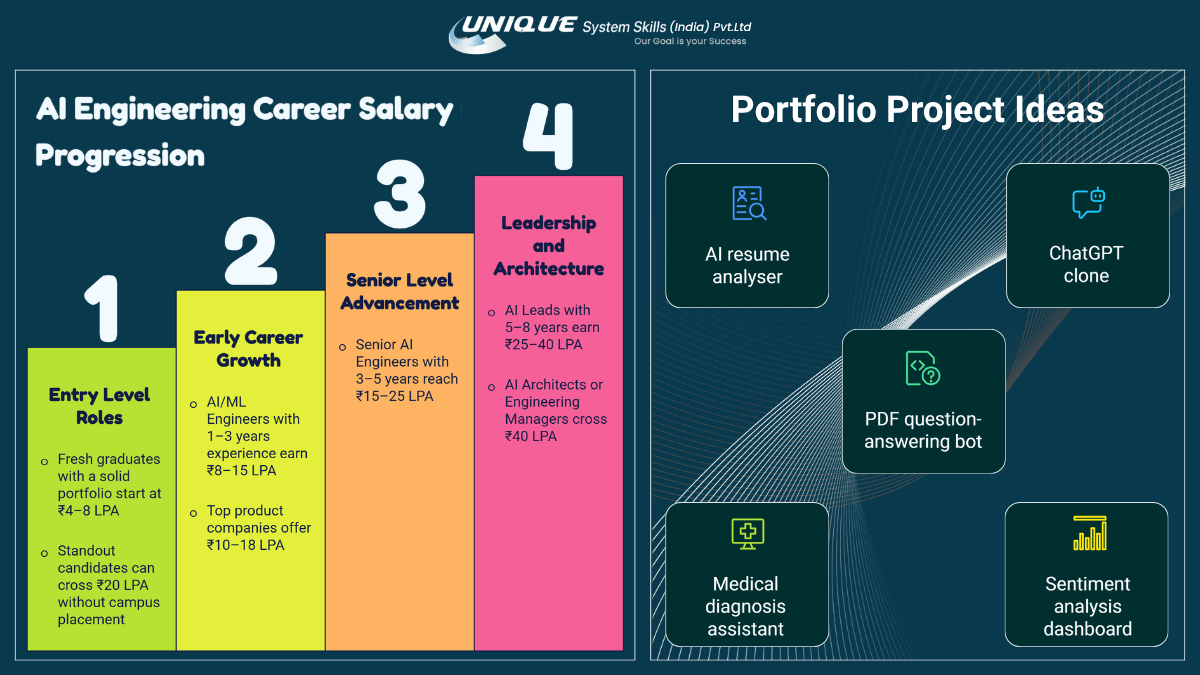
An infographic showcasing AI engineering career growth stages, expected salary ranges, and practical portfolio project ideas to build skills for a successful AI career.
Fresh graduates with a solid portfolio typically start at ₹4–8 LPA, with top product companies offering ₹10–18 LPA, and standout candidates crossing ₹20 LPA even without a campus placement. From there, the path only gets stronger: AI/ML Engineers with 1–3 years of experience earn ₹8–15 LPA, Senior AI Engineers at the 3–5 year mark reach ₹15–25 LPA, AI Leads with 5–8 years earn ₹25–40 LPA, and AI Architects or Engineering Managers beyond that routinely cross ₹40 LPA.
Courses like USS’s AI Fundamentals Course and Data Science with AI Training are built to walk learners through exactly this plan, with the structured, hands-on practice that turns a plan into a real portfolio. And if you’re picturing where you’d want to build this career, one Indian city has quietly become the place where this opportunity is growing fastest.
Flourishing Artificial Intelligence Jobs in Pune
Pune has grown from a strong engineering town into one of India’s leading technology and SaaS hubs, and that shift is driven directly by Artificial Intelligence Growth across the region’s employers.
The city pairs a deep, established engineering talent pool with running costs noticeably lower than Bengaluru or Mumbai. This combination drawn in product companies, GCCs, and SaaS firms actively hiring for artificial intelligence jobs in Pune at every career stage. Local employers span established IT services firms building out AI teams alongside fast-growing product and startup teams building AI-native tools from day one. Salary ranges in Pune broadly follow the national bands with fresh graduates around ₹4–8 LPA, with experienced architects reaching well into six figures at senior levels, while offering a meaningfully lower cost of living than India’s other big tech centres.
For someone building a career in this field, that’s a strong opportunity without the steep cost of entry that comes with cities like Bengaluru. The natural next question, then, is how to prepare for these roles in a way that local employers recognise and trust.
Enrolling in an Artificial Intelligence Course in Pune
A lot of academic AI coursework still teaches theory the way it was taught a decade ago, while employers are hiring for hands-on, tool-specific, portfolio-backed skill. That gap is exactly why choosing an artificial intelligence course in Pune with a practical structure matter more than choosing one with an impressive-looking syllabus on paper.
Look for mentor-led programmes with real lab access, because a gap between watching someone build a model and building one yourself cam show up in interviews. Flexible scheduling matters too, since most learners in this space are either working professionals fitting training around a job, or students balancing coursework alongside it. Getting this choice right is less about finding the most polished brochure and more about finding a structure that will get you building, which is where a training partner with a real track record starts to matter.
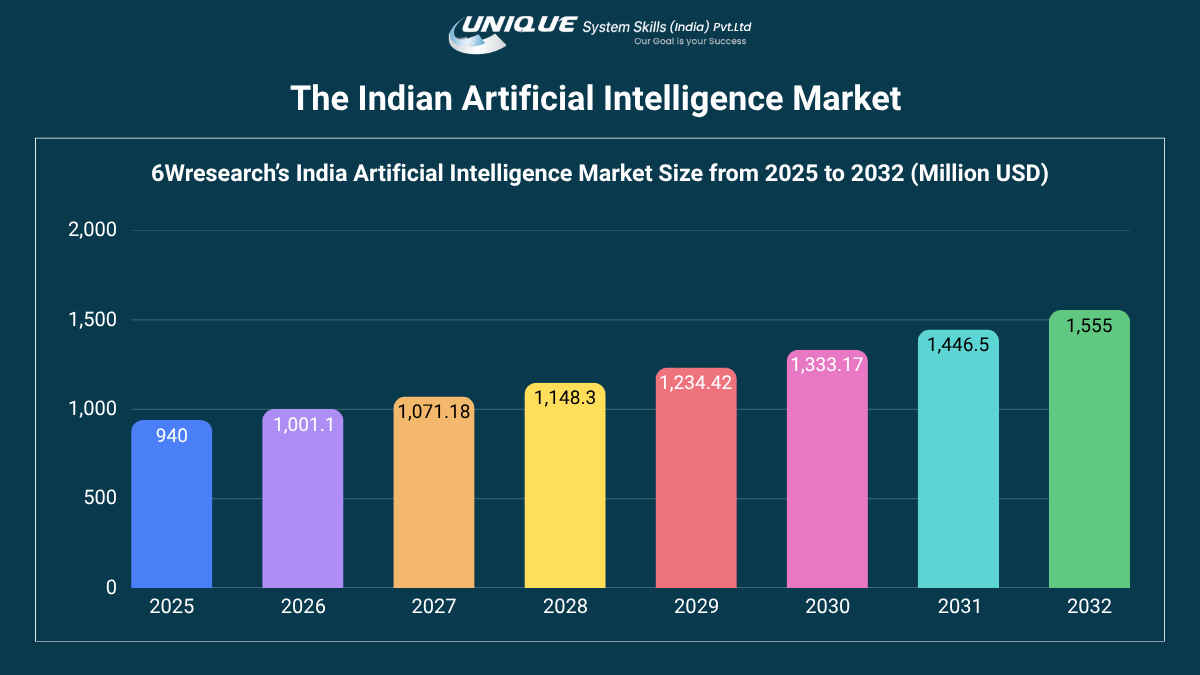
A bar chart illustrating the projected growth of India’s Artificial Intelligence market from 2025 to 2032, highlighting the increasing adoption and expansion of AI technologies.
A Data Science and Artificial Intelligence Course at Unique System Skills
Unique System Skills (USS) has built its entire training model around closing exactly this gap. As Maharashtra’s first USA-based IT training and placement institute, we are headquartered in Nashua, USA, with operations across India, Canada, and Bahrain. USS brings a global training standard to local learners, with more than 7,000 students trained over 17 years. Every artificial intelligence classes cohort at USS runs in batches capped at 15 students, so trainers can give real, individual attention instead of lecturing to a crowd, with weekday, weekend, and fully virtual formats (including lifetime access to recordings).
The AI Fundamentals course takes complete beginners through Python libraries, machine learning, deep learning, NLP, and computer vision, before a dedicated generative AI module covering transformers, prompt engineering, and hands-on chatbot development. The Data Science with AI course runs a full 6 month, phase-based path from Excel and SQL through Power BI and Tableau to Python-driven machine learning. For testers looking to move into AI-driven automation, the Software Testing Playwright Automation course builds exactly that bridge, while learners wanting a broader data foundation can start with the Data Analytics course, and those pairing AI skills with full application development can add the Java Full Stack course. Every programme follows a practical structure, with real capstone projects. Here, the curriculum directly around active hiring needs across more than 1,000 partner organisations, including Infosys, TCS, Capgemini, Persistent Systems, and Accenture.
Launch Your Career into AI
Artificial Intelligence future in India isn’t a wave that’s going to pass you by if you wait a little longer to react to it, but it also doesn’t rewards standing still either. This is what sustained Artificial Intelligence Growth looks like from the inside. It isn’t one dramatic breakthrough moment like a timelapse shoot in a film. It is a steady, building shift in where value, hiring, and opportunity are gathering.
The professionals and students who benefit most from this shift are the ones who treat it as exactly what it is, the biggest structural career opportunity Indian IT has seen in a generation. With the right training like the one provided at Unique System Skills, it will be open to anyone willing to put in the effort of building real and demonstrable skill. As discussed, a comprehensive portfolio, and a clear plan completes this trio. In 2026, you don’t just have to watch this change happen, you can be one of the people building it.
Frequently Asked Questions
What is the current growth of Artificial Intelligence in India?
India is going through one of the fastest AI-driven shifts its economy has ever seen. PwC estimates AI could add close to $967 billion to India’s economy by 2035, and generative AI tools already handle a real share of routine, entry-level IT work. A June 2026 Cognizant-Pearson study found AI performs 37% of entry-level tasks in Indian organisations, above the 33% global average.
What are the career opportunities for Artificial Intelligence engineers?
Opportunities span software, agriculture, manufacturing, healthcare, finance, and e-commerce with companies like Flipkart (AI-powered visual search) and Reliance Jio (real-time network management) are actively hiring. The Confederation of Indian Industry estimates India needs one million AI specialists, with only about one qualified candidate for every ten open roles. Pay scales from ₹4–8 LPA for freshers up to ₹40+ LPA for AI Architects/Engineering Managers.
What job opportunities are available in Artificial Intelligence?
Roles range from AI/ML Engineer to Senior AI Engineer, AI Lead, and AI Architect, plus specialised generative AI and MLOps positions. Employers across IT services, product companies, GCCs, and startups are hiring, with demand extending well beyond the software industry into sectors like telecom, retail, and finance. Structured, industry-aligned training such as Unique System Skills’ IT courses can help you build toward these roles.
What types of Artificial Intelligence jobs are available in India?
These include core like:
- ML/AI engineering roles, generative AI roles like working with LLMs like GPT-4, Claude, Gemini, prompt engineering, LangChain, vector databases
- MLOps roles like deployment/monitoring with Docker, Kubernetes, AWS/Azure
These roles can span entry-level to senior architect and leadership positions.
What Artificial Intelligence jobs are available for freshers?
Freshers can enter with a strong base in Python, SQL, linear algebra, probability, and statistics, plus hands-on experience with TensorFlow, Keras, or PyTorch. Additionally, a solid GitHub portfolio helps candidates land roles typically starting at ₹4–8 LPA, with top companies offering ₹10–18 LPA. Programmes like the AI Fundamentals Course are built to walk beginners through exactly this path.
What Artificial Intelligence jobs are available in Pune?
Pune has become one of India’s leading AI/SaaS hubs, combining a deep engineering talent pool with lower costs than Bengaluru or Mumbai. Product companies, GCCs, and SaaS firms hire at every career stage, alongside established IT services firms building out AI teams. Salaries broadly follow national bands where freshers can get around ₹4–8 LPA, rising well into six figures for senior architects. Additionally, along with competitive salaries the city also has a lower cost of living.
What can you learn in Artificial Intelligence classes?
Courses like USS’s AI Fundamentals Course cover Python libraries, machine learning, deep learning, NLP, and computer vision, followed by a generative AI module on transformers, prompt engineering, and chatbot development. The Data Science with AI Training runs a 6-month, phase-based path from Excel and SQL through Power BI/Tableau to Python-driven machine learning. Related paths include the Data Analytics Course for a broader data foundation, the Java Full Stack Course for pairing AI skills with application development, and the Software Testing Playwright Automation Course for testers moving into AI-driven automation.
How can I choose the best Artificial Intelligence course in Pune?
Here’s what you should look for:
- Mentor-led programmes with real lab access
- Flexible scheduling (weekday/weekend/virtual options)
- Small batch sizes for individual attention
- A track record of placements
Unique System Skills runs batches capped at 15 students and works with 1,000+ partner organisations including Infosys, TCS, Capgemini, Persistent Systems, and Accenture.