
If you have been wondering whether now is the right time to chase a career in AI, you are right on track. The demand for artificial intelligence engineer jobs in India has grown by more than 40% year-on-year, and the country has become the second-largest AI and machine learning talent hub in the world. This is not a small trend limited to a few startups. It is a nationwide shift, with banks, hospitals, and retailers all racing to build AI teams almost overnight as the GenAI wave changes what competitive means in every industry. What this also means is that a number of AI training courses have propped up to cap on this opportunity but not every course will help you with your career growth. What you need is a training curriculum aligned with the rapid growth and a practical led teaching. In this city-by-city guide, we discuss the scope of AI Engineering in some of the Top cities in India.
The Indian AI Landscape
The scale of what is coming is worth pausing on. India’s AI market is expected to grow from around $13 billion in 2025 to $130.6 billion by 2032, a tenfold jump in under a decade. On the workforce side, NASSCOM and Deloitte project that India’s demand for AI-skilled professionals will cross 1 million by 2026 and climb toward 1.25 million by 2027. That gap between demand and available talent is exactly why knowing where these roles actually sit, city by city, can turn a vague ambition into a real plan. Picture two equally skilled graduates: one applies broadly with no sense of which city or sector fits their goals, while the other targets a specific hub aligned with their strengths. The second candidate usually lands offers faster, simply because focus beats scatter in a market this competitive. Let us start with the two hubs leading the pack.
Here is a quick snapshot of how the major hubs compare, based on 2026 salary benchmarking:
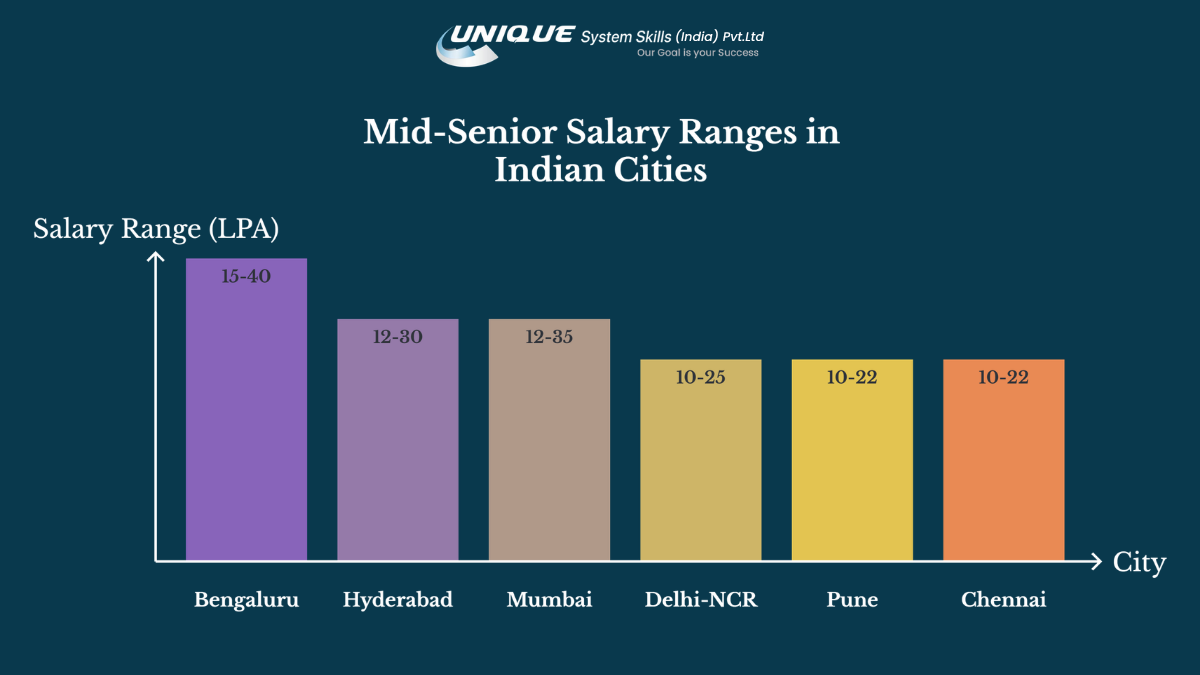
Mid-Senior Salary Ranges in Indian Cities
Bengaluru and Hyderabad: Leading the Artificial Intelligence Jobs Salary Race
Bengaluru remains India’s clear AI capital, home to the largest number of AI-focused companies, from global names like Google and Amazon to a packed startup scene building on top of them. This shows up directly in pay: Bengaluru consistently offers the highest artificial intelligence jobs salary in the country, with mid-to-senior roles typically paying between ₹15 lakhs and ₹40 lakhs a year. If you are weighing where to build your AI career, the sheer number of roles here alone makes it worth serious thought.
Hyderabad has become Bengaluru’s closest rival, and for good reason. The Telangana government’s dedicated AI mission, combined with strong hiring from companies like Microsoft, has turned the city into a genuine second hub rather than a distant follower. What makes Hyderabad especially appealing early in a career is that living costs run noticeably lower than Bengaluru’s, so a solid salary here often stretches further in real terms. A fresher choosing between the two might pick Bengaluru for sheer volume of openings, or Hyderabad for an easier cost of living while building experience. Either way, this pairing is not the only story worth knowing, as two other major metros show clearly.
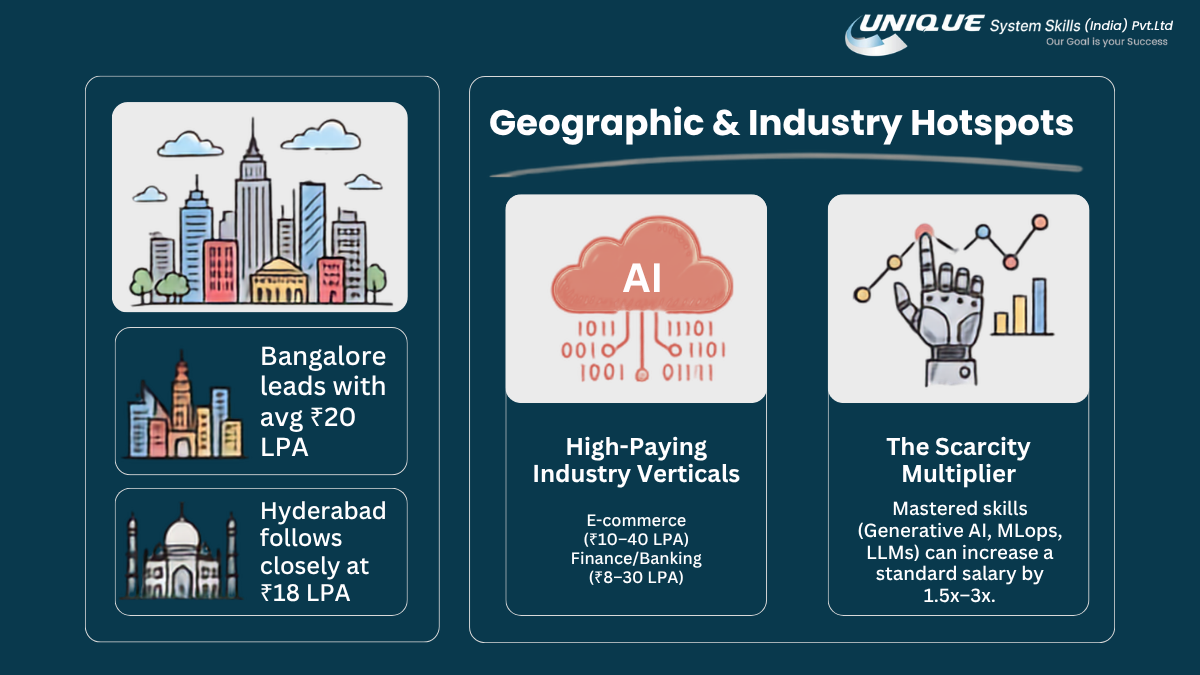
Geographic & Industry Hotspots
Mumbai and New Delhi: High-Stakes Artificial Intelligence Job Opportunities
Mumbai’s AI story is written by finance. As India’s financial capital, the city has become a major centre for AI in fraud detection, risk modelling, and real-time transaction monitoring, with FinTech and retail companies pushing salaries as high as ₹35 lakhs for experienced professionals. Working in AI here often means your models are protecting real money in real time, which brings a level of precision that differs from a typical consumer-app role. These artificial intelligence job opportunities reward candidates who can pair technical skill with genuine understanding of financial risk.
New Delhi and the wider NCR region tell a different but equally compelling story. A real mix of scrappy startups and large enterprise AI projects, with competitive pay typically ranging from ₹10 lakhs to ₹25 lakhs depending on the employer and seniority. This variety means Delhi-NCR offers something Bengaluru and Mumbai sometimes lack, a wider range of company sizes and cultures to choose from, which matters a lot if you are still working out what kind of environment suits you. Between Mumbai’s calculated precision and Delhi’s mixed energy, it is clear that AI jobs in India are not stuck to one single mould. Two more cities prove this spread reaches well beyond the four traditional metros.
Pune and Chennai: Emerging Hubs for Artificial Intelligence Jobs in Pune
Even if you are not based in one of India’s priciest cities: opportunity is spreading. Artificial intelligence jobs in Pune have grown steadily, driven by major IT services firms like Wipro and Capgemini building out dedicated AI practices, with salaries typically in the ₹10–22 lakh range. Pune’s real advantage is pairing solid technical demand with a noticeably lower cost of living than Bengaluru or Mumbai, so the same salary often buys a genuinely better quality of life.
Chennai, meanwhile, leans on its deep roots in IT services and SaaS, with established players like Zoho and HCL anchoring a stable, steadily growing AI hiring scene. What Chennai offers that flashier hubs sometimes do not is consistency. Instead of boom-and-bust startup cycles, the city’s AI roles tend to sit inside larger, more established companies, which can suit you well if you value stability while building skills. Across Pune and Chennai alike, you do not need to move to India’s most crowded, expensive cities to build a genuine AI career. With 6 major hubs now on the table, the next real question is how you actually break into any of them, especially if you are just starting out.
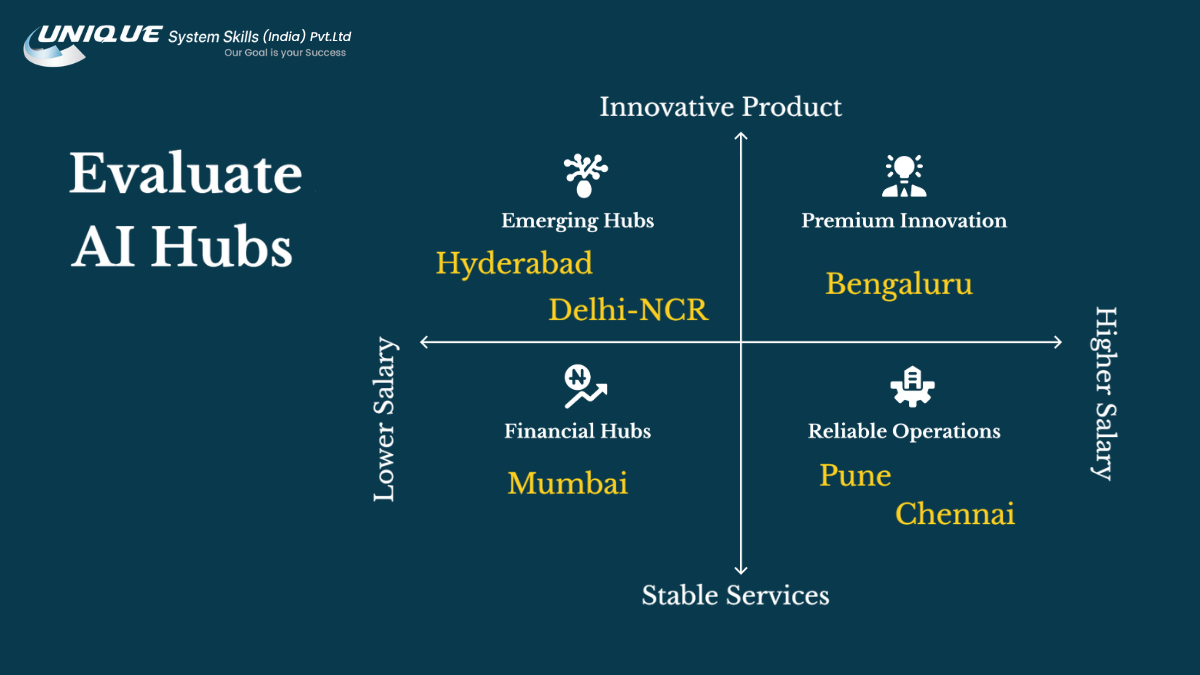
Evaluate AI Hubs
Launching Your Career: AI Jobs for Freshers and Skill Development
If you are worried that a lack of a ‘fancy’ background will keep you out of this field, here is real reassurance. AI jobs for freshers in India now offer entry-level packages between ₹5 lakhs and ₹12 lakhs, and companies increasingly value demonstrated skill over pedigree. Many successful newcomers come from non-computer-science backgrounds entirely, which tells you this field rewards proof of ability far more than where you studied.
That proof matters a great deal, and building it follows a fairly clear pattern.
- Keep an active GitHub with 3 to 5 complete, real projects. This can include an end-to-end LLM application or a custom retrieval-augmented generation (RAG) pipeline.
- Contributing to open-source projects on platforms like HuggingFace signals genuine community involvement.
- Quantifying your results, showing a clear ‘before’ and ‘after’ on a model’s accuracy or a prompt’s output quality, gives a recruiter something concrete to judge.
The portfolio does the convincing a resume alone cannot. Once that foundation is building momentum, the next step is learning the specific skills the market is actually paying for.
Mastering the Craft: Essential Skills for Top AI Jobs
Every strong AI career rests on the same technical base: Python as the main language, and genuine comfort with frameworks like PyTorch and TensorFlow for building and training models. Beyond raw coding, employers increasingly expect familiarity with statistical basics like linear algebra and probability, since these explain why a model actually works rather than just how to call its API. This is exactly the base a structured programme like the AI Fundamental Course is built to give you, offering a genuine starting point rather than a scattered, self-taught patchwork that can take far longer to piece together alone.
Beyond the basics, specialisation is where the real salary jumps happen. Generative AI has created what many call a genuine gold rush in the Indian market: while a traditional machine learning engineer might earn ₹10–40 lakhs, a Generative AI engineer with equal experience can earn ₹20–70 lakhs, purely because skilled talent in large language models and RAG systems remains scarce relative to demand. MLOps, the discipline of reliably deploying and maintaining models in production, is similarly prized, because companies need AI that works consistently. Newer specialisations like Agentic AI, which involves building autonomous AI agents using frameworks like LangGraph, are already earning premiums at the senior level. The scarcer and production-relevant your specific skill, the steeper your earning curve is.
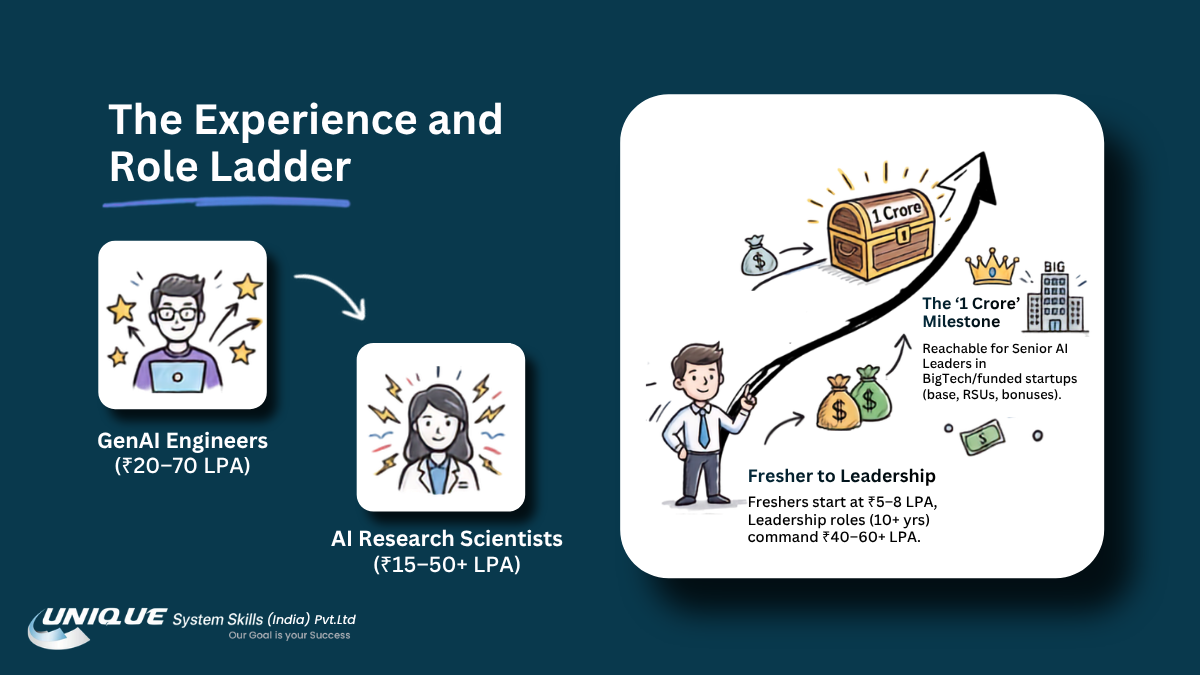
The Experience and Role Ladder
Why Train With Unique System Skills
Everything covered in this guide is exactly what the AI Fundamental Course at Unique System Skills is built around. Rather than teaching AI as scattered theory, the course focuses on the same practical foundations covered here: Python, model-building frameworks, and the kind of documented, real-world project work that actually gets noticed by recruiters hiring for artificial intelligence engineer jobs.
For freshers weighing whether to self-teach or train formally, it is worth knowing that a structured, mentor-guided learning consistently gets candidates interview-ready faster than piecing skills together from scattered tutorials and videos, which can stretch on for many months without a clear endpoint. Working professionals looking to move from a general IT role into a specialised AI one benefit just as much, since the course is built around the exact skills needed.
Future Outlook: The Evolution of Artificial Intelligence Jobs
The long-term direction here is a structural shift in how Indian companies operate. As the market pushes toward that $130.6 billion valuation by 2032, companies are moving past hiring traditional software engineers and specifically seeking specialists who can build scalable AI solutions that predict behaviour and automate genuinely complex work. A hospital using AI to flag patient risk, or a retailer forecasting demand down to individual store shelves, are not futuristic ideas. They are already live projects, and the engineers behind them were building these exact skills just a few years ago. This is the infrastructure being actively built for the next decade of Indian business.
For anyone weighing whether to invest the time now, hold on to this, the demand curve, the pay premiums, and the sheer geographic spread of strong roles across Bengaluru, Hyderabad, Mumbai, Delhi, Pune, and Chennai all point the same way. It is the time to move from wondering if AI is for you to genuinely competing for these roles.
Frequently Asked Questions
How do I get a job in artificial intelligence?
Start with the fundamentals: learn Python and get comfortable with frameworks like PyTorch or TensorFlow, ideally through a structured course, like the one offered by Unique System Skills rather than scattered tutorials.
Build a portfolio: Create 3 to 5 real, documented projects on GitHub, such as an end-to-end LLM application, since recruiters hiring for artificial intelligence engineer jobs consistently value proof of work over credentials alone.
Target: Specific cities and sectors will match your goals. Whether that is Bengaluru for volume, Mumbai for FinTech, or Pune for a strong quality-of-life balance, you choose.
Is AI a high-paying job in India?
Yes. Entry-level AI jobs for freshers typically start between ₹5 lakhs and ₹12 lakhs a year, well above many other entry-level tech roles, and pay climbs sharply with experience and specialisation. Senior professionals in high-demand niches like Generative AI or Agentic AI can earn ₹20–70 lakhs or more, particularly in hubs like Bengaluru and Mumbai.
What is the AI jobs salary per month in India for freshers?
Fresher packages of ₹5–12 lakhs a year work out to roughly ₹42,000 to ₹1,00,000 a month before deductions, though the exact figure depends heavily on the city, company type, and specific skill set a candidate brings. Freshers who add automation or GenAI-specific skills on top of core Python and machine learning fundamentals tend to land toward the higher end of that monthly range.
Are AI jobs in demand in India?
The demand for artificial intelligence engineer jobs has grown more than 40% year-on-year. This demand spans far beyond tech companies alone, with banks, hospitals, and retailers all actively building AI teams.
Can I get an AI job in India with no experience?
Yes. Many successful entrants into AI jobs in India come from non-computer-science backgrounds with no prior professional experience, because employers increasingly prioritise demonstrated skill over formal pedigree. A well-built portfolio of real projects, paired with solid Python and machine learning fundamentals, can meaningfully offset the lack of a traditional resume. You can opt for industry oriented training course to transition to an AI Career.
Which AI skill is in high demand in India?
Generative AI and large language model expertise currently command the steepest pay premiums, with skilled professionals earning ₹20–70 lakhs compared to ₹10–40 lakhs for traditional machine learning roles. MLOps and emerging Agentic AI skills, such as building autonomous agents with frameworks like LangGraph, are close behind and growing fast as companies move AI systems from pilot projects into full production.