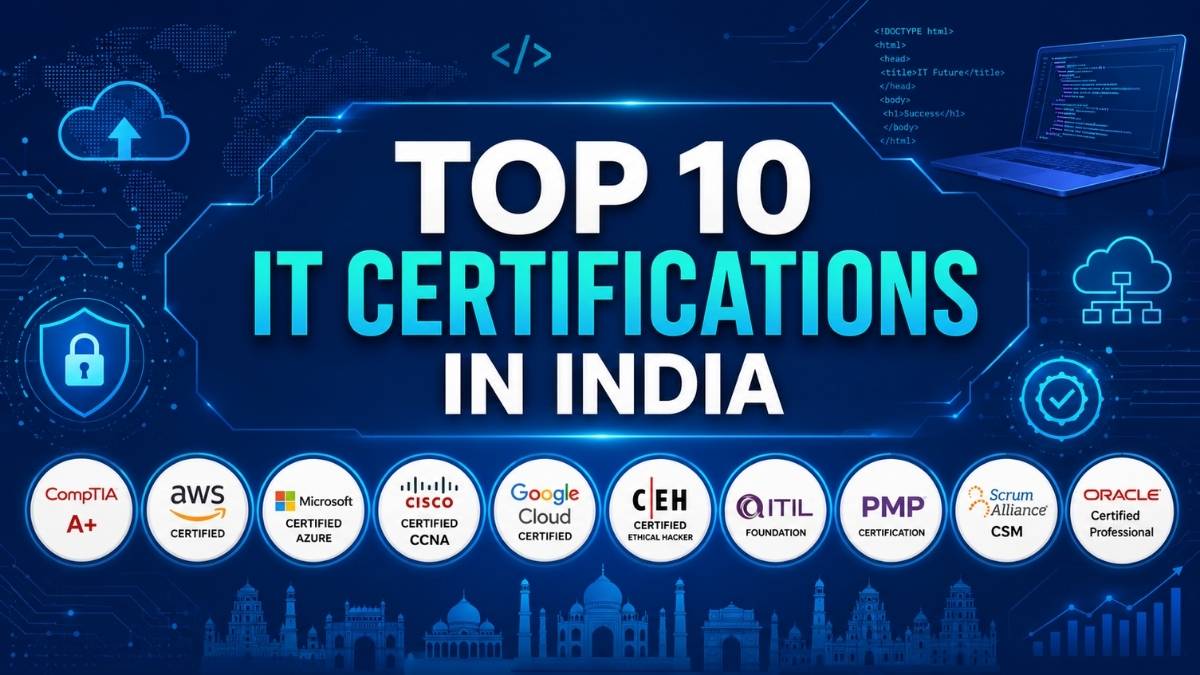
How digital the world has become, IT security is increasing in demand. Along with cybersecurity-based degrees, this has also led to IT security certifications being pushed to the top of every serious IT professional’s to-do list.
The cybersecurity job market in India is booming and this is the right time to jump into the field even of your college degree does not align with it. This is because most training courses offered by Institutes like Unique System Skills, you need to get these certifications assume that you don’t know the basics. The curriculum is build keeping in mind that you learn to do what actually happens in the real corporate world.
In this blog, we outline a clear, practical map to the IT security certifications that actually matter in India’s 2026 job market, and the order to pursue them in.
The Rise of IT Security Certifications in India’s 2026 Digital Economy
India’s Digital Personal Data Protection (DPDP) Act, passed in 2023, is being enforced in 2026. The Data Protection Board is now active, and RBI, SEBI, and CERT-In are tightening their own security rules too. Any company handling Indian user data now needs people who can put compliance into practice, not just talk about it. That shift has turned governance, risk, and compliance (GRC) into one of the country’s most in-demand specializations, one that pays metro-level salaries even remotely from a Tier 2 city.
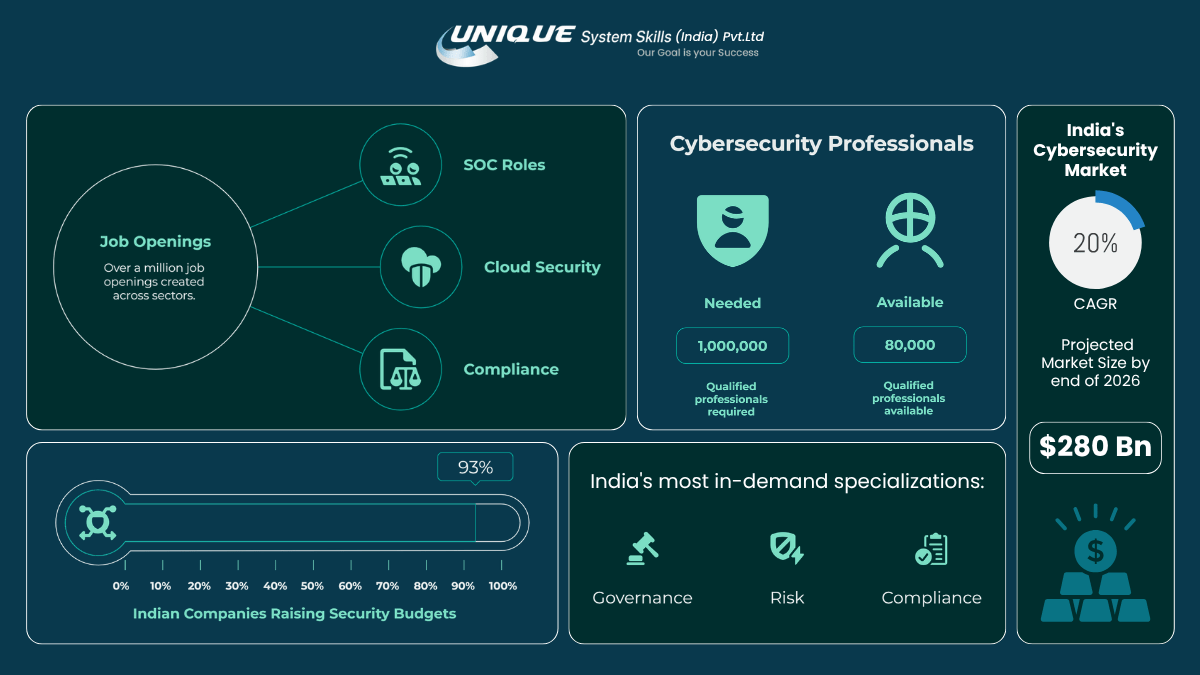
India’s Cybersecurity Market
According to the EICTA Consortium, as India needs close to one million qualified cybersecurity professionals but currently has only around 80,000. 93% of Indian companies are raising their security budgets this year. That gap is your opening.
But this cannot just be filled with skills. Hiring in India increasingly runs through Applicant Tracking Systems that scan resumes for exact keywords (like CEH, CISSP, CompTIA Security+) before a human recruiter opens the file.
A certification is proof of knowledge, but it’s also the password that gets your resume past the algorithm. So, the real question which credential to chase first, based on where you’re starting from. This guide is built as a ladder for exactly that reason, walking through the top 10 IT certifications in India worth pursuing in 2026, mapped to your career stage.
Best IT Certifications for Beginners
If you’re starting from zero, the good news is that the best IT certifications for beginners no longer assume you have either.
The Google Cybersecurity Professional Certificate has become the standard starting point for career changers. It needs no prerequisites, takes about 6 months of self-paced study, and covers networking basics, Python fundamentals, and tools like Splunk from scratch. If your networking knowledge is shaky, pair it with the Google IT Support Professional Certificate first.
At entry level, coding is not mandatory. Python, JavaScript, and Bash matter more as you move into technical roles, but many SOC analyst and compliance jobs don’t require them on day one. If you want a lower-friction technical entry point that leans on logic rather than deep architecture knowledge, software testing with Playwright automation is worth exploring as a side door into the field.
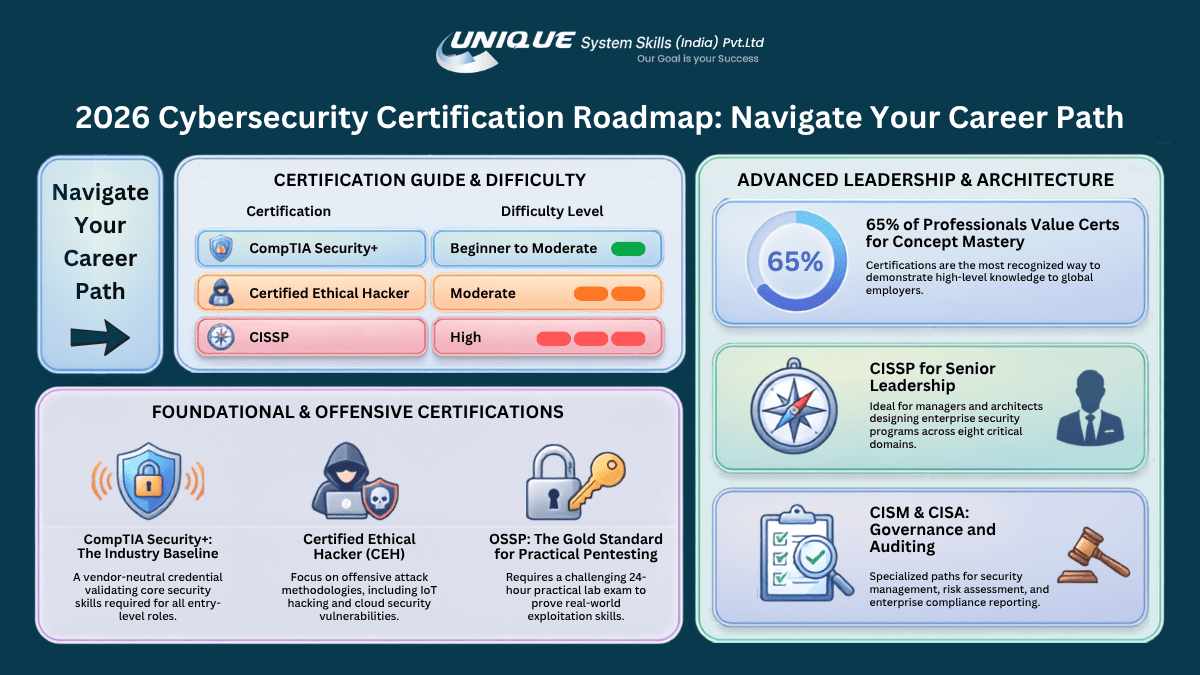
2026 Cybersecurity Certification Roadmap
Once you clear that first certificate, CompTIA Security+ is the natural next step. It is the global baseline for entry-level security roles because it’s vendor-neutral and tests the fundamentals (risk management, cryptography, network security) every later certification builds on. In 2026, freshers without any certification typically start around ₹4-5 LPA, while those holding Security+ or CEH move into the ₹6-8 LPA range almost immediately. That’s a strong return for a few months of study, which is why we treat these 2 IT certifications as non-negotiable starting points in our Cyber Security Course & Training programme.
One lesser-known route for ambitious beginners is the (ISC)² lets you sit the CISSP exam and earn Associate of (ISC)² status before you have the required 5 years of experience, giving you up to 6 years to build that experience while holding a recognised credential.
Top 10 IT Certifications in Demand for Mid-Career Growth
Once you have 2-3 years of hands-on experience, the calculus changes. This is where the top 10 IT certifications in demand split into 2 tracks:
Managerial Track
If you’re aiming for leadership, CISM (Certified Information Security Manager) and CISA (Certified Information Systems Auditor) show you can bridge technical teams and business stakeholders. Both lean on governance, risk, and audit work rather than exploit development, and both are tied closely to DPDP-driven hiring.
Technical Track
The credentials recruiters ask for most often here are CISA, CRISC, ISO 27001 Lead Auditor, and CompTIA Security+ as a technical base.
If you’d rather stay closer to hands-on technical work, CompTIA PenTest+ is the natural bridge for professionals moving from general IT into penetration testing without jumping straight into a fully offensive credential.
Mastering Offensive Security: IT Programming Certifications for Ethical Hackers
For readers specializing in offensive security, no credential carries more weight in India right now than OSCP (Offensive Security Certified Professional). Unlike a multiple-choice exam, OSCP is a 24-hour practical test where you actually have to break into live systems. Its philosophy forces candidates to build real problem-solving instincts and that difficulty is why it pays. Certified professionals see salary lifts of roughly 30-45% over non-certified peers, and experienced OSCP-holders in India are commanding ₹18-35 LPA in 2026, with senior bug-bounty specialists sometimes out-earning salaried roles entirely.
Coding is not optional here. Python, Bash, and SQL are how you write your own exploit scripts, automate reconnaissance, and query databases mid-engagement. That’s why we describe OSCP-track roles as IT programming certifications in spirit, even though the exam itself isn’t a coding test and you can’t pass the lab work without functional scripting skills. A structured, lab-heavy programme can shorten this timeline considerably. Our AI Fundamentals course is a useful complement too, since AI-powered threat detection and adversarial testing are becoming part of every modern pentester’s toolkit.
Senior Leadership & Architecture: The Top IT Certifications in the Industry
The true top IT certifications are those without which large enterprises simply won’t consider you for a leadership security role without. CISSP is the clearest example. It requires 5 years of paid experience across at least two of its eight domains before you can claim it, and that barrier is what makes it valuable. Certified professionals in India report averages between ₹20-26 LPA, with the top 10% clearing ₹38-40 LPA.
Multiple industry sources put the certified-versus-uncertified pay gap at 25-40%. A mid-level professional can move from a ₹9 LPA offer to ₹14 LPA after adding CISSP.
For senior technical experts who’d rather not move into management, CompTIA SecurityX, an advanced successor to CASP+, is a credible alternative that lets architects and engineers keep climbing the pay scale without being funnelled into a leadership track. Between CISSP and SecurityX, this senior tier represents the top 10 certifications in IT industry rankings you’ll see cited most often in 2026 salary surveys.
2026 Salary Benchmarks: Mapping Credentials to Roles in India
Numbers make the case better than adjectives. Here’s roughly how the ladder looks in rupees this year. The actual pay may vary by city, company, and experience:
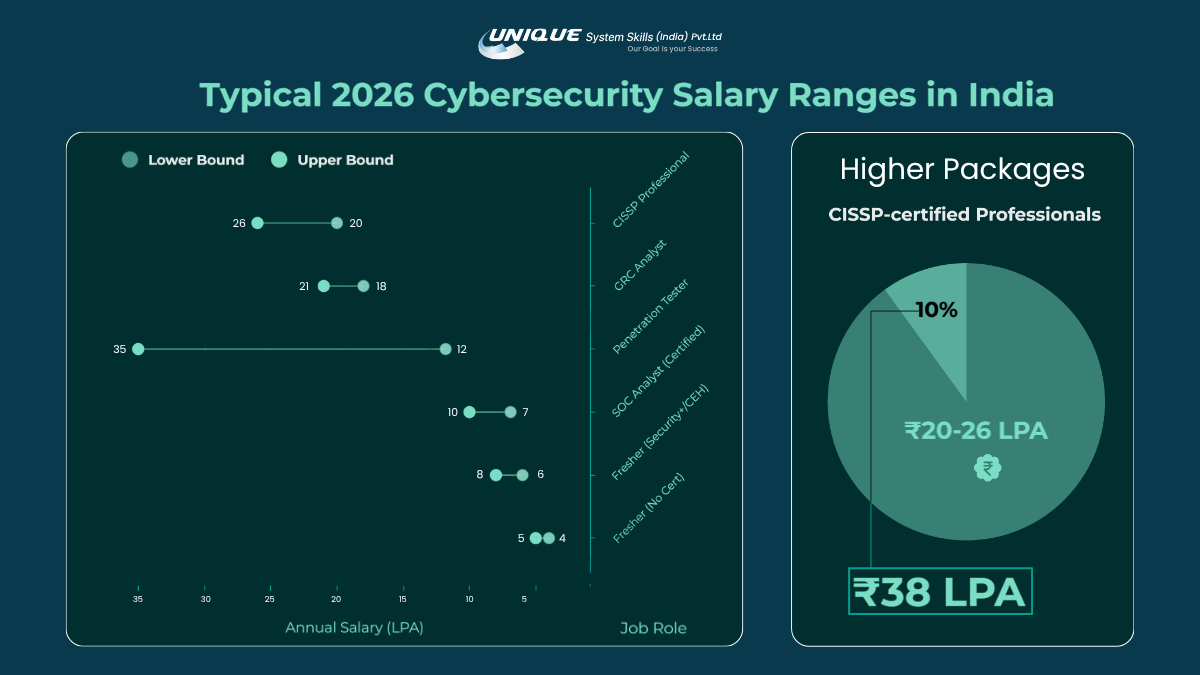
Typical 2026 Cybersecurity Salary Ranges in India
One pattern holds across every band, professionals holding recognised IT security certifications report earning roughly 30-50% more than uncertified peers, and that premium compounds with each job change rather than fading. For a deeper city-by-city breakdown, see our guide to cybersecurity salary in India.
Bridging the Career Gap: Why Practical Skills Training Is Essential
The gap where many freshers get stuck, even with a valid certificate in hand is when job postings ask for 1-2 years of experience a fresher doesn’t have by definition. The way around it isn’t more theory, it’s proof you can actually do the work. Building a portfolio through bug bounty programmes, Vulnerability Disclosure Programs (VDPs), and a GitHub repository of your own security scripts is one of the most effective ways to close that gap before your first paid role.
It’s also why our approach at Unique System Skills runs on 80% hands-on practice and 20% theory. Students work directly in lab environments with Kali Linux, Wireshark, Metasploit, Burp Suite, and Splunk. We cap batch sizes at 15 students so mentors can give real, individual debugging support, and because USS also runs its own staffing division serving 100+ global clients, the curriculum tracks what hiring managers are actually screening for right now, including Zero Trust implementation and AI-powered threat detection.
Choosing Your Path Forward
India’s cybersecurity market is growing at roughly 18-20% a year and is projected to approach $280 billion by year’s end, creating well over a million job openings across SOC roles, cloud security, and compliance. Because of the nations need, our Cyber Security Course & Training programme is built around practical skills, from foundational best IT certification courses through advanced, lab-heavy tracks.
Infographic 3
And whichever stage you’re at, the principle stays the same: IT security certifications work best paired with real, lab-tested skill, not memorised answers alone. With India’s talent gap widening, professionals who can combine the right credential with demonstrable ability are the ones getting interviews, offers, and repeat raises in 2026.
Frequently Asked Questions
Can corporate IT training programs be customized?
Yes. Most established providers of IT certification courses build corporate tracks around a company’s tech stack, compliance obligations like the DPDP Act, and the team’s existing skill level, rather than running one fixed public batch. At Unique System Skills, corporate cohorts draw on the same real-time hiring intelligence that feeds our staffing division, so training maps to what the client’s own security team is actually being asked to do.
What are the top IT certifications for corporate employees?
It depends on the role. General IT staff benefit from CompTIA Security+ and CEH for a shared baseline. Team leads and managers use CISM and CISA to translate technical work into governance language. Cloud teams increasingly need AWS Certified Security and Azure AZ-500 and Compliance and legal-adjacent staff typically pursue CRISC and ISO 27001 Lead Auditor.
Who can attend corporate IT training programs?
Anyone the employer nominates, technical or not. Cohorts typically include engineers building baseline security awareness, SOC staff working toward hands-on IT security certifications, and non-technical employees from compliance, HR, or legal who need working knowledge of DPDP obligations. Batches are usually grouped by role and skill level.
How do I choose the right corporate IT training provider?
You need to look for the following 5 things:
- A practical-heavy ratio of hands-on lab work over lecture.
- Batch sizes small enough for individual mentoring.
- A curriculum tied to real hiring and skills-gap data.
- A track record of enterprise placements.
- Credentials that are recognized.