Software testing is still worth building a career around especially when AI and automation are about to make the whole field expand. Software testing growth in India in 2026 is speeding up, changing shape, and splitting into specialisations that didn’t exist 3 years ago. The people who understand this shift, and position themselves on the right side of it. With the right, industry-aligned training, they are walking into more opportunity, better pay, and more long-term stability than testing has ever offered.
Testing has been repositioned from something that happened after development was done to a continuous engineering discipline built into every stage of how software gets shipped. This guide is to understand why software testing growth has taken this path and what it means for your own career choices right now.
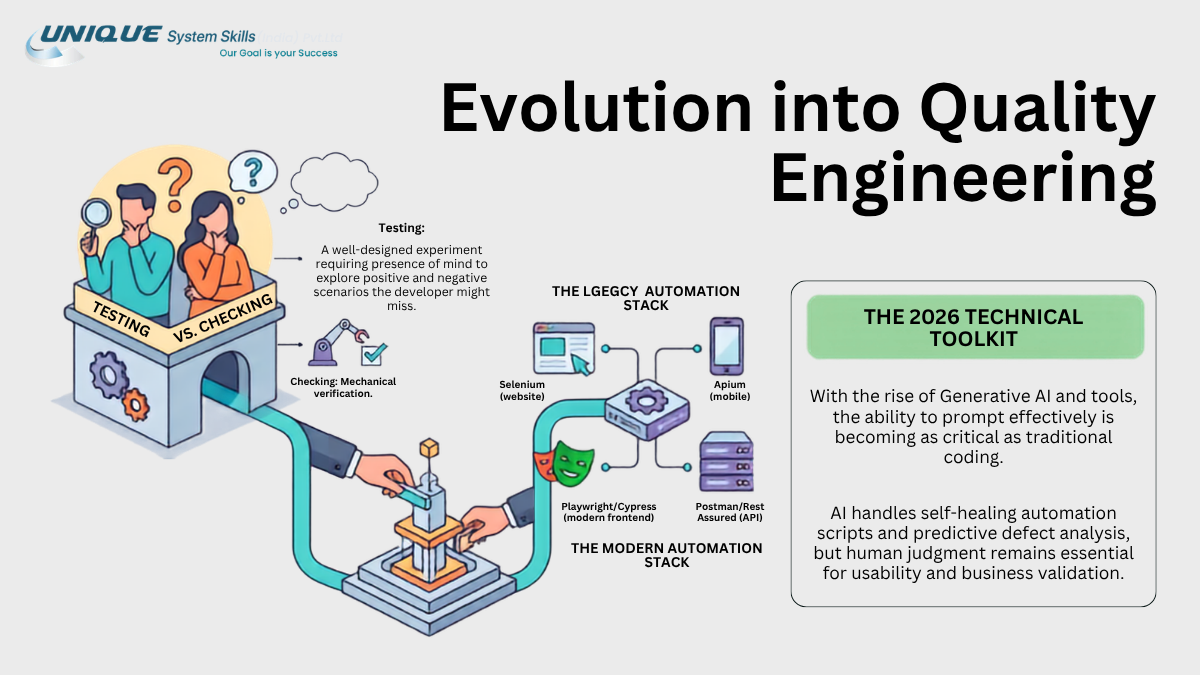
Software testing is evolving into quality engineering through modern automation, AI-assisted testing, predictive defect analysis, and stronger human judgment.
The Future Scope of Software Testing
The future scope of software testing looks very different from what most people who’ve been in the field would have predicted back in 2021. The global automation testing market alone is projected to grow from roughly $40 billion in 2026 to nearly $79 billion by 2031 with a growth rate of over 14% a year.
The shift from slow, planned test cycles at the end of a project to continuous testing built into every agile sprint has completely changed what a QA professional actually does. Testing is now a layer running through the whole process. When testing happened in occasional batches, it was easy to treat it as a cost to be trimmed because teams could shrink between release windows and grow again before launch.
In a world where code ships several times a day, that model doesn’t work. You can’t manually re-check an entire app three times a day. The only way to keep quality up at that speed is automated test coverage that runs on every code change, watched over by engineers who can fix failures and keep the framework working as the app evolves. This has turned software testing job opportunities from support roles into real engineering jobs that need genuine coding skill and pay has followed. Today, the scope of software testing depends less on how carefully you click through a screen and more on how well you can build and maintain the automated systems that check every part of a product, continuously and reliably.
Is Software Testing a Good Career in India in 2026?
Software testing a good career is an excellent career for people actively building automation and AI skills, and a genuinely tough one for people who aren’t. But, moving from manual testing to automation is more achievable and more structured than it looks from the outside.
The software testing career in India has real pay data behind it. The SDET (Software Development Engineer in Test) track where testing and development skills genuinely overlap. These skills can pay freshers ₹4–10 LPA to start, mid-level engineers ₹12–22 LPA, and senior engineers ₹25–40 LPA at strong employers. While, at the Principal Engineer and Engineering Manager level, software testing career growth in SDET roles at GCCs and global product companies can reach ₹60 LPA and above.
The industries driving software testing career in India hiring right now are exactly the ones growing fastest including.
- BFSI (banking, Financial Services, and Insurance): hires heavily, because financial systems can’t afford bugs that miscalculate numbers or expose customer data.
- Healthcare Technology: is similarly demanding, since patient records and diagnostic software need thorough checking before anything goes live.
- E-commerce platforms, SaaS companies, and the fast-growing GCCs: in cities like Pune, Bengaluru, and Hyderabad are also hiring steadily, especially for automation engineers who can contribute to a testing pipeline from week one.
Software testing career in India has rarely offered this good a mix of demand, pay, and stability.
Software Testing Future Scope
The biggest force shaping software testing future scope in 2026 and beyond is AI becoming part of the testing discipline itself
Understanding this correctly matters for anyone making career decisions here. AI in testing is a tool that automates the most repetitive, lowest-judgment parts of the job while opening up new, higher-value work that still needs a human engineer.
According to the World Quality Report 2025-26 (published by Capgemini, Sogeti, and OpenText, based on a survey of over 2,000 senior technology and quality leaders worldwide), close to 90% of organizations are now actively piloting or using generative AI in their quality engineering work. Though only 15% have it running at full enterprise scale so far, the numbers show interest and full rollout intentions.
How AI Is Changing What QA Professionals Actually Do
This is where the future of QA testing gets exciting. Tools like Testim, Mabl, and Functionize use machine learning to generate and update test cases automatically, learning from how the app behaves rather than needing someone to manually fix every broken script. AI coding assistants also help engineers write test scripts noticeably faster than manual scripting alone.
There is a need for professionals who know how to set up, check, and manage AI testing tools, along with those who can tell when the AI’s decisions are good and when they need a human correction.
The future of software testing in India belongs to QA engineers who treat AI as a tool inside their own engineering practice. The people most likely to feel disrupted are those who avoid building any automation or AI skill and keep positioning themselves purely as manual testers. For anyone willing to upskill, the future of software testing jobs is more interesting and better paid than the role has ever been.
Automation Testing is the Future and Why Playwright Has Become the Go-To Framework
No conversation about automation testing future scope in 2026 is complete without talking specifically about Playwright. Playwright is Microsoft’s open-source framework that has largely taken over from Selenium at modern product companies, GCCs, and forward-thinking IT services firms. Understanding why Playwright has risen this fast, and what it means for your own skill investment, is directly relevant to where automation testing future scope is heading.
Playwright solves 3 specific problems that made Selenium frustrating to work with at scale.
Cross-browser coverage: Playwright runs one test suite across Chromium, Firefox, and WebKit at once, without separate drivers or configuration files for each browser.
Reliability: Playwright’s built-in auto-waiting feature makes tests noticeably more stable than equivalent Selenium tests, because it waits intelligently for elements to become ready instead of needing the engineer to add manual pauses or complicated wait logic.
API testing: Playwright includes native API testing alongside UI testing, so engineers can check both the frontend and the backend service layer from a single framework.
The latest trends in software testing tool adoption back this up clearly. A 2026 industry survey of more than 40,000 testers found Playwright usage has overtaken Selenium for the first time.
Roughly 45% of QA professionals now use Playwright compared to around 22% still using Selenium. Indian hiring data reflects the same shift, with a growing share of QA job postings specifically asking for Playwright experience. For anyone building automation skills with an eye on career opportunities in software testing, Playwright is the most relevant technical skill to build right now. This is exactly why USS’s Software Testing Playwright Course is built around Playwright as its core framework.
Latest Trends in Software Testing
Playwright and AI in testing are the two biggest forces reshaping quality engineering right now. But, the latest trends in software testing cover more ground than just those 2, and a complete career plan needs to account for the rest. Knowing these trends helps you plan your skill-building with real direction, instead of chasing each new tool one at a time.
- Shift-left testing has moved from a buzzword to a standard way of working at modern companies. It means testing earlier (during design, during code review, during development itself) instead of treating it as something that happens after the fact.
- Continuous testing in CI/CD pipelines is shift-left put into practice at the infrastructure level. Automated test suites that run on every code commit (unit tests, integration tests, API tests, and full Playwright suites, all within minutes) are the backbone of how modern software gets delivered. Engineers who can set up, maintain, and troubleshoot these pipelines using Jenkins, GitHub Actions, or Azure DevOps are among the most valuable people on any engineering team.
- Performance and load testing has grown in importance as apps scale to serve millions of users at once. Tools like JMeter, Gatling, and Locust let engineers simulate real traffic conditions and catch bottlenecks before they cause production problems, This is especially critical in e-commerce, BFSI, and healthcare apps where traffic spikes have to be handled reliably.
- Security testing integration (DAST-Dynamic Application Security Testing and SAST (Static Application Security Testing) is becoming a standard expectation for senior QA engineers at companies in regulated industries. Knowing how to plug security scanning into a CI/CD pipeline and read its results is a cross-discipline skill that adds real pay premium for experienced testers.
- Full-Stack QA engineering has become a popular skill. This means that the Software testing career growth has the highest ceiling for professionals who understand both what they’re testing and how it was actually built. A QA engineer who understands Spring Boot APIs, database queries, and frontend structure can write tests that are sharper, more complete, and more useful than one who treats the app as a black box.
USS’s Java Full Stack Course pairs directly with automation skill-building along with backend and API knowledge that takes their test coverage from surface-level UI checks to real system validation.
Career Opportunities in Software Testing
The path to the fastest, most sensible order to build skills in differs depending on your background.
If you’re new to software testing:
Start with manual testing basics including understanding the testing lifecycle, writing test cases, reporting bugs clearly, and basic SQL for checking data. This builds the careful, analytical thinking that makes learning automation faster later. Add an ISTQB Foundation Level certification if you want recognition at IT services firms. Then move into Playwright automation with Python or JavaScript, the Page Object Model for building maintainable tests, and API testing with Postman. This path, backed by real projects on GitHub, is what gets freshers ₹6–8 LPA starting roles instead of ₹3–4 LPA ones.
If you’re a manual tester looking to move up:
The single biggest thing you can do is learn to write automation scripts in Playwright using Python or TypeScript. Your understanding of how an app should behave is a real advantage over developers who are new to testing. Adding automation on top of that knowledge is what opens up the SDET pay brackets that manual testing alone can’t reach. Career opportunities in software testing at the SDET level are genuinely realistic within about six months of structured automation training for experienced manual testers.
If you’re already an automation engineer aiming for the top:
Full-Stack QA and AI testing are the two paths with the highest long-term software testing career growth. Full-Stack QA means adding backend development understanding, through something like USS’s Java Full Stack Course. AI testing means learning machine learning basics and how to check AI model behavior, through something like USS’s AI Fundamentals Course. Career scope in software testing at this level is where the field’s pay reaches the same level as the best-paid engineering roles in Indian IT.
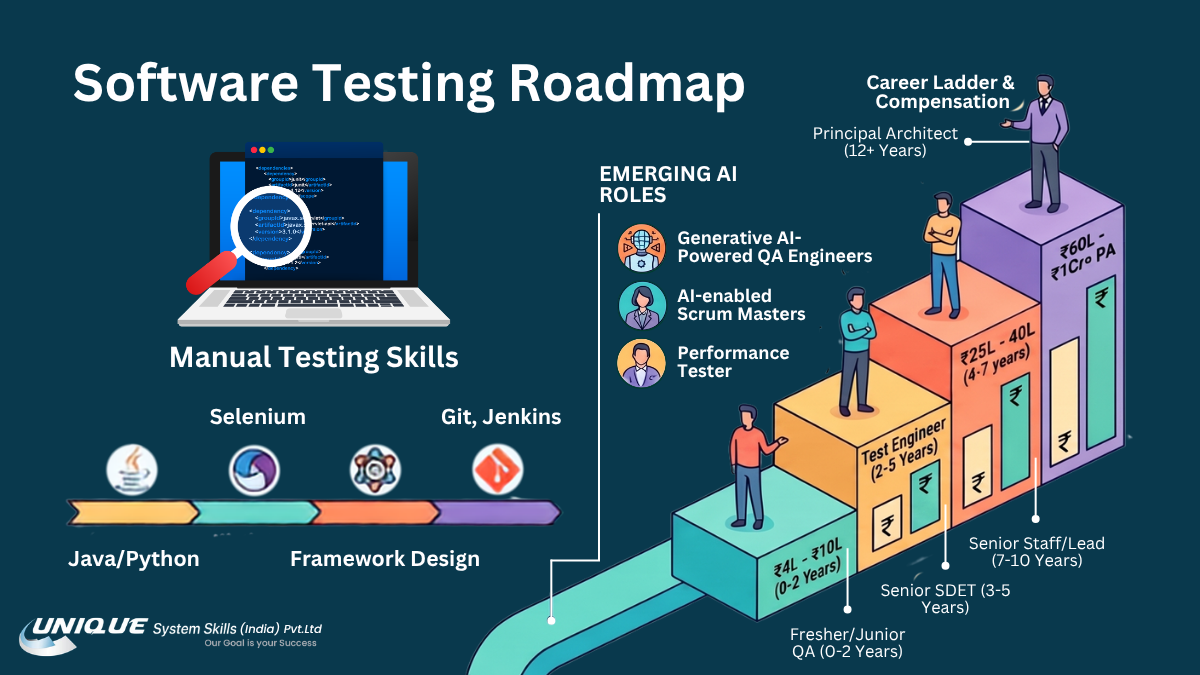
Software testing career roadmap covering core technical skills, automation tools, emerging AI-driven QA roles, and progression from junior tester to senior leadership positions.
Software Testing Growth in India
The software testing growth trend in India isn’t a temporary spike tied to one market moment. It comes from 4 forces that aren’t going away:
- Software systems getting more complex.
- Delivery cycles speeding up through CI/CD
- AI tools needing new kinds of checking.
- India’s growing role as the world’s main engineering hub for global tech companies.
Any one of these would keep demand strong on its own. Together, they make the future of software testing in India one of the most secure and expansive paths in the whole IT sector. The people who’ll benefit most from this software testing future scope are the ones investing now.
When it comes to automation frameworks, AI testing skills, backend understanding, and portfolio that actually shows what they can do, it’s an achievable 6-month outcome from where most working testers and students are right now. With the right training, the right project structure, and the right placement support, career opportunities in software testing in India in 2026 are as strong as they’ve ever been.
Your next step:
- Building automation from scratch: Software Testing with Playwright Course
- Adding Full-Stack QA capability: Java Full Stack Course
- Moving into AI/ML Testing: AI Fundamentals Course
Frequently Asked Questions
What is the current scope of software testing in the IT industry?
Testing has moved from a manual, end-of-pipeline check to a role embedded throughout development to continuous testing in CI/CD pipelines, performance testing, and security testing integration (DAST/SAST). This has turned many testing roles into engineering positions requiring real coding skill.
How is software testing career growth expected to change in the next five years?
Career growth is expected to increasingly favour automation, Full-Stack QA, and AI/ML testing specialisations over manual testing alone. SDET-track professionals already see pay grow from ₹4–10 LPA (fresher) to ₹25–40 LPA (senior) and beyond, and that gap between automation-skilled and manual-only testers is expected to widen further. Testers building toward Full-Stack QA typically add backend skills through a programme like the Java Full Stack Course, while those aiming at AI/ML testing roles build their foundation through a course like AI Fundamentals.
What are the best software testing job opportunities for freshers?
Freshers with demonstrated automation skills like a documented Playwright project on GitHub, basic API testing with Postman, and solid manual testing fundamentals (SDLC, STLC, test case design). These skills typically access ₹6–8 LPA starting roles at product companies and GCCs, compared to ₹3–4 LPA roles for freshers without a portfolio. USS’s Software Testing with Playwright Course is built to help freshers build exactly this kind of portfolio.
What is the future of QA testing with the rise of AI and automation?
AI is automating the repetitive, low-judgment parts of testing while creating new, higher-value work for engineers who can configure, evaluate, and correct AI testing tools. Per the World Quality Report 2025, close to 90% of organisations are now piloting or using generative AI in quality engineering, though only a smaller share has it running at full production scale. This means that skilled human oversight is still very much in demand. Testers who want to build this oversight skill set can start with USS’s AI Fundamentals Course, which covers the machine learning basics needed to evaluate AI testing tools properly.
Is automation testing a good career for the future?
Yes. Automation-focused SDET roles already pay well above manual testing roles at the same experience level, and the global automation testing market itself is projected to grow from around $40 billion in 2026 to nearly $79 billion by 2031, at over 14% a year, according to Mordor Intelligence. This is a clear sign of sustained, structural demand. USS’s Software Testing with Playwright Course is a common starting point for testers making this move.
How can a fresher start a career in software testing in India?
Start with manual testing fundamentals (test case design, defect reporting, basic SQL), then add Playwright automation with Python or JavaScript and API testing with Postman, backed by real, documented projects on GitHub. This sequence is what typically moves freshers from ₹3–4 LPA offers into the ₹6–8 LPA range at product companies and GCCs. USS’s Software Testing with Playwright Course is structured around exactly this progression.