Quick Answer: The best Java classes in Pune combine Core Java, Spring Boot, REST APIs, real-time projects, and honest placement preparation — not just certificates and slogans. Unique System Skills India is rated 4.7/5 by 1,000+ students and offers 100% placement assistance with industry-experienced trainers.
The Pattern Nobody Talks About
There’s something that keeps showing up across Pune’s software training world — and most freshers don’t realize it until it’s too late.
Students spend months watching tutorials, collecting certificates from five different platforms, and still freeze in interviews when asked something like:
“How would you design a login API?”
Meanwhile, a student who built even two or three real Java projects — an employee management system, a REST API backend, a Spring Boot mini-application — gets shortlisted faster. Sometimes with average marks.
That surprises people. But it shouldn’t.
Recruiters in 2026 are less interested in whether you memorized definitions. They want to know if you can:
- Solve a practical problem
- Understand how backend logic actually flows
- Work with databases and APIs
- Debug when things break
- Explain your project confidently in an interview
That’s exactly why choosing the right Java training institute in Pune matters so much right now. And honestly, not every institute is keeping up with what the industry actually needs.
Why Java Is Still a Strong Career Choice in 2026
There’s a lot of noise about AI replacing developers. It’s worth cutting through that.
Java continues to power the backbone of enterprise India — banking software, fintech platforms, healthcare systems, ERP applications, cloud-based APIs, and large-scale e-commerce backends. Companies like Infosys, Wipro, TCS, Cognizant, and hundreds of Pune-based product startups still hire Java developers at scale.
Here’s the honest truth:
AI tools can generate code snippets. But businesses still need developers who understand systems — architecture, debugging, scalability, data flows, API design. That’s where a well-trained Java developer stays valuable and stays employed.
Pune’s IT market — across Hinjewadi, Kharadi, and Magarpatta — reflects this. Java developer roles consistently rank among the most-posted positions on Naukri and LinkedIn for Pune in 2026.
Entry-level Java developers in Pune can expect ₹3–6 LPA. Full Stack Java developers with Spring Boot experience regularly see ₹8–18 LPA.
The opportunity is real. The question is how you prepare for it.
What the Best Java Course in Pune Should Actually Teach
If an institute is still teaching Java like it’s 2015 — loops, arrays, and textbook theory — be careful.
A strong Java course in Pune in 2026 needs to prepare you for real development workflows, not just clear an exam.
Here’s the skill map that actually matters:
| Skill | Why It Matters |
|---|---|
| Core Java | Programming fundamentals, interview baseline |
| OOP Concepts | Asked in every technical round |
| Collections Framework | Frequently tested in company assessments |
| JDBC | Database connectivity foundation |
| Hibernate | ORM for enterprise applications |
| Spring Framework | Enterprise-grade backend development |
| Spring Boot | Most in-demand Java framework in 2026 |
| REST APIs | The standard for modern backend development |
| SQL / MySQL | Every Java application needs database skills |
| React JS (basics) | Required for Full Stack Java developer roles |
| Git & GitHub | Non-negotiable — industry workflow from day one |
| Live Project Work | Where interview confidence actually gets built |
The curriculum should also include placement preparation — resume building, mock interviews, aptitude training, GitHub portfolio setup, and communication practice. These aren’t extras. They’re the difference between a student who clears interviews and one who doesn’t.
Seven Things to Evaluate Before Joining a Java Training Institute
Most students make this decision based on advertisements, fees, or a friend’s recommendation. Here’s a more structured way to think about it.
1. Are Practical Projects Central to the Course?
This is the single most important thing to check.
A student who has built an employee management system, a banking application backend, a Spring Boot REST API, and a Full Stack project using React + Java — that student performs differently in interviews.
They don’t freeze. They’ve seen how real applications work. They can explain decisions they made. That’s what recruiters respond to.
Ask the institute directly: “What projects will I build, and can I show me past student projects?”
2. What Does Placement Support Actually Look Like?
A lot of institutes in Pune advertise “100% Placement Guarantee.” Be very careful with that phrase.
No ethical institute can guarantee a job. Hiring decisions are made by companies, not training institutes.
What a strong institute can do—and what you should look for — is genuine placement preparation:
- Multiple rounds of mock technical interviews
- HR interview practice
- Resume and LinkedIn profile building
- GitHub portfolio guidance
- Active company referrals with verifiable records
Ask: “Can you show me where your last batch got placed?” If they avoid the question, that tells you something.
3. What Is the Batch Size?
This surprises people, but it matters enormously.
In overcrowded batches, students hesitate to ask doubts. Personal attention disappears. Coding practice becomes passive. You’re watching, not doing.
Smaller batches create space for actual interaction — debugging help, project discussions, mentor feedback. That’s especially important if you’re coming in with a weak programming foundation.
4. Are the Trainers Industry-Experienced?
Academic trainers can teach syntax. Industry-experienced trainers teach you how development actually works — the shortcuts, the debugging habits, the architecture thinking, the interview realities.
Ask if you can speak to a trainer before enrolling. A confident, transparent institute will say yes.
5. Does the Curriculum Include Spring Boot?
If Spring Boot is absent or treated as an “optional advanced topic,” the curriculum is outdated. More on this in Section 6.
6. Is Flexible Timing Available?
If you’re still in college or working part-time, you need options — weekend batches, weekday batches, hybrid (online + offline) formats. A good institute accommodates real student schedules.
7. Are the fees transparent and certification recognized?
Ask for a complete fee breakdown upfront. Check whether EMI is available. Verify whether the certification is NSDC-affiliated or industry-recognized — not just a printed PDF with a stamp.
Java Classes for Freshers in Pune — What to Expect
If you’re a fresher — BE/BTech/MCA/BCA/BSc IT, career switcher, or non-CS graduate — here’s an honest picture of the learning journey.
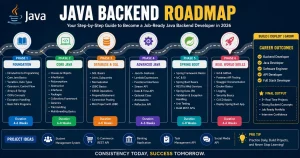
Month 1: Java fundamentals, OOP concepts, syntax practice, basic coding problems
Month 2: Collections, Exception Handling, Multithreading, JDBC
Month 3: Advanced Java — Servlets, JSP, Hibernate, Spring Framework introduction
Month 4: Spring Boot, REST API development, MySQL integration
Month 5: React JS basics, Full Stack project development
Month 6: Placement preparation — resume, mock interviews, GitHub, company referrals
You do not need prior programming experience to start. A good institute will begin from zero.
What you do need: consistency, willingness to practice 2–3 hours daily outside class, and the discipline to build things on your own, not just follow along.
Why Spring Boot Training in Pune Is No Longer Optional
This is the shift most freshers miss.
A few years ago, knowing Core Java was enough to get your foot in the door. Today, the hiring bar looks more like this:
Junior Java Developer (0–1 year): Core Java + Spring Boot basics + REST APIs + SQL
Mid-Level Developer (1–3 years): Spring Boot + Microservices + Hibernate + React or Angular
Senior Developer (3+ years): Architecture ownership, cloud integration, performance thinking
Spring Boot isn’t advanced anymore — it’s the baseline for fresher roles.
When you’re evaluating advanced Java classes in Pune, ask specifically:
- “Do students build and deploy a REST API from scratch?”
- “Is there a Microservices module in the curriculum?”
- “Do students connect a Spring Boot backend to a React frontend in a live project?”
If the answer to any of these is no, the course is behind the market.
Online vs Offline Java Classes — Which One Should You Choose?
Both can work. It depends entirely on how you learn.
Offline classes are usually better if you:
- Need external discipline to stay consistent
- Learn better through live interaction and classroom energy
- Get distracted easily at home
- Prefer immediate doubt resolution
Online classes work better if you:
- Already have some programming exposure
- Need flexible scheduling around college or work
- Want to revisit recorded sessions at your own pace
In 2026, hybrid learning is increasingly the smartest option — live classes with recorded backups, practical assignments, online doubt sessions, and, where possible, in-person project reviews.
The mode matters less than the quality of teaching and the structure of practice.
Questions to Ask Before You Pay a Single Rupee
Most students don’t ask nearly enough before enrolling. That’s where regret starts.
Here are the questions worth asking every institute you evaluate:
✅ Will I build live, real-world projects — and which ones?
✅ Is Spring Boot explicitly covered, with hands-on practice?
✅ Are mock technical and HR interviews included?
✅ Will I learn Git and GitHub workflows?
✅ Are trainers currently working in the industry?
✅ Can I attend a free demo class before deciding?
✅ What does placement support actually include, and for how long?
✅ Can you share where students from the last batch got placed?
If an institute hesitates or deflects on any of these — that itself is useful information.
Common Mistakes Freshers Make While Choosing Java Classes in Pune
These patterns come up again and again:
Choosing based on price alone. The cheapest course often cuts corners on projects, trainer quality, or placement support. The most expensive doesn’t automatically mean the best.
Falling for “100% placement guarantee” marketing. If an institute is leading with that claim and can’t back it up with specific company names and student outcomes — be skeptical.
Not attending a demo class. Almost every decent institute offers a free demo. There’s no reason to skip it. One session tells you more about teaching quality than any brochure.
Ignoring batch size. A batch of 60 students is a very different experience from a batch of 15. Ask.
Prioritizing certification over curriculum. A certificate means very little if the skills behind it aren’t real. Companies test you in interviews — not on paper.
How Unique System Skills India Is Different
Unique System Skills India is a Pune-based Java training institute rated 4.7/5 by over 1,000 students — with a curriculum and support structure built around what the job market actually demands.
Here’s a transparent picture of what they offer:
Curriculum Built for 2026 Hiring
The Full Stack Java course covers Core Java → Advanced Java → Spring Boot → Hibernate → REST APIs → Microservices → React JS → MySQL → Git—structured progressively, not scattered.
Industry-Experienced Trainers
Trainers at Unique System Skills India come with real enterprise development experience. They’ve built production applications. They teach you how the industry actually works, not just how to pass tests.
Real Projects, Real Portfolio
Students build live projects — not toy examples. By the time you finish, you have a GitHub portfolio you can walk an interviewer through confidently.
Placement Preparation That’s Actually Honest
- Dedicated placement team (not a shared contact)
- Resume writing and LinkedIn profile optimization
- Multiple mock technical and HR interview rounds
- Company referrals to IT firms across Pune
- Post-course placement support
They don’t promise a job. They prepare you to get one — which is what actually matters.
Flexible Learning Formats
- Online + Classroom (Hybrid) training
- Weekday and Weekend batch options
- Suitable for freshers, final-year students, and working professionals
Recognized Certification
NSDC (NSDCL) certification is included—globally recognized, not just a printed diploma.
Accessible Fees with No-Cost EMI
Structured to be genuinely accessible. No-Cost EMI options are available so financial constraints don’t block deserving students.
📞 +91 9970666888
🌐 systemskills.in/java-classes-in-pune
📍 Pune (Online + Offline available)
Frequently Asked Questions
Which is the best Java class in Pune for freshers?
The best Java classes for freshers prioritize practical training, Spring Boot projects, interview preparation, and real placement support — not just theory and certificates. Unique System Skills India is specifically structured for freshers starting from zero.
Is Java still good for jobs in 2026?
Yes. Java remains one of the strongest backend languages for enterprise applications, banking systems, fintech platforms, and large-scale business software. It’s not going anywhere soon.
What should a Java Full Stack course include?
Core Java, Advanced Java, Spring Boot, REST APIs, Hibernate, MySQL, React JS basics, Git/GitHub, and real project implementation. If any of these are missing, the curriculum is incomplete.
How much do Java classes cost in Pune?
Java course fees in Pune generally range from ₹35,000 to ₹1,20,000, depending on course depth, duration, and placement support. Contact Unique System Skills India directly at +91 9970666888 for current pricing and EMI options.
Is Spring Boot necessary for freshers?
Yes. Most Java backend job descriptions in 2026 expect Spring Boot fundamentals and REST API development skills. It’s not advanced anymore — it’s the baseline.
How long does it take to become job-ready in Java?
Most freshers become interview-ready within 5–6 months of consistent training and project practice. The more actively you build things alongside the course, the faster this happens.
Should freshers choose Core Java or Full Stack Java?
Full Stack Java opens more doors. Companies increasingly value developers who understand both frontend and backend, and Full Stack Java profiles are among the most hired in Pune’s IT market.
Are placements guaranteed after Java training?
No ethical institute can guarantee placement — that decision belongs to companies. But strong training significantly improves your employability. Look for institutes that prepare you honestly rather than making unrealistic promises.
Is coding difficult for beginners?
It feels difficult at the start for almost everyone. With structured learning, regular practice, live projects, and good mentor support, it becomes manageable — and eventually, genuinely enjoyable.
Can non-CS students join Java classes in Pune?
Absolutely. BCA, BSc IT, Commerce graduates and career switchers from non-technical backgrounds are welcome at Unique System Skills India. The course starts from the fundamentals.
Your Next Step
Here’s what it comes down to.
The best Java classes in Pune in 2026 aren’t the ones with the biggest advertisements or the boldest placement claims. They’re the ones that make you genuinely capable—practically, technically, and confidently.
That means real projects. Experienced trainers. Honest placement preparation. A curriculum that reflects what companies are actually hiring for right now.
If you’re evaluating options, the smartest thing you can do before paying fees anywhere is attend a free demo class. One session will tell you more than any brochure or review.
Book Your Free Demo Class at Unique System Skills India
See the teaching quality, meet the trainers, and evaluate whether it’s the right fit — before you commit.
👉 Book a Demo Class → 📞 Call / WhatsApp: +91 9970666888
Unique System Skills (India) Pvt. Ltd. — Practical, Placement-Focused Java Training in Pune