AI in Cybersecurity has become one of the most in-demand skill combinations in Indian tech, and once you understand why, that uncertainty can turn into a clear, confident career plan.
This guide is written for 3 kinds of readers:
- Students choosing a specialization
- IT professionals who want to add security skills
- Working cybersecurity professionals who want to stay relevant as AI reshapes the field.
The numbers behind this shift are real. India’s internet user base has crossed 900 million people, and every one of those users, along with the businesses that serve them, adds to a growing digital attack surface. The country also faces a shortfall of well over one million skilled cybersecurity professionals. This gap lines up with the wider global shortage tracked by ISC2’s Cybersecurity Workforce Study.
When a gap this large meets a demand this urgent, the professionals who understand both AI and security are the ones companies compete hardest to hire. But before we move to the processing of upskilling for this demand, understanding how AI in cybersecurity is reshaping defence itself is important.
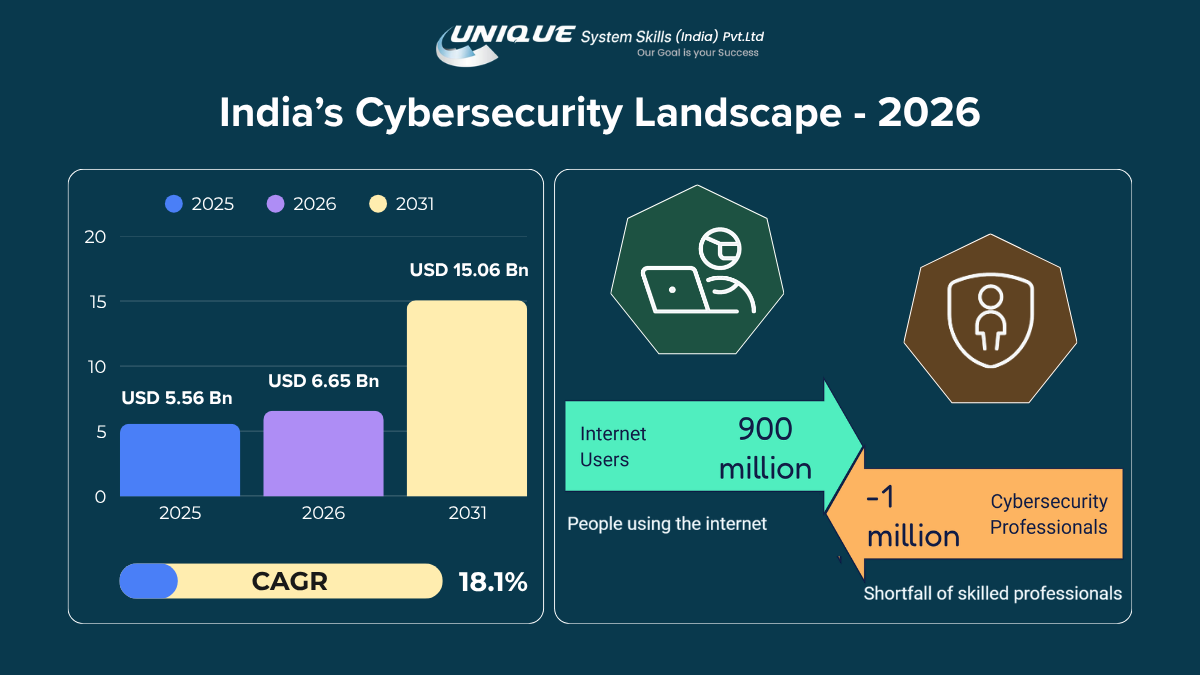
India Cybersecurity Landscape 2026 – Market Growth & Skills Gap
How AI in Cybersecurity Is Transforming Threat Detection and Response
For years, security teams relied on manual monitoring. This meant people scanning dashboards and logs, reacting only after something had already gone wrong. That approach cannot keep up anymore. Modern threat detection and response now runs on AI systems that scan huge amounts of data in seconds, spotting problems a human analyst might take hours to notice. Now, with India’s cybersecurity market projected to grow from roughly $6.56 billion in 2026 to $15.06 billion by 2031, AI systems are going to take up more space.
This shift shows up clearly in cyber threat detection around phishing, still one of the most common ways attackers get in. Phishing detection using machine learning has moved from experimental research to genuinely reliable defense. Peer-reviewed studies report accuracy rates well above 95%, with several models exceeding 99%, at spotting dangerous links before anyone clicks them. Phishing URL detection systems study the structure of a link itself to flag danger in milliseconds.
For a bank handling thousands of incoming emails a day, no human team could check each one, but an AI-based cybersecurity threat detection layer can quietly scan every message and flag only the handful that truly need human judgement. This is exactly the kind of always-on, proactive defence that makes AI cybersecurity solutions so valuable, and it is reshaping what a security career actually looks like day to day.
The Expanding Career Scope of AI in Cybersecurity
Interestingly, this shift is not eliminating security jobs, it is creating more of them, in new, higher-paying specialisations. The career scope of AI in cybersecurity now spans roles that barely existed a few years ago, and people fluent in both domains usually earn more than those who specialise in only one.
Pay reflects this clearly. An entry-level Security Analyst in India can expect around ₹40,000–₹70,000 a month (Source), while specialists in AI-adjacent areas like cloud security often start above ₹8 lakhs a year and climb quickly from there. Senior strategic roles, such as Chief Security Architect, typically pay ₹25–35 lakhs, and CISO-level pay at major Indian enterprises can cross ₹60 lakhs (Source).
AI in cybersecurity jobs are also spreading geographically. While Bengaluru still holds roughly a tenth of national vacancies, cities like Pune, Hyderabad, and Delhi-NCR are closing the gap fast as more IT parks and Global Capability Centres open there. This growing career scope of AI in cybersecurity is a direct result of how deeply AI has embedded itself into everyday security work.
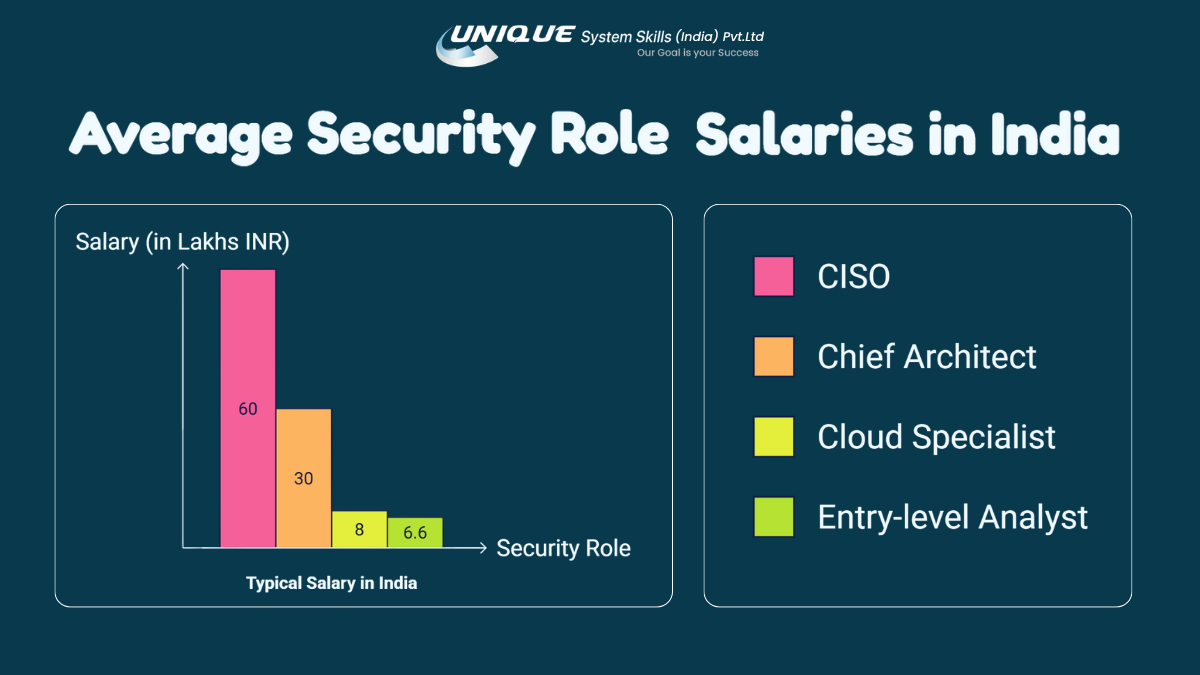
Average Cybersecurity Salaries in India
High-Impact AI Cybersecurity Solutions Reshaping the Job Market
The same intelligence that makes phishing detection more precise is reshaping every other layer of a modern security team as well. Step into a modern Security Operations Centre today and you will find AI cybersecurity solutions built into nearly every part of the workflow. Behavioural analytics tools learn what normal looks like for a specific network and flag anything unusual automatically, while automated response tools can contain a threat within seconds of detection. This happens long before a person could manually isolate the affected system.
Thus, instead of removing people from the loop, this changes what they are actually doing. Today’s analysts read AI-generated insights, decide which flagged issues genuinely matter and which are false alarms, and then direct the response. In this shift toward “AI vs. AI” defence, security teams must keep pace with attackers who are themselves using AI-written phishing emails and deepfake-based social engineering. This involvement of artificial intelligence in cybersecurity careers increasingly reward people who understand both the technologies and the judgement layered on top of it. An analyst skilled with AI in cybersecurity can look at a suspicious deepfake voice call and quickly judge whether it fits a known attack pattern, instead of treating every alert as equally urgent.
Pathways for Freshers: AI Cybersecurity Jobs for Beginners
If you have felt discouraged by job listings that call themselves ‘entry-level’ while asking for 1-2 years of experience, you are far from alone. This experience paradox is real, but it is not a locked door. AI cybersecurity jobs for beginners are genuinely within reach if you focus on building visible, provable skill rather than waiting for a perfect resume.
Start by putting your work on GitHub including security scripts, small automation tools, or write-ups from practice penetration tests. Along with this, Internships through recognised institutions or government bodies like the NCIIPC carry real weight with Indian recruiters, especially when they lead to a documented vulnerability report.
A fresher with only a transcript is less likely to be chosen by the recruiter who has someone with 3 GitHub projects and am Internship letter. With that kind of visible groundwork, genuine AI and cybersecurity career opportunities open up far faster than most newcomers expect and can turn into real AI cybersecurity job openings within months rather than years. But before building this kind of proof you need to make sure that your formal training actually matches what these roles demand.
The Value of Specialised AI in Cybersecurity Courses
A general computer science degree is useful, but on its own it is no longer enough for this field, because AI-driven security changes faster than most college syllabi can keep up with. This is exactly why targeted AI in cybersecurity courses have become so valuable. A good training will build the specific, current skills recruiters are actually screening for.
This includes the following:
- Getting Comfortable with Python for security automation, so you can script routine checks and build your own tools.
- Adding machine learning basics so you can judge whether a security tool’s output actually makes sense.
- Grounding all of this in network and cloud security fundamentals, since most AI systems today run on AWS, Azure, or GCP.
You can explore this exact combination through the AI Fundamental Course and the Cybersecurity Training Course, both built around the practical, current skill set this field now demands.
Not sure which one to pick?
If you are a complete beginner, start with the AI Fundamental Course. If you already have a networking or IT background, the Cybersecurity Training Course is your more direct path.
Practical Steps: How to Start a Career in AI Cybersecurity
Knowing you want to enter this field is the easy part. Knowing exactly where to begin is where most people get stuck. Here is a workable roadmap for how to start a career in AI Cybersecurity, laid out in the order that actually builds on itself:
- Learn networking fundamentals. Understand the OSI and TCP/IP models because every AI security tool you will use later assumes you already understand what a normal network behaviour looks like.
- Practice ethical hacking. Move into foundational security principles and hands-on ethical hacking, so you build real comfort with how attacks actually work before trying to defend against AI-powered versions of them.
- Build Python and machine learning literacy. This is what lets you move from simply using security tools to actually understanding and eventually building them.
- Earn recognised certifications. Certifications such as CompTIA Security+ or CEH act as the filters most Applicant Tracking Systems and recruiters use to shortlist candidates in the first place.
This path into AI in cybersecurity can build a solid foundation that actually holds up under real interview pressure.
Why Unique System Skills Is Ideal for This Career Path
Unique System Skills has built its training around everything covered in this guide. As Maharashtra’s first USA-based IT training and placement institute, USS aligns its curriculum with what hiring managers actually test for.
The program batches are capped at a maximum of 15 students, keeping mentorship personal while learners work hands-on with industry-standard tools like Kali Linux, Wireshark, Metasploit, and Splunk. Because USS also operates its own staffing and recruitment division, with a network of over 100 hiring partners including Infosys, TCS, and Accenture. Our graduates have gone on to secure roles like AI/ML Engineer and Python AI Developer, with some placements reaching ₹16.5 lakhs at companies like Persistent Systems.
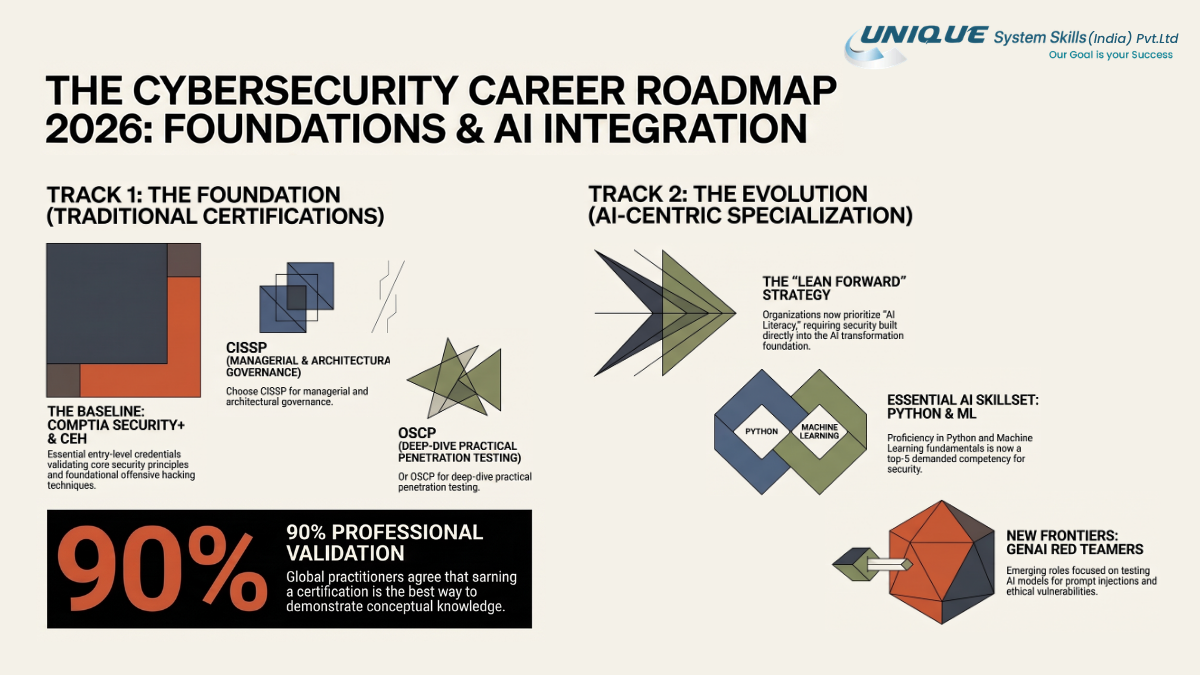
Cybersecurity Career Roadmap 2026 Certifications & AI Skills
Conclusion: Your Path Forward Starts Here
AI in cybersecurity is not a passing trend to watch cautiously from the sidelines. It is a deep, lasting transformation in how Indian organisations defend themselves, and it is creating well-paying career opportunities right now. If you started this guide unsure whether to specialise in AI or in security, let this be the reassurance you needed. The strongest careers in AI in cybersecurity belong to people who stopped choosing between the two.
Whether you are a fresher building your first portfolio or a working professional adding AI fluency to existing security skills, the path forward is built from concrete, achievable steps.
And with USS, you can walk into your next interview comfortable explaining how a phishing detection model actually works because you built one yourself. That confidence is entirely within reach, and there has rarely been a better moment in India to start building it.
Frequently Asked Questions
What are the best careers in AI in Cybersecurity?
Some of the strongest options are AI-driven Threat Detection Analyst, Cloud Security Specialist, Security Automation Engineer, and roles inside a modern Security Operations Centre that combine threat detection and response with machine learning. Senior paths include Chief Security Architect and CISO, where AI in cybersecurity skills are now expected rather than optional.
What skills are needed for AI cybersecurity jobs?
You need networking fundamentals (OSI and TCP/IP), hands-on ethical hacking practice, Python for security automation, working knowledge of machine learning so you can judge a security tool’s output, and cloud security basics on AWS, Azure, or GCP. Certifications like CompTIA Security+ or CEH help recruiters shortlist you.
How do I get a job in AI in Cybersecurity?
Build visible, provable proof of skill: publish security scripts and write-ups on GitHub, take part in bug bounty or Vulnerability Disclosure Programs, and look for internships through recognised institutions or bodies like the NCIIPC. Pair that proof with a focused course — such as USS’s AI Fundamental Course or Cybersecurity Training Course — and follow the four-step roadmap: fundamentals, ethical hacking practice, Python/ML literacy, then certification.
What is the salary of an AI cybersecurity engineer?
In India, entry-level Security Analysts typically earn ₹40,000–₹70,000 a month, while AI-adjacent specialists such as cloud security engineers often start above ₹8 lakhs a year. Senior roles like Chief Security Architect pay ₹25–35 lakhs, and CISO-level compensation at major enterprises can exceed ₹60 lakhs (see the PayScale India salary data linked earlier in this guide).
Can cybersecurity professionals work in AI?
Yes. Most working cybersecurity professionals do not need to become data scientists — they add machine learning literacy on top of the security skills they already have, so they can interpret AI-generated alerts, evaluate AI tool outputs, and work inside AI-driven Security Operations Centres.
Can AI replace cybersecurity jobs?
No it is reshaping them rather than removing them. AI now handles high-volume, repetitive scanning such as phishing URL detection, but a human still has to interpret flagged anomalies, decide which alerts genuinely matter, and direct the response. The career scope is expanding, not shrinking.
Will AI create more cybersecurity jobs?
Yes. As shown throughout this guide, the career scope of AI in cybersecurity now includes roles that barely existed a few years ago, and India’s cybersecurity market is projected to grow from about $6.56 billion in 2026 to $15.06 billion by 2031, alongside a shortfall of well over one million skilled professionals.
What qualifications are needed for AI in Cybersecurity?
A mix of practical proof and recognised certification works best: hands-on projects (GitHub, bug bounty programs, internships), a focused course covering Python, machine learning basics, and cloud security, plus certifications such as CompTIA Security+ or CEH.
What degree is needed for AI in Cybersecurity?
A general computer science or IT degree is a reasonable starting point, but on its own it is usually not enough. Most recruiters now also look for a specialised course or certification that covers Python for security automation, machine learning fundamentals, and cloud security — the areas a traditional syllabus often does not keep up with.
Is cybersecurity with AI in demand?
Yes, strongly. India faces a shortfall of well over one million skilled cybersecurity professionals, and companies are actively competing for people who understand both AI and security. Demand is spreading beyond Bengaluru into Pune, Hyderabad, and Delhi-NCR as more IT parks and Global Capability Centres open.