
Yes, for most students, graduates and career switchers in India, a front end developer course with placement is worth it in 2026, but only if it makes you build and launch real projects. A frontend developer now does much more than style pages. You are expected to build fast, easy-to-use screens, connect them to APIs, and check code written by AI tools.
Learning all this alone is hard, and many beginners give up halfway through a video playlist. If that sounds like you, you are not behind. You just need a clear path. This guide shows what a good course teaches, how it compares with learning alone, what to check in Pune, and what the salary data says. First, let’s look at the skills that get people hired.
What a Front End Developer Course with Placement Should Teach You
Hiring managers rarely check whether you remember syntax. They check whether you can turn a design into a working page that fits every screen, and whether you can explain your choices. A good course teaches skills in a clear order, where each one helps the next. The first step is the base.
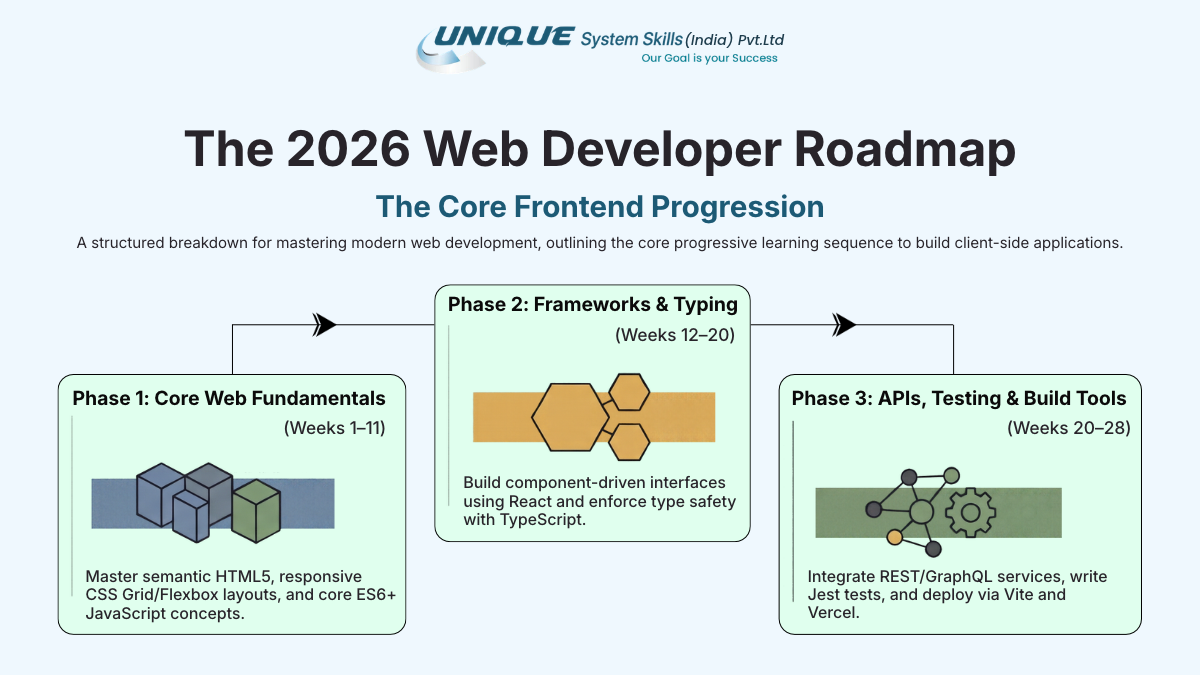
A three-phase frontend development roadmap covering web fundamentals, React and TypeScript, API integration, testing and deployment.
HTML, CSS and JavaScript: The Base
A HTML CSS JavaScript course with placement should begin with semantic HTML5, which helps screen readers and search engines understand your page. Next is CSS3. With Flexbox, Grid and media queries, one layout can fit a phone on a Mumbai local train and a big office monitor. Learn plain CSS before UI libraries, because interviewers often ask for a layout with no framework. Then comes modern JavaScript (ES6+): the DOM, array methods, destructuring, promises and async/await. Once these basics feel easy, frameworks look less scary, and that leads us to React.
React and Modern Tools
React is the library most employers ask for. The 2025 Stack Overflow Developer Survey showed React use rising from 39% to 44% and admiration for React fell from 62% to 52%. That tells you that people use React because teams already depend on it, and hiring follows usage.
A good React developer course with placement covers the following components:
Props, State, Hooks (useState, useEffect, useContext) and single-page apps.
TypeScript, Context API or Redux, REST and GraphQL, testing with Jest, builds with Vite.
Deployment on Vercel or Netlify followed by Git and GitHub
As recruiters read your repositories, knowing what to learn is half the job. How you learn it decides whether it sticks.
Course or Self-Learning: Which Path Works Better?
Free lessons are great, and many good developers began with them. The problem is not quality. It is order and feedback. Many beginners get stuck in hours of videos and a feeling of progress followed by a blank screen they cannot fill alone.
A guided course fixes this. A mentor can see your screen and explain an error right away, so a missing bracket does not cost you a weekend. Clear checkpoints show what you know and what is weak. Mock interviews and resume reviews add career help that videos never give. That is the real case for a front end developer course with placement in pune. it shortens the gap between learning code and being tested on it.
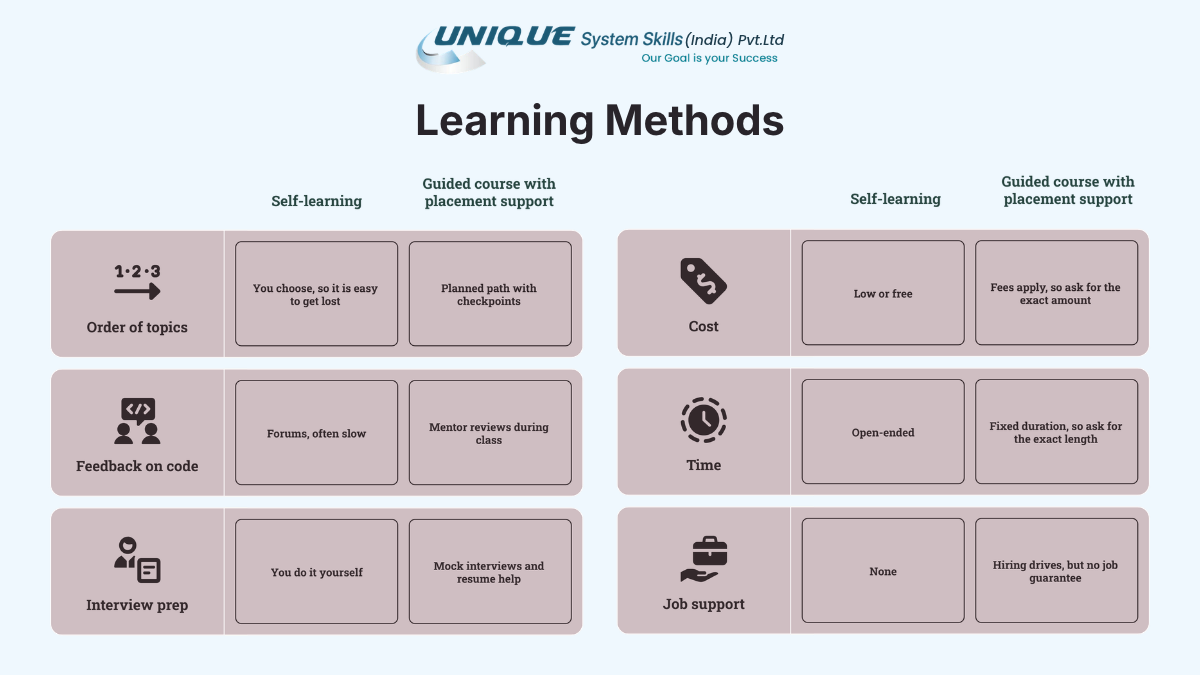
Compare self-learning with a guided frontend development course across six factors, including mentoring, fees and placement support.
The cost and time rows are where you should ask hard questions before you join. Basics also matter more now because of AI. The Stack Overflow data, says 84% of developers use AI tools but only 29% trust them. AI can write starter code and suggest fixes in seconds, but a beginner who cannot read the code cannot tell if it is safe, fast or wrong. Good training shows you how to use AI for repeat work while you stay in charge of design choices. The best proof that you can do this is a strong portfolio.
Build Projects That Recruiters Remember
Recruiters see hundreds of resumes with the same to-do app and weather widget copied from a tutorial. What stands out is a small set of complete, live apps that act like real products like:
- A shop page with cart logic
- A weather dashboard that handles failed API calls well
- A shared task board with filters
Building at this level teaches things no short example like loading states, errors that arrive late, tidy folders or publishing a live link on Vercel or Netlify can teach. This is why the practice ratio matters. A Java programme with about 80% hands-on work and 20% theory, plus 10+ projects, gives you far more to discuss in interviews than one full of slides like Unique System Skills’ Java Full Stack Course.
Use this quick check on your own portfolio:
- Every project is live and opens well on a phone and a laptop.
- Each repository has a short README that says what you built and why.
- At least one project uses a real API and handles errors.
- You can explain every file without looking at notes.
Choosing a Front End Developer Course with Placement in Pune
Pune has one of India’s busiest IT scenes, with tech parks, product companies and services firms that all hire frontend talent. Indeed’s 2026 India salary data, as reported by GreatFrontEnd, lists Pune among the cities with higher average frontend pay, along with Hyderabad, Gurgaon, Bengaluru and Ahmedabad. A simple search for a front end developer course Pune gives dozens of results, so you need a way to filter them.
When you review any frontend developer course Pune offers, check these points:
- Curriculum: does it cover JavaScript in depth, React, Git, TypeScript and deployment, along with HTML and CSS?
- Batch size: smaller batches usually mean real code reviews.
- Format: classroom, online or hybrid, with recordings if you work during the day.
A job oriented frontend developer course in Pune with hybrid classes and recordings lets you keep your salary while you switch careers. In the same way, a frontend developer course in Pune with placement should let you attend a demo class before you pay.
Red Flags to Spot in Any Front End Developer Course with Placement
Some courses sell hope instead of skills. Watch for these warning signs:
- A “100% job guarantee.” – No institute controls hiring decisions.
- No named hiring companies or alumni.
- Huge batches where you cannot ask questions.
- Pressure to pay today, with no demo class.
- Student projects shown as screenshots instead of live links.
This path is also not for everyone right now. If you cannot practise regularly, or you expect a job without effort, wait until your routine allows it. If you have never written a line of code, try a free lesson for a week first. That small test saves money and tells you if you enjoy the work. If the signs look good, here is one institute that learners often add to their shortlist.
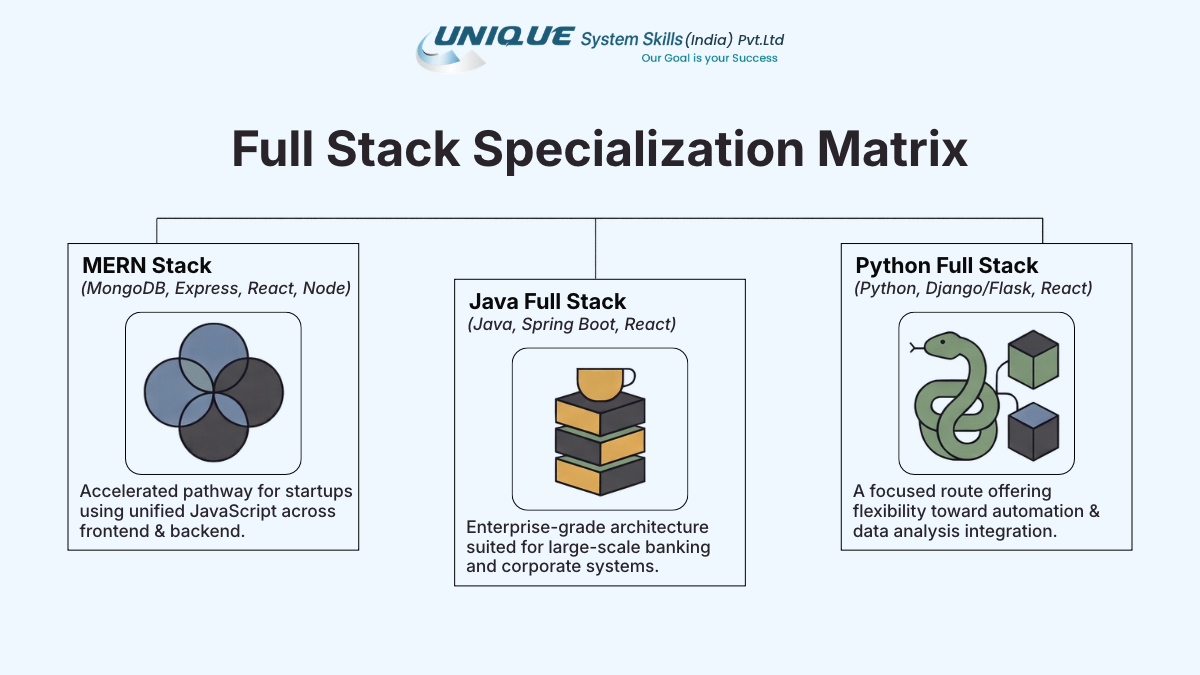
Compare MERN, Java and Python full stack development paths by core technologies and application focus.
Why Unique System Skills Is on Many Lists for a Frontend Training Institute Pune
Unique System Skills (USS) describes itself as Maharashtra’s first USA-headquartered IT training and placement institute, based in Nashua, New Hampshire, with hubs in India, Canada and Bahrain. The institute has 17+ years of experience and 7,000+ placements.
The features that matter most for a front end developer course with placement are the practical ones. Batches are capped at 15 students, so trainers can review your code one to one. The Kothrud campus has live labs, and online and hybrid options include live classes, recordings and doubt-clearing labs. The programme follows an 80:20 practice-to-theory split with 10+ projects, and learners get a Course Completion Certificate and an Industry Internship Certificate. For careers, USS lists 1,000+ hiring partners, including Infosys, Capgemini, Cognizant, TCS and Accenture, along with resume help for ATS filters, mock interviews, 1:1 doubt sessions and campus drives. It also points to alumni placed at firms such as Persistent Systems, with one package reaching ₹16.5 LPA.
Whether it is the best frontend developer course with placement for you depends on your goals, schedule and budget. Once your frontend base is strong, you may ask what to learn next.
What to Learn Next: Full Stack and AI
Most people who finish a front end development course with placement support soon ask about the other half of an app. If you want to build complete products, the Java Full Stack Course in Pune at USS takes your skills into server-side work and databases, which opens more job roles. If you are curious about the AI tools now built into every code editor, the AI Fundamentals Course in Pune explains how they work and where they fail.
Neither one is a must on day one. A sensible path is to get your first frontend job, learn on the job for a year, and then add backend or AI skills when you know what your team needs.
What Can You Earn After Frontend Development Training with Placement?
Salary numbers differ a lot by source, so it is safest to compare several. Here is what 2026 data shows for India:
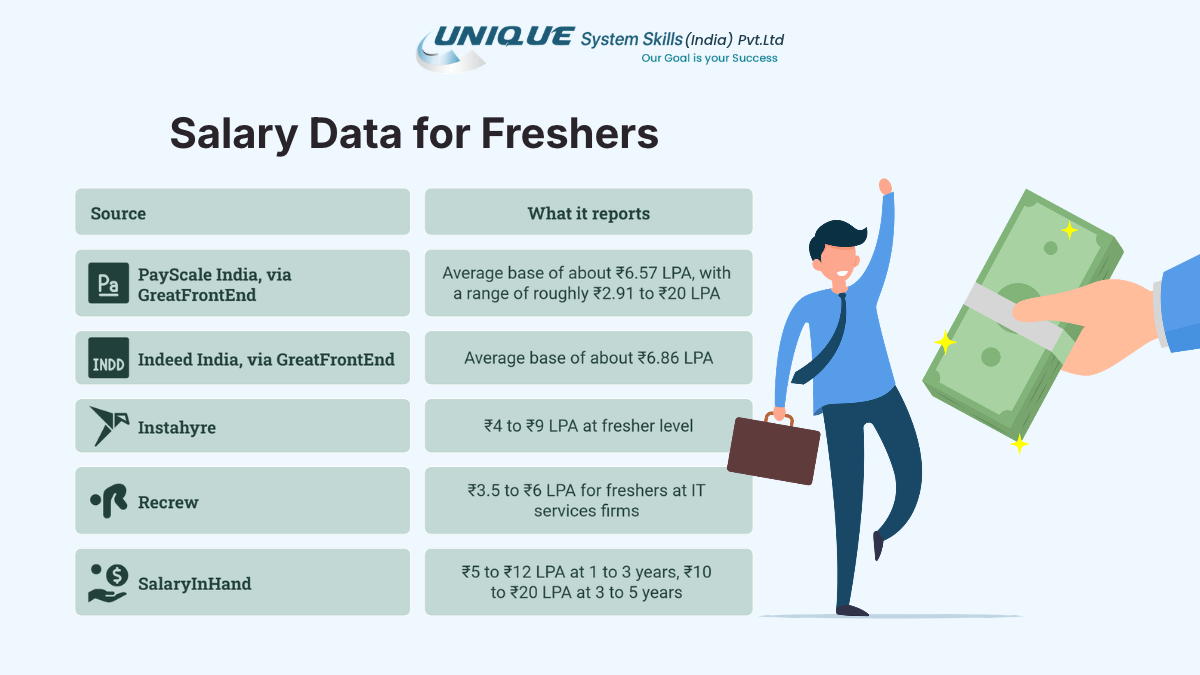
Reported developer salaries in India from five sources, covering fresher pay, overall averages and experience-based ranges.
Freshers at IT services firms often start around ₹3.5 to ₹6 LPA, product companies and global capability centres pay more, and mid-level engineers with React and TypeScript skills can reach double digits within a few years. Entry titles usually include Frontend Developer, UI Developer, React Developer or Software Trainee.
This is where a front end developer course with placement earns its value. It rarely changes the market’s pay scale, but it can change which pay band you land in and how fast you get your first offer. Pay also grows with the skills you add.
The Verdict: Is It Worth It?
If you will show up regularly, build projects and ask questions, a front end developer course with placement is one of the more practical ways into IT in 2026. It saves you from tutorial hell, gives you mentors and mock interviews, and puts your portfolio in front of real recruiters. What you need to know is that a frontend developer course with placement is a guided launchpad and not a shortcut.
With that effort and the right support, you can go from curious beginner to confident developer sooner than you think. Imagine what one live project can do for your next interview. Your journey with a front end developer course with placement starts with that first small step.
FAQs
Is frontend developer course with placement worth it?
Yes, for most beginners it is worth it if you practise daily through live projects and mentor feedback. Entry pay at IT services firms often starts near ₹3.5 to ₹6 LPA and grows as you add skills.
Can I become a frontend developer without a degree?
Yes. Many employers care more about what you can build than about your degree. A portfolio of 3 or 4 live projects, clean GitHub code and clear interview answers can open doors.
How long does it take to become a frontend developer?
Most beginners need about 4-6 months of steady daily practice to reach job-ready basics in HTML, CSS, JavaScript and React. Your pace and schedule change it. This process can be more structured with the Java Full Stack Course in Pune offered by Unique System Skills.
Which frontend course is best for beginners?
The best beginner course starts from zero and teaches HTML, CSS, JavaScript, React and Git in order, with small batches and live projects. A good HTML CSS JavaScript course with placement that adds mentor feedback is a safe start, and the React developer course with placement stage should come after the basics.
Does frontend developer course provide placement?
Many do, but promises differ. Good ones offer resume help, mock interviews and hiring drives because no one can honestly guarantee a job. USS lists 1,000+ hiring partners and 7,000+ placements.
What skills are needed for frontend developer jobs?
Core skills are HTML, CSS, JavaScript and React, plus Git, responsive design, API use and basic testing. Clear communication also matters. Knowing how AI tools work helps too. The AI Fundamentals Course in Pune is a good start.
