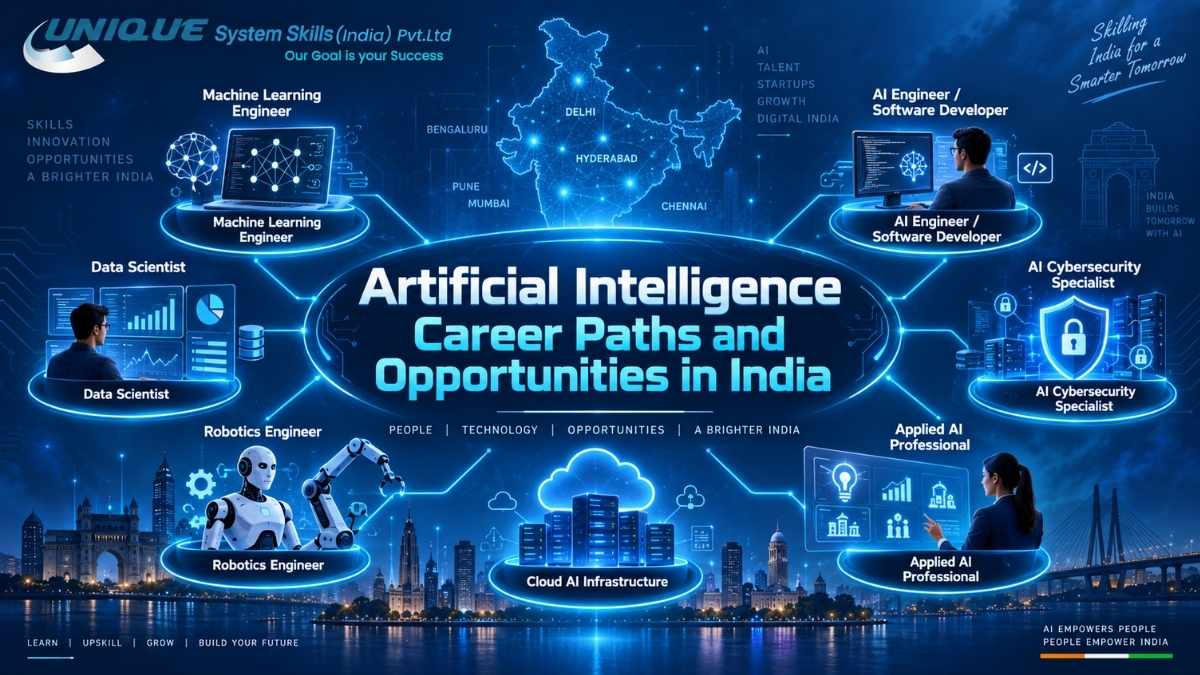
Picking a career path in technology feels harder than ever right now. Even though. artificial intelligence comes up in almost every hiring report and every industry conversation, most students and working professionals in India don’t know what a real artificial intelligence career actually look like day to day. This unclarity is also present when it comes to the skills it needs, and how to pursue it.
If you have been asking yourself these things, this guide gives you an honest, practical map of the artificial intelligence career paths. We also discuss what the industry is actually hiring for India today, and what you need to do to get ready for them. We also explore how the right training can help you follow the fastest and the safest path such that the skills you learn actually translate into a job offer.
Understanding Artificial Intelligence Career Paths
India is home to 16% of the world’s AI talent and already has more than 600,000 active AI professionals, according to NASSCOM’s 2026 AI Workforce Report. The country will need close to 1.25 million AI professionals within the next 2 years.
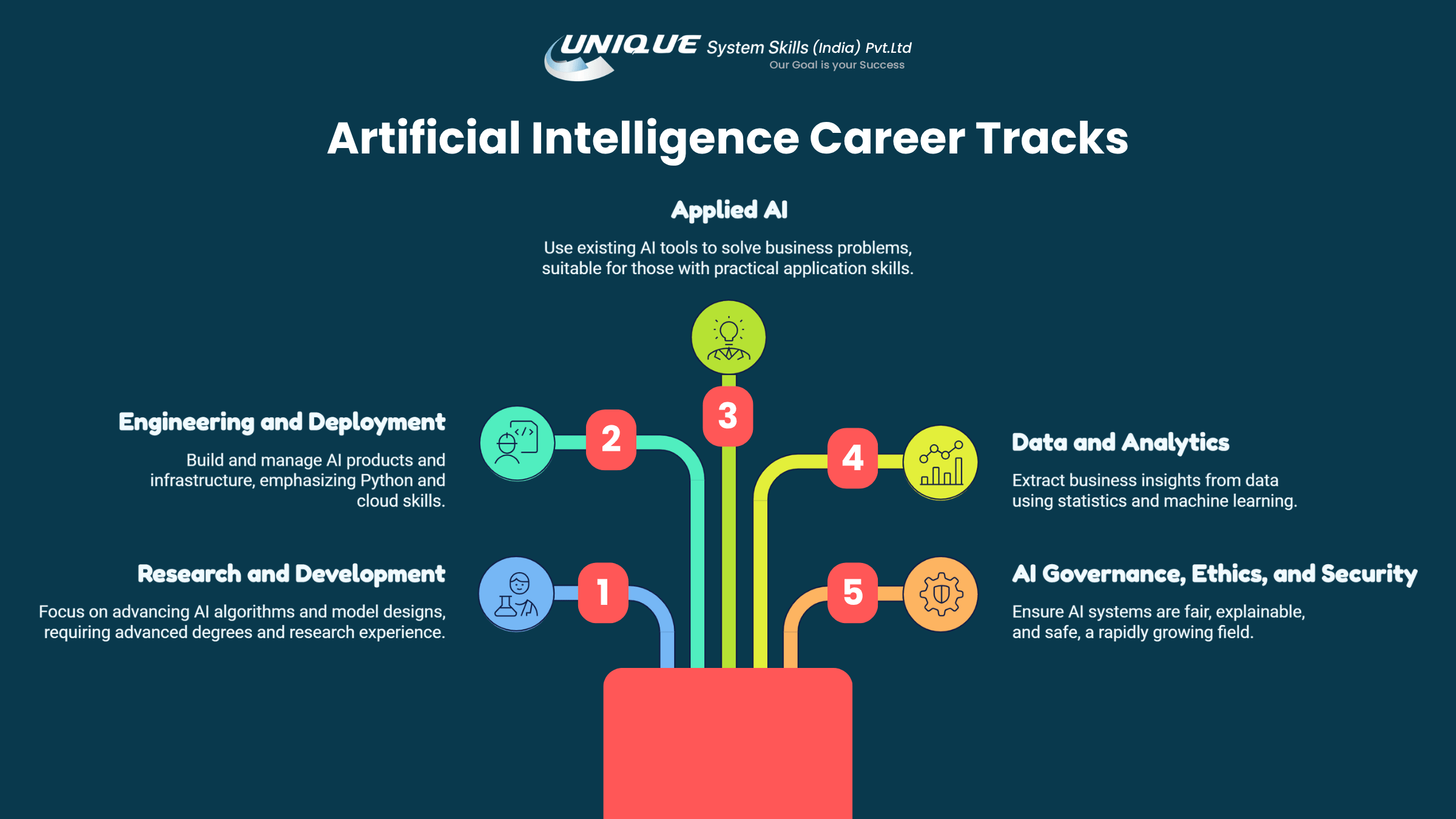
different Artificial Intelligence career tracks, from AI research and engineering to applied AI, data analytics, and responsible AI governance.
Despite the gap, a big misunderstanding about an artificial intelligence career is that it means one single job. Artificial intelligence career paths cover a wide range of work. This includes:
- Building the models that power AI systems
- Using those models to put them into real products
- Using AI insights for business decisions
- Protecting AI systems from attackers
Broadly, artificial intelligence career options in India in 2026 fall into 5 main tracks.
The Research and Development track:
This track works on advancing the field itself with new algorithms, model designs, and training methods. It usually needs a Master’s or PhD and is found mostly at research labs, universities, and the R&D arms of large tech companies.
The Engineering and Deployment track:
This track takes AI models and turns them into working products like building APIs, managing servers that run models, and setting up MLOps pipelines. This is the fastest-growing and most reachable track, and it leans more on strong Python and cloud skills than research-level math.
The Applied AI track:
This track uses existing AI tools to solve real business problems, such as recommendation engines for online stores or risk models for banks.
The Data and Analytics track:
This track turns data into business insight using a mix of statistics and machine learning.
AI Governance, Ethics, and Security track:
This is the newest and fastest-growing track of all. Professionals in this field makes sure AI systems are fair, explainable, and safe from attack.
Each track leads to a genuinely different job, pay range, and long-term direction. The right one depends on what you enjoy building and what you want your workday to look like.
Career in Artificial Intelligence and Machine Learning
The most direct and best-known career in artificial intelligence and machine learning is the engineering track which involved building, training, testing, and deploying the models that power real products. In India in 2026, this track brings the steadiest hiring volume and some of the strongest pay for experienced engineers.
An ML Engineer or AI Engineer works across the whole life of a model. They clean and prepare training data, choose the right method, check how well the model performs against real business goals, and launch working models as APIs or cloud services. In 2026, this job increasingly expects comfort with generative AI. This involves understanding how large language models work, how to build RAG pipelines that connect an LLM to a company’s own knowledge base, and how to use open-source models through platforms like HuggingFace.
Entry-level AI and ML engineers in India start around ₹6–14 LPA at product companies and global capability centres. Engineers with 3-5 years of focused experience earn ₹14–28 LPA, and senior engineers who specialise deeply in generative AI, computer vision, or NLP can earn ₹30–60 LPA or more at top firms.
Career in Artificial Intelligence in India
Not every career in artificial intelligence in India means building models from scratch. 2 related tracks, namely Applied AI and Data Analytics, offer equally strong and well-paid paths for people whose strengths lie in analysis and business problem-solving.
The Applied AI track is for professionals who use ready-made AI tools and platforms to solve specific business problems. An Applied AI Specialist is expected to do the following:
- Build a product recommendation engine using a cloud ML service
- Set up an AI pipeline to read customer feedback using an API
- Design a chatbot using a framework like LangChain and a vector database
The focus here is connecting existing AI tools to real outcomes, not inventing new ones. Pay for applied AI roles in India runs ₹8–20 LPA at mid-level, with senior applied AI architects earning ₹25–40 LPA at banking, insurance, and healthcare technology firms.
The Data Analytics and AI track sits between data science and business intelligence. Data Analysts and BI Engineers here use SQL, Python, Power BI, and statistics to turn raw numbers into dashboards and predictions that business teams can act on. India’s data analytics market is expected to cross $22 billion by 2030, and every sector generating data now needs these professionals.
Careers in Robotics and Artificial Intelligence
One of the most exciting corners of artificial intelligence career opportunities in India is the mix of robotics and AI. Careers in robotics and artificial intelligence are growing fast as factory automation, self-driving vehicles, medical robots, and smart infrastructure projects pick up speed across the country.
Government programmes like the Production Linked Incentive scheme and the semiconductor mission are pushing more investment into domestic robotics and automation. Companies such as KPIT, Tata Motors, and Mahindra, along with a growing number of AI-first startups, are hiring teams that combine embedded systems, computer vision, reinforcement learning, and ROS skills.
The skill base for careers in robotics and artificial intelligence usually combines solid math, Python and C++, computer vision with OpenCV, and reinforcement learning for decision-making. This is one of the toughest artificial intelligence career paths to break into, but also one of the best paid with typically ₹15–40 LPA at specialist firms and global automotive tech companies with India teams.
Cyber Security vs Artificial Intelligence Career
Among Indian IT professionals and students, when choosing or changing careers, a choice between the cyber security vs artificial intelligence career often comes up. Both fields are growing fast, both are short on skilled people, and both pay well over the long run. It helps to understand the real differences, and the growing overlap, rather than treating this as an either-or choice.
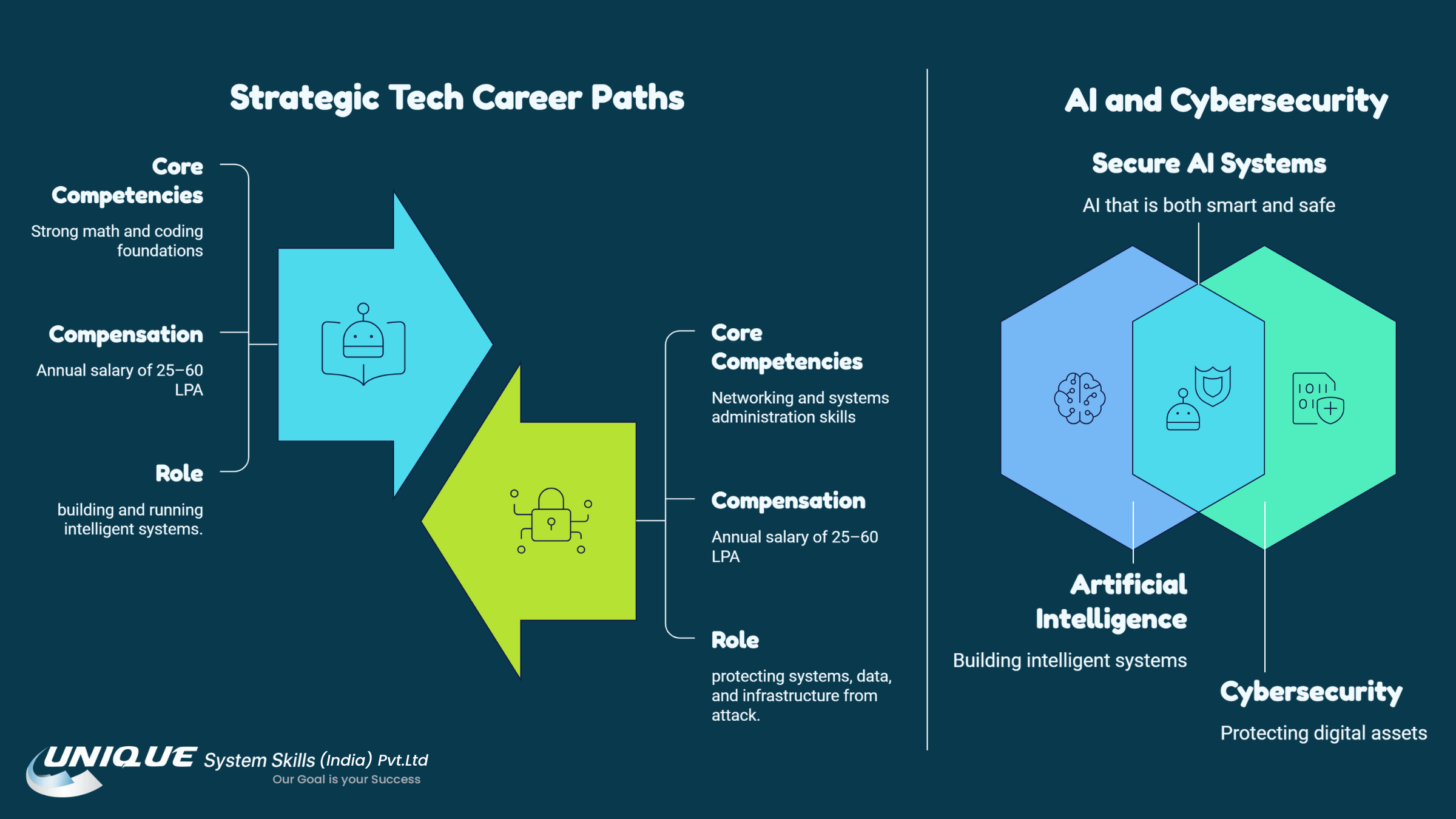
career opportunities in artificial intelligence and cybersecurity, including required skills, roles, salary expectations, and the importance of securing intelligent systems.
What makes the cyber security vs artificial intelligence career question more interesting in 2026 is how much the two fields now overlap. AI for cybersecurity is one of the fastest-growing specialisms in Indian IT — using machine learning to spot threats, using LLMs for faster incident response, and building defences into AI systems against attacks like model poisoning and prompt injection. Professionals who are comfortable in both areas are rare, and they are paid accordingly.
Artificial Intelligence Career Opportunities Across Industries
Looking at artificial intelligence career opportunities industry by industry helps you prepare for a real job instead of a generic “AI role” that doesn’t actually exist. Each industry uses AI differently, at a different level of maturity, and needs different skills.
BFSI (banking, financial services, and insurance):
This industry hires the most AI professionals in India by volume, using AI for fraud detection, credit risk models, algorithmic trading, compliance monitoring, and customer service. BFSI pays above-market rates because getting it wrong like a missed fraud pattern or a biased credit model, has direct financial and regulatory costs.
Healthcare Technology:
Healthcare is the fastest-growing area for AI use, applying it to diagnostic imaging, patient risk scoring, drug discovery, and health record analysis.
E-commerce and Retail:
This field use AI for recommendations, demand forecasting, supply chain planning, and personalised shopping.
Manufacturing and Automotive Industry:
These are investing in AI for predictive maintenance, quality checks through computer vision, and self-driving systems. Government and public sector bodies, through Digital India and related programmes, use AI for public services, farming advice, and traffic management.
Each industry hires differently, uses different tools, and expects something different from an AI professional on day one.
Career Scope in Artificial Intelligence
The career scope in artificial intelligence in India is wider and more lasting than almost any other tech field, because AI is a skill that every industry is weaving into its core work. AI skills stay valuable no matter which sector you join, which company you work for, or which tool becomes popular 3 years from now.
Building a career here in 2026 needs a clear plan:
- Move step by step through Python, data handling, statistics, machine learning, deep learning, and finally generative AI and LLM integration.
- Build a real portfolio of projects that show deployed models, working RAG pipelines and live AI apps.
Recruiters at global capability centres and product companies are now more likely to ask for a GitHub link than a stack of certificates.
If you want to build this foundation with structured, hands-on training, Unique System Skill’s Data Science with AI Training covers the full path from Python and statistics through deep learning, NLP, and generative AI. For related skills, we also offers AWS with DevOps for cloud-based AI deployment, Java Full Stack for building AI-powered applications, Software Testing with Playwright for AI and automation testing, Digital Marketing for AI-driven marketing roles, Data Analytics, Cybersecurity Training, and an AI Fundamentals Course for beginners. Each of these artificial intelligence career paths is can transform into a well-paid specialism.
The Artificial Intelligence Career Decision
The most useful thing you can do right now is take an honest look at where you are starting from, and match that to the artificial intelligence career roles open to you.
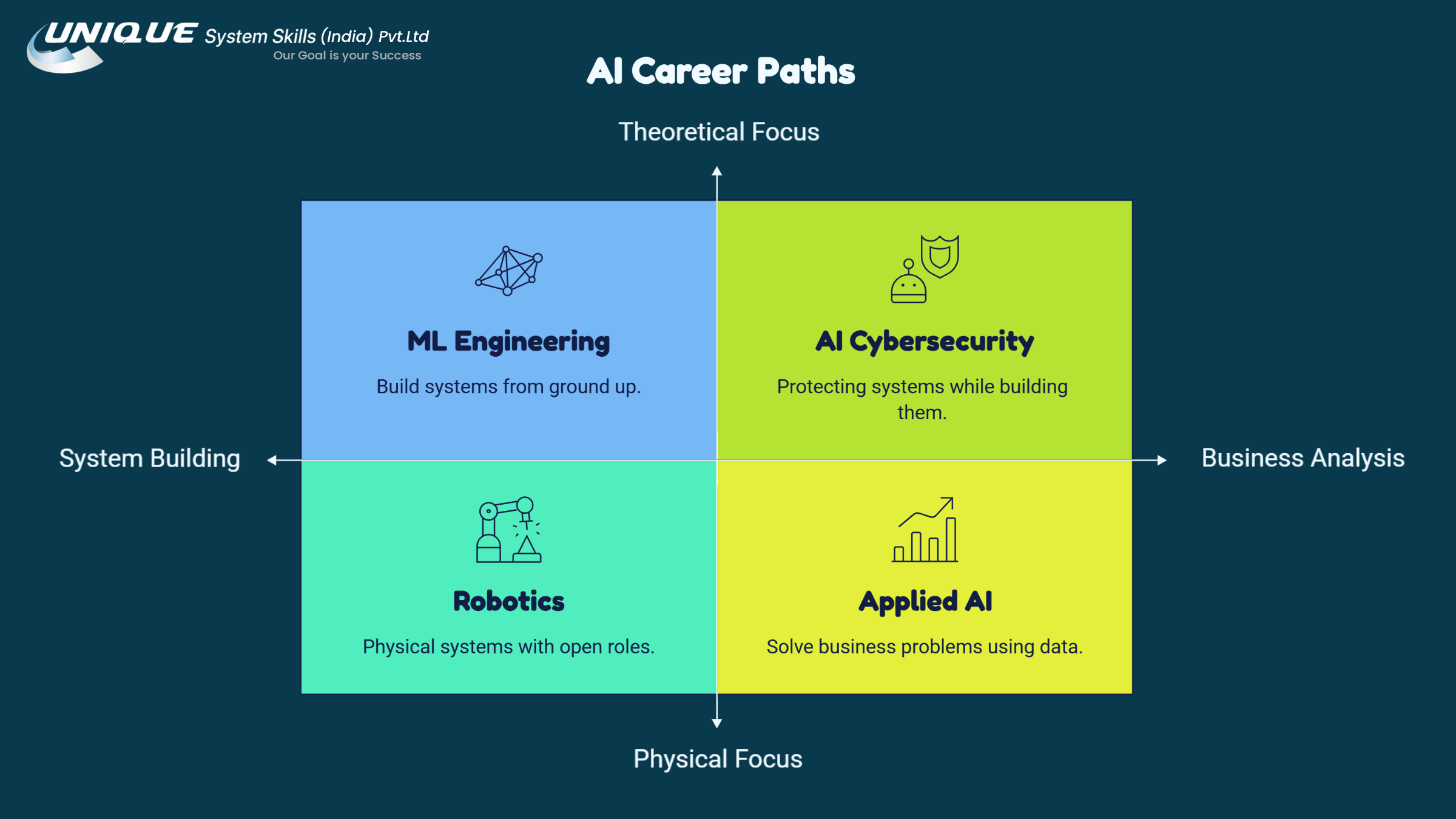
Explore different AI career pathways, including machine learning engineering, AI cybersecurity, robotics, and applied AI based on technical focus and business applications.
If you have strong math skills and enjoy building systems from the ground up, the ML engineering and research tracks will reward you the most directly. If your strength is analysis and solving business problems, the applied AI and data analytics tracks will put your skills to work faster and get you employed sooner. If you’re drawn to protecting systems as much as building them, the AI cybersecurity track is one of the most future-proof profiles in the Indian market today. And if robotics and physical systems interest you, that field has never had more open roles compared to the people qualified to fill them.
With such diversity in the artificial intelligence career paths, getting into this growing field becomes easier and with a structured industry aligned curriculum offered by Unique System Skills, that journey becomes a cakewalk.
Frequently Asked Questions
How to start a career in Artificial Intelligence?
Start with Python programming, then build up through data handling, statistics, and machine learning basics before moving into deep learning and generative AI. Alongside learning, build a portfolio of real projects, such as a deployed model or a working RAG pipeline, since recruiters increasingly want to see a GitHub profile rather than just certificates. A structured, hands-on AI Fundamentals Course can help you follow this path in the right order, and if you want to go deeper into applied ML and generative AI, the Data Science with AI Training builds on those fundamentals.
How can I start a career in Artificial Intelligence?
Begin by deciding which track fits you:
- if you enjoy deep technical building, aim at ML engineering through a course like Data Science with AI
- if you prefer business problem-solving, look at applied AI or the Data Analytics Course.
- From there, build core skills in order (Python, statistics, machine learning, deep learning, and generative AI) and pair the learning with real, deployable projects so you have proof of skill.
Unique System Skill’s AI Fundamentals Course is designed to walk you through exactly this sequence.
What career options are available after learning Artificial Intelligence?
After building AI skills, you can move into ML/AI Engineer roles (via the Data Science with AI Training), Applied AI Specialist roles, Data Analyst or BI Engineer roles (via the Data Analytics Course), AI-focused robotics roles, or AI governance and security roles (via the Cyber Security Course).
Many AI professionals also pair their skills with cloud deployment knowledge from the AWS with DevOps Course or full-stack development from the Java Full Stack Course to build and ship complete AI-powered applications.
What are the top career opportunities in Artificial Intelligence?
The strongest current opportunities are in engineering and deployment, applied AI roles connecting AI tools to business outcomes, AI in cybersecurity, and robotics-AI roles in autonomous vehicles and manufacturing automation. BFSI and healthcare technology are the industries hiring AI talent most aggressively right now.
What is the career scope of Artificial Intelligence in India?
The career scope in artificial intelligence in India is unusually wide and durable because AI skills stay valuable regardless of the sector, company, or specific tools you end up working with, as long as you keep the underlying Python-to-generative-AI skill stack current. Starting with the AI Fundamentals Course and layering in specializations like Data Analytics or Digital Marketing (for AI-driven marketing roles) keeps that skill stack broad and current.
What are the best career opportunities in Artificial Intelligence and Machine Learning?
The best opportunities are in the ML/AI Engineering track, where entry-level professionals start at ₹6–14 LPA, mid-level engineers with 3-5 years of experience earn ₹14–28 LPA, and senior specialists in generative AI, computer vision, or NLP can earn ₹30–60 LPA and above, especially at product companies and global capability centres. The Data Science with AI Training is built specifically to prepare learners for this track, and pairing it with the Software Testing with Playwright Course can open doors into AI-driven test automation roles as well.
Cybersecurity vs Artificial Intelligence: Which is a better career in India?
They suit different strengths and pay comparably at senior levels (₹25–60 LPA and above for both). AI careers need stronger math and coding foundations, built through courses like the AI Fundamentals Course or Data Science with AI Training, while cybersecurity needs stronger networking and systems administration foundations, covered in the Cyber Security Course. The two fields are increasingly converging through AI-driven threat detection and defence against attacks on AI systems, so professionals who build skills in both are especially rare and well-rewarded.