For a Fresher, walking into a QA interview for the first time can feel like standing at the edge of a pool without knowing how deep it is. You’ve read the theory, maybe even practiced a few mock rounds, but the moment an interviewer asks you to connect concepts on the spot, the nerves do take over. Most testers feel the same uncertainty before facing a fresh set of software testing interview questions. The good news is that this uncertainty almost always comes down to a student not knowing which concepts you might be asked about and not having a clear enough grasp of how they connect to each other. A good training course, like the ones offered by Unique System Skills, covers this base right from the beginning with a strong focus on technical and soft skills needed to clear such interviews.
This guide is built to close that gap. Rather than listing definitions in isolation, it walks through how testing concepts build on one another. This includes fundamentals that every software testing interview questions list starts with, along with the strategic thinking senior QA leads are expected to demonstrate. By the end, you’ll have a working mental map of the entire testing lifecycle, and be able to move from being a nervous candidate into a confident one.
Software Testing Fundamentals
Every strong answer in a QA interview traces back to a handful of core ideas, which is why software testing fundamentals are almost always the opening act of any set of software testing interview questions. Quality assurance itself is process-oriented and preventive. It’s the set of practices that stop defects from being created in the first place. Software testing, in contrast software building, is the functional checkpoint where programmers catch what had slipped through. Understanding this distinction early sets up almost everything else you’ll be asked.
The next fundamental most interviewers’ probe is the difference between Verification and Validation.
Verification: This happens on paper with reviews, walkthroughs, and inspections of specifications and designs. Verification asks, “are we building the product right?”.
Validation: This happens on a running build with actual test execution against real user scenarios. Validation asks, “are we building the right product?”
Once you can explain that distinction cleanly, you’re ready for the next layer which explores how these activities map onto the Software Development Life Cycle (SDLC) and Software Testing Life Cycle (STLC). This is a shift from requirement analysis and test planning through test case design, environment setup, execution, and closure. Getting comfortable with this full sequence is what allows a candidate to move confidently from theory into the more hands-on, scenario-based questions that come next.
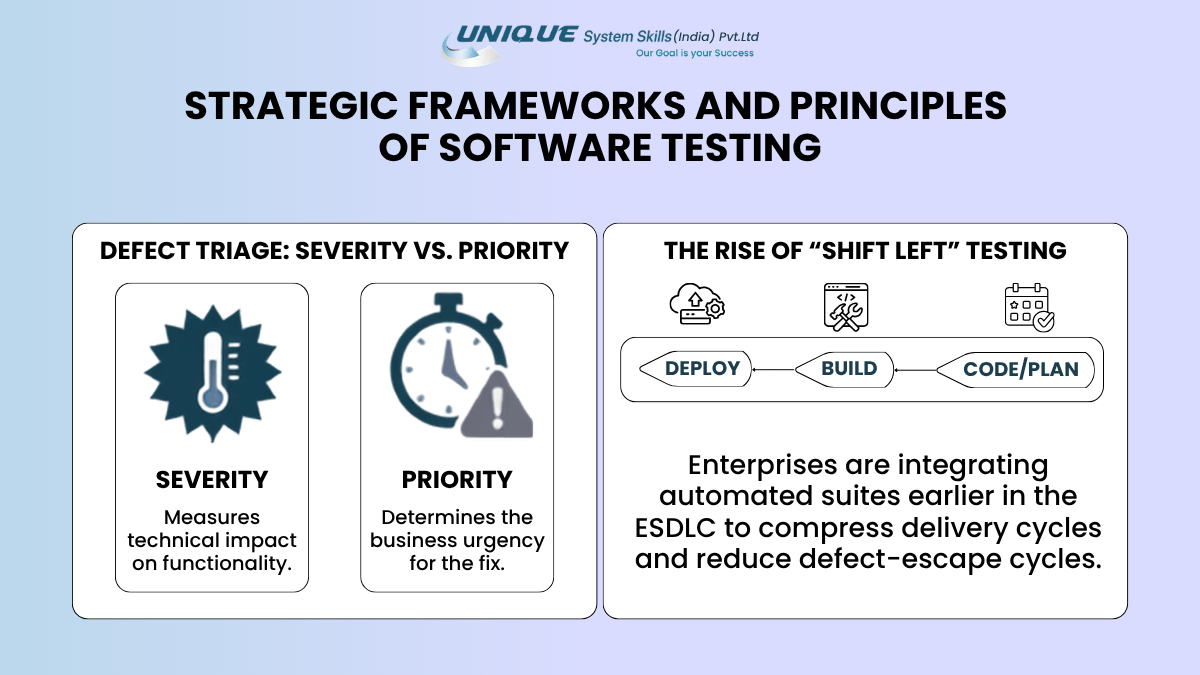
Key software testing strategies explaining defect severity, priority assessment, and the role of shift-left testing in improving software delivery.
Manual Testing Interview Questions for Freshers
If you’re starting out, the manual testing interview questions for freshers you’ll face are designed to check one thing above all.
Do you understand why manual testing still matters in a world full of automation tools?
The programmer worldwide understands that exploratory testing, ad-hoc checks, and usability judgment simply cannot be scripted. A human tester notices when something feels wrong on a screen in a way no automation suite can. Interviewers want to see that you grasp this before they trust you with anything more complex.
From there, the conversation usually moves to structure. You need to know the difference between the following:
- A high-level test scenario – example: ‘explain how verify login works’.
- A detailed, repeatable test case – example: ‘tell me the exact steps, test data, and expected results in the process you use’.
This distinction matters because it’s the backbone of consistent testing across a team. Anyone should be able to pick up your test case and execute it the same way you would.
Naturally, this leads to the next skill freshers are tested on:
What actually counts as a bug, and how do you write one up?
- A strong bug report is objective, reproducible, and specific
- A Vague reports waste a developer’s time and slow the whole release down.
Once you can write a clean bug report, you’re ready to be evaluated on how well you verify actual product requirements, which is where functional testing comes in.
Functional Testing Interview Questions
Among the most common software testing interview questions asked at this stage are the functional testing interview questions, which almost always start with the basics of input-output validation with questions like:
- Does a login form authenticate correctly?
- Does a checkout page total the cart properly?
- Does a search bar return relevant results?
These are the everyday transactions users depend on, and functional testing exists to confirm they hold up.
A closely related idea interviewers love to probe is positive versus negative testing.
- Positive testing confirms how valid inputs produce the expected outcome.
- Negative testing checks that invalid inputs are handled gracefully, with clear, descriptive error messages instead of a confusing crash.
Together, these two angles tell you whether a feature is truly production-ready or just working under ideal conditions.
The last piece of this puzzle is traceability which in simple terms means how do you prove that every requirement actually has a test behind it. This is where the Requirement Traceability Matrix (RTM) comes in, mapping each product requirement back to its corresponding test cases so nothing slips through unnoticed. Once you’ve covered functional depth, interviewers typically shift the conversation toward how you handle testing when the requirements themselves aren’t so clean.
Manual Testing Interview Questions for 3 Years Experience
Manual testing interview questions for 3 years experience is one of the most searched categories of software testing interview questions in India. This is because by the time you’re facing these, interviewers assume you already know the fundamentals which means what they’re really testing now is judgment under imperfect conditions. One of the most common questions at this stage:
How do you test a product when specifications are incomplete or still changing?
This involves collaborating closely with product owners, relying on domain knowledge, and documenting your assumptions so the team stays aligned even without a finished spec.
This leads into test design strategy, where two techniques come up again and again:
Equivalence Class Partitioning (ECP): ECP groups inputs into valid and invalid classes so you only need to test one representative value per group. For example, for an age field accepting 18 to 60, you’d test one value below 18, one within range, and one above 60.
Boundary Value Analysis (BVA): BVA then sharpens that further by focusing on the exact edges, since developers frequently make small comparison errors (using < instead of <=) that cause bugs to cluster right at the boundary.
Together, these two let you cover a massive input space with a handful of smart, targeted test cases. The final concept at this experience level is knowing exactly when to retest a fixed defect versus when to run a full regression suite to check that the fix hasn’t broken anything else.
Manual Testing Interview Questions for 10 Years Experience
Manual testing interview questions for 10 years experience you’ll facestop being about individual test cases altogether and start being about strategy. At the 10-year mark, interviewers want to know how you decide what to test first when a release timeline is tight. This always centers on risk-based testing, where you prioritise test coverage around the features most likely to cause serious business impact if they fail, rather than treating every feature as equally important.
Alongside strategy comes measurement. Senior QA professionals are expected to speak comfortably about metrics like Defect Detection Percentage (DDP), Defect Removal Efficiency (DRE), and Root Cause Analysis (RCA) as tools that reveal whether your process is actually improving release after release. And because almost no serious QA team operates outside agile today, this level of interview also expects you to describe how testing fits into sprint planning, backlog refinement, and daily triage. This involves a continuous feedback loop back into the development cycle rather than testing in a silo at the end. When it comes to software testing questions, this strategic, process-level fluency is exactly what separates a senior tester from someone who has simply been testing for a long time.
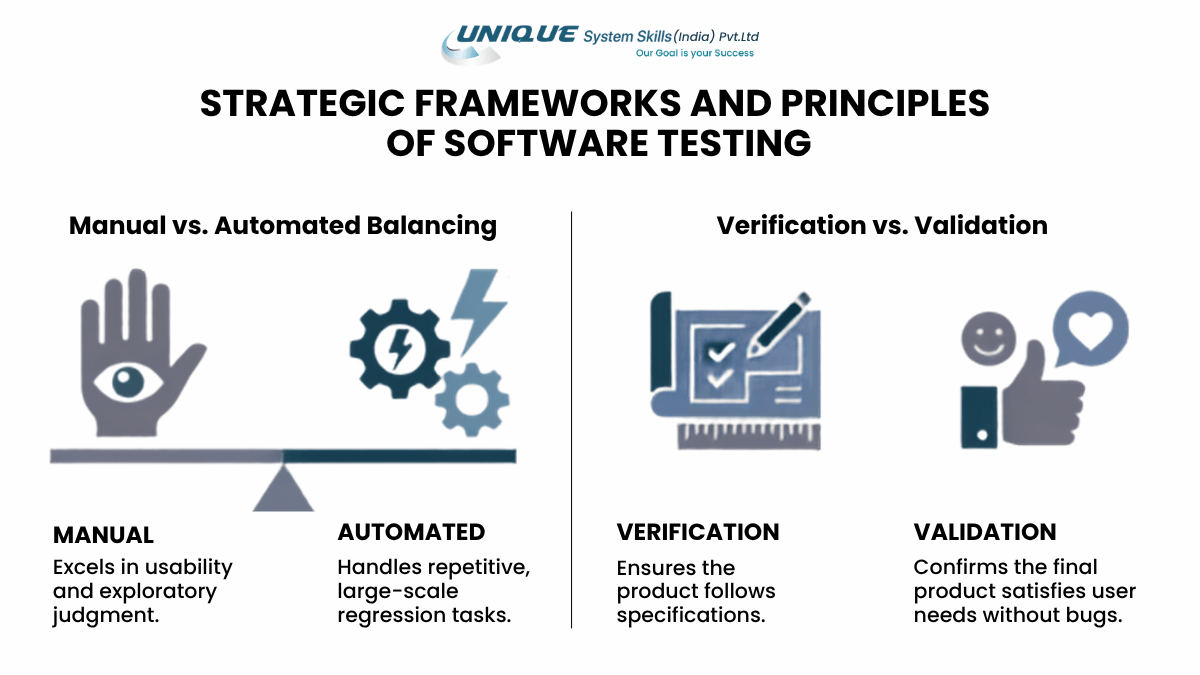
Overview of key software testing principles, including the balance between manual and automated testing and the difference between verification and validation.
Testing Interview Questions for Experienced Professionals: Going Deep on Technical Mechanics
The most demanding testing interview questions for experienced candidates dig into mechanics that only show up in complex systems. What interviewers are really testing for here of if you can see through the defect cascading effect where a single bug in one module quietly triggers failures in every module that depends on it. You should be able to trace a symptom back to its true origin, rather than just patching the visible failure.
Database testing is another area of focus. Writing SELECT, UPDATE, DELETE, and JOIN queries to validate front-end inputs directly against the underlying tables shows that you can verify data integrity beyond what the UI displays.
From there, the conversation naturally moves toward release readiness. Here, the interviewer expects you to demonstrate how you define exit criteria, write a formal test closure report, and coordinate User Acceptance Testing (UAT) cycles before giving sign-off.
Getting comfortable with this end-to-end view is what prepares you for the final, forward-looking category of questions.
Software Testing Job Interview Questions and Answers
No modern set of software testing job interview questions and answers is complete without a conversation about where the field is going
Global Market
The global software market is projected to grow from roughly USD 926 billion in 2026 to over USD 2.2 trillion by 2034, and within that, the automation testing market alone is expected to reach close to USD 79 billion by 2031.
India Market
In India, software testing market size has already reached USD 54.44 billion in 2026 and is projected to climb to USD 99.94 billion by 2031, advancing at a 12.92% CAGR. In 2025, automation testing held 42.53% of software testing market share, while AI-augmented and autonomous testing platforms are set to expand at a 13.16% CAGR to 2031.
This growth is being driven by cloud-native architectures, microservices, and increasingly AI-assisted automation. This is why interviewers today expect candidates to speak about tools like Playwright, Selenium, and Postman alongside traditional manual concepts.
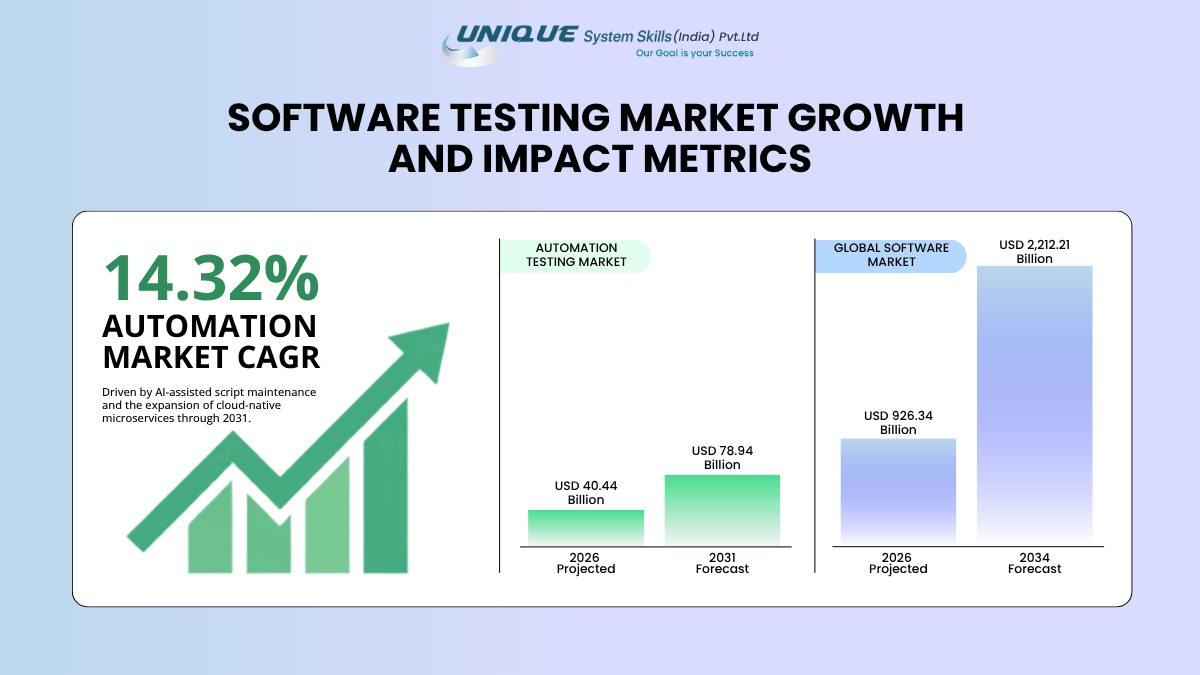
Software testing market trends highlighting automation testing growth, projected market values, and global software industry expansion.
Prep Right for the Software Testing Interview Questions
With the diverse complexities at each level, when preparing software testing interview questions, the right, structured training genuinely pays off. Testers looking to build real automation depth can start with the Software Testing Playwright Course, which focuses on the fast, parallel browser automation skills that modern CI/CD pipelines demand. For those who want to understand the backend logic behind the applications they test the Java Full Stack Course builds that structural foundation. And since AI-driven test maintenance and self-healing scripts are becoming a real interview topic, the AI Fundamental Course introduces the generative AI and LLM concepts now shaping the next generation of testing tools. Testers curious about the data side of quality engineering can also explore the Data Science with AI Training or the Data Analytics Course to round out a broader, future-ready skill set.
Bringing It All Together
Preparing for software testing interview questions and answers was never really about memorising definitions. It’s about understanding how each concept supports the next, from the basic idea of verification versus validation all the way through to strategic, metrics-driven QA leadership. Once you can hold that full picture in your head, individual questions stop feeling like traps and start feeling like natural extensions of what you already know.
In 2026, you need to walk into your next interview not bracing for a surprise question, but recognising it as just another piece of a framework you’ve already mapped out. That shift is what turns preparation into real confidence, and it’s within reach for any tester in India willing to put in the structured effort to get there.
FAQ Answers
Q1. What software testing job interview questions and answers should candidates prepare?
Preparing effectively for software testing job interview questions and answers requires understanding that interviews in India in 2026 are structured in clear layers. The Fundamentals like the difference between QA and software testing or severity and priority in defect classification are asked at every level. This is followed by the next year, which includes questioning the functional and manual testing depth. Functional testing questions focus on input-output validation. The key software testing job interview questions and answers at this layer include:
- What is positive vs negative testing?
- How do you write a test case for a login page?
- What is an RTM (Requirement Traceability Matrix) and why does it matter?
In the third layer, the Interviewers, especially those at product companies and GCCs, routinely ask about Playwright and Selenium, API testing with Postman, and CI/CD integration basics. As Senior candidate, you will arrive at the 4th layer, where you are expected to demonstrate awareness of where the industry is heading.
To build all four layers systematically, USS’s Software Testing with Playwright Course covers fundamentals through automation in a live-lab, placement-focused structure. For broader technical depth, the Java Full Stack Course adds the backend understanding that QA engineers who test APIs and services genuinely need.
Q2. What are the top software testing job interview questions and answers?
The top software testing job interview questions and answers fall into 5 categories. Mastering these will cover the majority of what any Indian QA interview throws at you.
- SDLC vs STLC: This covers the full product journey. The Software Testing Life Cycle is a subset describing only the testing phase which includes the requirements analysis, test planning, test case design, environment setup, test execution, and test cycle closure. The insight that earns strong marks is explaining that STLC runs in parallel with and feeds back into SDLC.
- Verification vs Validation: Verification includes reviews, walkthroughs, and inspections that happen before code execution. Validation includes actual test execution on a running build against real user scenarios.
- Severity vs Priority: Severity describes the technical impact of a defect on the system. Priority describes the urgency with which it needs to be fixed.
- Positive vs Negative Testing: Positive testing confirms that valid inputs produce the expected outcome. Negative testing confirms that invalid inputs are handled gracefully with clear error messages rather than a crash or data corruption.
- The Bug Report Question: A complete, professional defect report includes a specific, descriptive title; numbered reproduction steps; expected result clearly separated from actual result; severity and priority classification; build version and test environment details; and attached evidence (screenshot, video, or logs).
For candidates who want to prepare these through live practice rather than reading, USS’s Software Testing with Playwright Course includes structured mock interviews.
Q3. What are the basic software testing fundamentals?
Software testing fundamentals are the conceptual foundation on which every interview question is built. Here are the core fundamentals that every QA professional must know deeply, not just definitionally.
Quality Assurance vs Software Testing: Quality Assurance is process-oriented and preventive. It is the set of practices that prevent defects from being created in the first place (process audits, standards enforcement, review processes). Software testing is product-oriented and detective. It finds defects that have already been created.
Verification and Validation: Verification checks that development artefacts meet their intended standards while validation checks that the delivered product meets the actual user need.
Types of Testing:
- Smoke testing: run after a new build to verify basic system stability before deeper testing begins
- Sanity testing: run after a specific bug fix to verify the fix works without breaking adjacent functionality.
- Regression testing: run after any code change to verify that existing features continue working. Exploratory testing: unscripted, relies on the tester’s analytical thinking to find defects that scripted tests miss.
Equivalence Partitioning and Boundary Value Analysis: Equivalence Partitioning groups inputs into valid and invalid classes so you test one representative from each group rather than every possible input. Boundary Value Analysis focuses on the exact boundary values where developer errors most commonly occur.
Q4. What manual testing interview questions are asked for 3 years of experience?
Manual testing interview questions for 3 years’ experience are usually about evaluating judgment under imperfect conditions with the following question:
- How do you test a product when specifications are incomplete or still changing?
- Explain your test design approach using Equivalence Class Partitioning and Boundary Value Analysis.
- When do you retest a defect versus run a full regression suite?
- How do you handle a developer who rejects your defect as ‘works as designed’?
- How do you estimate testing effort for a new feature?
Candidates who want to add backend and API understanding increasingly relevant for three-year-level roles at product companies can complement this with the Java Full Stack Course.
Q5. What are the most common testing interview questions and answers?
Conceptual Foundation Questions
Q: What is the difference between smoke testing and sanity testing?
Q: What is a Requirement Traceability Matrix?
Experience-Level Questions
Q: How do you approach regression testing under deadline pressure?.
Q: What metrics do senior QA professionals use to measure quality?
Modern Tools and Market Questions
Q: Why has Playwright largely replaced Selenium in modern testing stacks?
Q: What is the growth trajectory of the software testing market in India?
USS’s full testing and technology curriculum provides the preparation infrastructure for all of these question types: the Software Testing with Playwright Course for core QA preparation, the Java Full Stack Course for backend and API depth, the AI Fundamentals Course for AI-assisted testing awareness, the Data Science with AI Training for data quality testing specialisation, and the Data Analytics Course for SQL and data validation skills increasingly required in modern QA technical rounds.