Every week, dozens of students walk into our center in Pune and ask the same question—”Should I start with Core Java or jump straight into Advanced Java?”It’s a fair question. The internet gives you ten different answers, coaching centers give you whichever one sells their current batch, and your college seniors give you whichever one worked for them three years ago.
This article gives you the honest, structured answer. No agenda. No shortcuts. Just a clear breakdown of what Core Java vs Advanced Java actually covers, who needs what, and how to map your learning to a real job in 2026.
“Trying to learn Advanced Java without Core Java is like trying to build the second floor of a house before you’ve poured the foundation.”— Faculty Team, Unique System Skills India, Pune
The Mistake Most Freshers in Pune Are Making Right Now
It happens constantly, and the pattern is almost always the same. A fresher watches a few YouTube tutorials on Spring Boot. The demos look slick, the projects look impressive, and suddenly they’re convinced they should skip the basics and jump directly into the following:
- Spring Boot and REST APIs
- Full Stack development bootcamps
- Advanced frameworks without any Java foundation
At first, everything feels manageable—tutorials make it look easy. Then the interviews start. And suddenly, OOP concepts feel confusing, debugging becomes painful, collections don’t make sense, and backend logic starts to fall apart.
The student hasn’t failed because Java is too hard. They’ve failed because the learning sequence was wrong. This is the most common reason capable students underperform in technical rounds — and it’s entirely avoidable.
The smarter path is simpler: learn Core Java properly first, then move into Advanced Java. That sequence still works best in 2026—and it’s the path followed in every credible core Java course in Pune that actually produces placed developers.
What Is Core Java?
Core Java is the foundation layer of the Java programming language. It teaches you how programming logic actually works before you start building real applications. When you join java classes for beginners, this is what the curriculum should cover:
- Variables, data types, operators, and control flow (loops, conditions)
- Arrays and strings—including the StringBuilder class
- Object-Oriented Programming — classes, objects, inheritance, polymorphism, abstraction, encapsulation
- Exception handling — try, catch, finally, custom exceptions
- Collections framework — ArrayList, HashMap, LinkedList, TreeMap, HashSet
- Multithreading and concurrency basics
- File handling and Java I/O
- Java 8+ features — Lambda expressions, Stream API, Functional Interfaces, Optional
- Basic JDBC — connecting Java to a relational database
Core Java is where students develop problem-solving instincts, logic building, coding structure, and debugging fundamentals. It’s the universal skill every Java developer, whether they build Android apps, backend microservices, or enterprise banking software, uses Core Java every single day.
Without strong Core Java knowledge, Advanced Java becomes harder to learn, harder to debug, and harder to explain in an interview. According to the TIOBE Index, Java has consistently ranked among the top three most-used programming languages globally, which means the fundamentals you build here have real, long-term career value.
What Is Advanced Java?
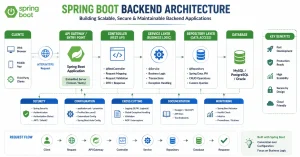
Once Core Java is solid, Advanced Java introduces real application development. This is where Java becomes practical and job-oriented—where you stop writing programs that run in a terminal and start building systems that power actual companies.
A credible advanced Java course in Pune typically covers:
- JDBC — advanced database operations, transactions, stored procedures
- Servlets and JSP — the foundation of Java web development
- Hibernate and JPA — Object-Relational Mapping (ORM)
- Spring Framework — Spring Core (IoC, DI), Spring MVC
- Spring Boot — the dominant backend framework in India’s job market
- REST API development with Spring Boot
- Microservices architecture basics with Spring Cloud
- Maven build tool and dependency management
- Application servers — Tomcat, JBoss
- Web services — REST and SOAP
Once students start building live projects at this stage, confidence changes dramatically. Theory becomes practical. And honestly? That’s when interviews become easier, too.
In any serious advanced Java training in Pune, Spring Boot occupies the largest portion of the curriculum — because that’s what the market demands right now. The moment you mention “Advanced Java” to any technical recruiter, they’re listening for Hibernate, Spring Boot, and REST APIs. That’s where the jobs are.
Core Java vs Advanced Java — Side-by-Side
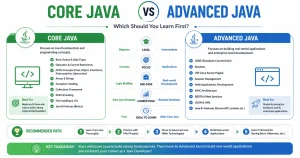
| Parameter | Core Java | Advanced Java |
|---|---|---|
| What it is | The Java language itself | Java frameworks & enterprise technologies |
| Best for | Absolute beginners | Intermediate learners with Java-based |
| Focus | Programming fundamentals & logic | Web, backend & application development |
| Difficulty | Approachable for beginners | More practically, it builds directly on Core Java |
| Prerequisite | Basic programming logic | Solid Core Java — no shortcuts |
| Key topics | OOP, Collections, Multithreading, Streams | Spring Boot, Hibernate, REST API, Microservices |
| Database work? | Basic JDBC only | Yes—deep database connectivity and ORM |
| Job roles | Junior Developer, Automation Tester | Backend Developer, Full Stack Java Developer |
| Avg. time to learn | 2–3 months (structured) | 3–4 months (after Core Java) |
| Salary range (Pune, 2026) | ₹3–5 LPA (fresher) | ₹5–10 LPA (1–2 years exp.) |
| Needed for Spring Boot? | Absolutely—it’s the prerequisite | Yes, this is where Spring Boot lives |
| Can you skip it? | Never | Only if your role truly doesn’t need web/enterprise apps |
The Answer: Always Start With Core Java
If you’re a fresher—a BE/BTech graduate, a BCA or BSc student, an MCA student, or someone switching careers—the answer is always the same: start with Core Java, without exception.
1. Advanced Java is built entirely on Core Java
Spring Boot uses dependency injection — that concept comes directly from Core Java’s object model. Hibernate maps Java objects to database rows — you need a deep understanding of Java classes for that. REST APIs return Java objects serialised as JSON, which requires understanding Java’s type system. Every concept in Advanced Java is an extension of something in Core Java. Without the foundation, you’re memorising steps without understanding them.
2. Interviews test Core Java first—every single time
Walk into any technical interview in Pune—at an IT services firm, a product startup, or an MNC—and the first 20 minutes will be Core Java. OOP concepts, Collection differences, exception handling, multithreading scenarios, and String immutability. Interviewers filter candidates on this before they even get to Spring Boot questions.
Students who skipped Core Java training fail at this stage, regardless of how much Spring they know. Someone may know how to “run” a project but still fail when asked: “Explain polymorphism with a real example.” That’s why fundamentals matter more than most freshers expect.
3. Core Java makes you a better debugger
When your Spring Boot application throws a NullPointerException or a ConcurrentModificationException, you need Core Java understanding to debug it quickly. Advanced Java tools are like power tools — useful only when you understand what’s happening underneath.
Should I learn Core Java or Advanced Java first in 2026? Always start with Core Java. It is the mandatory prerequisite for Advanced Java. Core Java covers OOP, Collections, Exception Handling, and Multithreading—concepts used directly in every Advanced Java framework, including Spring Boot and Hibernate. Attempting Advanced Java without Core Java leads to a shallow understanding, poor interview performance, and slow debugging on the job. Most freshers in Pune need 2–3 months of structured Core Java training before progressing to Advanced Java.
The Java Learning Roadmap for Freshers in 2026
Here’s the structured progression followed at our core Java training institute in Pune for students targeting backend and full-stack Java roles:
-
Phase 1 — Core Java Fundamentals (Weeks 1–4): Syntax, OOP concepts, data types, control flow, arrays, strings, methods. This is where you build real muscle memory for the language.
-
Phase 2 — Core Java Intermediate (Weeks 5–8): Collections framework, Exception handling, Java I/O, basic JDBC. You start connecting Java to real data at this stage.
-
Phase 3 — Java 8+ Modern Features (Weeks 9–10): Lambda expressions, Stream API, Functional Interfaces, Optional. Non-negotiable for modern Java roles — appears in virtually every job description.
-
Phase 4 — Advanced Java: JDBC, Servlets & JSP (Weeks 11–12) Database connectivity, session management, web application basics, MVC architecture foundations.
-
Phase 5 — Advanced Java: Hibernate & JPA (Weeks 13–15) ORM concepts, entity mapping, HQL, transactions, lazy and eager loading. Your first hands-on taste of the enterprise layer.
-
Phase 6 — Advanced Java: Spring & Spring Boot (Weeks 16–20) Spring Core (IoC, DI), Spring MVC, Spring Boot setup, REST API development, Spring Data JPA, Spring Security basics.
-
Phase 7 — Real Projects + Placement Prep (Weeks 21–24) Build complete end-to-end projects — employee management system, e-commerce REST API, or banking app backend. Resume, mock interviews, aptitude, and HR rounds.
This is the exact progression followed in our advanced Java training in Pune. Total duration is approximately 5–6 months for a complete beginner. Students with prior programming background often complete it in 4 months.
Online vs Offline Java Classes — Which Is Better?
This is a genuinely common question, and the honest answer is: it depends on how you learn best. Both modes work — provided the curriculum and mentorship quality are strong.
Offline Classes Work Best If You…
- Need structure and scheduled discipline
- Learn better through direct classroom interaction
- Want immediate face-to-face doubt resolution
- Prefer hands-on lab access at the institute
- Thrive in a peer learning environment
Online Classes Work Best If You…
- Already have some Java or coding basics
- Need a flexible or weekend-only schedule
- Want recorded lectures to rewatch anytime
- Are based outside Pune but want Pune-quality training
- Learn well independently with mentor support
Hybrid learning — live online classes with recorded backups and periodic in-person sessions — is increasingly popular among Pune students who want both flexibility and real mentorship. At Unique System Skills India, we offer all three formats. The curriculum, projects, and placement support are identical across all modes.
Who Needs Only Core Java (Without Advanced Java)?
Not every student needs the full Advanced Java stack immediately. If you’re heading into one of these areas, Core Java alone can be a valid starting point:
- Selenium automation testing — Core Java is the foundation; Spring Boot isn’t needed for test scripts
- Android development — Core Java (and/or Kotlin) powers Android; the platform has its own SDK
- Competitive programming and DSA — Core Java data structures and algorithms are what you practise
- Government/PSU technical exams — Core Java theory is tested; Advanced Java typically isn’t
- Non-IT career with coding as a secondary skill — Core Java gives enough to automate tasks and build logic
If, however, you want to work as a backend developer, full-stack Java developer, or Java software engineer at any modern IT company, you need both. There is no shortcut here, and any institute telling you otherwise is prioritizing enrollment over your actual career outcome.
A Real Story from Pune — What Changed One Student’s Career
Last year, a student from Hadapsar, whose name is Rohit Sadavarte, joined our Java training program after repeatedly failing technical interview rounds—despite applying to multiple Pune companies for over four months straight.
The issue wasn’t his coding speed. It wasn’t his attitude. It was understanding. He could copy and run programmes, but when interviewers asked him to explain OOP concepts, walk through a Collections scenario, or describe how a database connection works in Java, he couldn’t. He had learned Advanced Java tools without the Core Java foundation, actually to understand them.
After spending time rebuilding his Core Java base—OOP, Collections, exception handling, basic JDBC — and then progressing into Advanced Java projects with Hibernate and Spring Boot, his confidence changed completely. He went from failing basic screening rounds to confidently answering deep-dive technical questions.
A few months later, he secured a backend developer role at a Pune-based startup. That pattern repeats with freshers every year. Strong fundamentals change outcomes — consistently and predictably.
Why Java Is Still Worth Learning in 2026
A fair concern for any student reading this: “Is Java still relevant? Should I learn Python instead?” Here’s the realistic picture as of 2026:
- Java consistently ranks in the top 3 programming languages globally—check the TIOBE Index for the latest data
- Spring Boot is the dominant backend framework across Indian enterprise and product companies
- Banking, insurance, government IT, healthcare, and logistics sectors in India run heavily on Java
- Pune has a dense concentration of IT companies—Infosys, Wipro, Capgemini, Zensar, Persistent—where Java is the primary backend language
- Java powers Android; Kotlin is growing, but Java remains widely deployed in both legacy and new apps
- Microservices, cloud-native development, and Kubernetes deployments are increasingly Java/Spring-based
- According to the Stack Overflow Developer Survey, Java consistently ranks among the most commonly used languages by professional developers worldwide
Java isn’t legacy — it’s the backbone of India’s enterprise technology infrastructure. And Pune is one of the country’s most active Java hiring markets right now.
Frequently Asked Questions
Q1: Should I learn Core Java before Advanced Java?
Yes — always. Core Java builds the programming foundation required for every Advanced Java concept. Dependency injection, ORM mapping, API serialisation — all of these rely on Core Java principles. Skipping Core Java creates gaps that surface painfully during interviews and project work.
Q2: Is Advanced Java difficult for beginners?
Advanced Java feels overwhelmingly difficult when Core Java fundamentals are weak. Beginners who first build strong OOP, Collections, and exception handling skills typically find Advanced Java much more approachable. The technology isn’t the obstacle — the learning sequence usually is.
Q3: Can I get a job after learning Advanced Java in Pune?
Yes. Advanced Java combined with Spring Boot, SQL, REST APIs, and at least one real-world project can qualify freshers for backend developer and Java developer roles. Companies like Capgemini, Persistent, Zensar, and numerous startups actively hire Spring Boot developers at entry level in Pune.
Q4: Which is better for freshers — Core Java or Advanced Java?
Both are important, but freshers must begin with Core Java. It’s not a preference — it’s a technical prerequisite. Once Core Java fundamentals are solid (typically 2–3 months of structured learning), moving into Advanced Java becomes significantly faster and more effective.
Q5: How long does it take to learn Java professionally?
Most freshers need around 6–9 months of consistent learning and project practice to become interview-ready for Java developer roles. Students who attend structured, mentor-led training with daily coding practice typically reach this milestone in 5–6 months.
Q6: Is Core Java enough for placements in 2026?
Core Java alone is rarely sufficient for software development placements. Most companies expect backend development knowledge — at minimum Hibernate and Spring Boot — plus practical project experience. Core Java is your essential starting point, not your final destination.
Q7: What comes after Advanced Java?
After Advanced Java, most students progress into Spring Boot (if not already covered), REST API development, Hibernate ORM, Microservices architecture, and optionally Full Stack Java development (React or Angular with a Spring Boot backend). Cloud basics — AWS or Azure — are increasingly expected for mid-level roles.
Q8: Does Advanced Java include Spring Boot?
Not always — it depends on the institute. Some programmes teach Servlets, JSP, and JDBC under “Advanced Java” and deliver Spring Boot as a separate module. At Unique System Skills India, Spring Boot is integral to our Advanced Java curriculum because that’s what the current job market actually demands.
Q9: Which Java course is best for beginners in Pune?
Beginners should choose a Java training institute in Pune that prioritises practical coding over theory, includes project work, covers interview preparation, and follows the correct Core Java → Advanced Java progression. We encourage you to attend a free demo session at Unique System Skills India before making any decision.
The Bottom Line
Here’s the simplest way to remember this: Core Java is not a course. It’s a language. Advanced Java is the collection of frameworks and tools you use to build things with that language. You can’t skip learning the language just because the tools sound more exciting on a resume.
If you’re a fresher in Pune — an engineering graduate, BCA, BSc, MCA, or career switcher from a non-IT background—the path is clear:
- Start with a structured core Java course in Pune that genuinely covers OOP, Collections, and Java 8+ features
- Build multithreading and exception handling depth before moving on
- Transition into advanced Java training in Pune — Hibernate, Spring Boot, REST APIs
- Build at least one real-world project before you start applying
- Keep practicing Core Java interview questions in parallel—interviewers never stop asking them
That’s the roadmap. It works. It’s what gets students placed at companies in Pune, Hyderabad, Bangalore, and beyond. And it’s what we’ve been teaching at Unique System Skills India for over a decade — not because it’s tradition, but because it consistently produces developers who can actually do the job from day one.
Students who rush this process end up relearning the basics anyway. It’s faster and far less frustrating to learn the first time properly.