If your team’s skills already feel a step behind the tools they use every day, you are not imagining it, and you are not alone. Product cycles are shorter than ever, automation has taken over tasks that used to feel safely manual, and technical skills go out of date faster than they used to. Picture a mid-sized Pune IT firm that rolled out a new cloud platform last year with no proper training: six months later, half the team was still using old workarounds, quietly slowing down every release. For years, IT training programs were treated like a box to tick. Something HR scheduled once a year and everyone quietly sat through. But, in 2026, structured training is a core part of business strategy, and companies that still treat it as optional are already falling behind the ones that do not.
This shift comes down to one simple idea: lifelong learning. A single degree or certificate used to carry a career for a decade. Today, professionals are expected to keep adding small skills, continuously, for as long as they work. The same IT training programs that once felt like an obligation can now be the clearest, most reliable way a company stays competitive, and the same is true for an individual planning their own career. Whether you are an HR leader building a training plan or a working professional choosing your next course, the numbers behind this shift tell a clear story.
Here is a quick snapshot of what is driving this change, in India and globally:
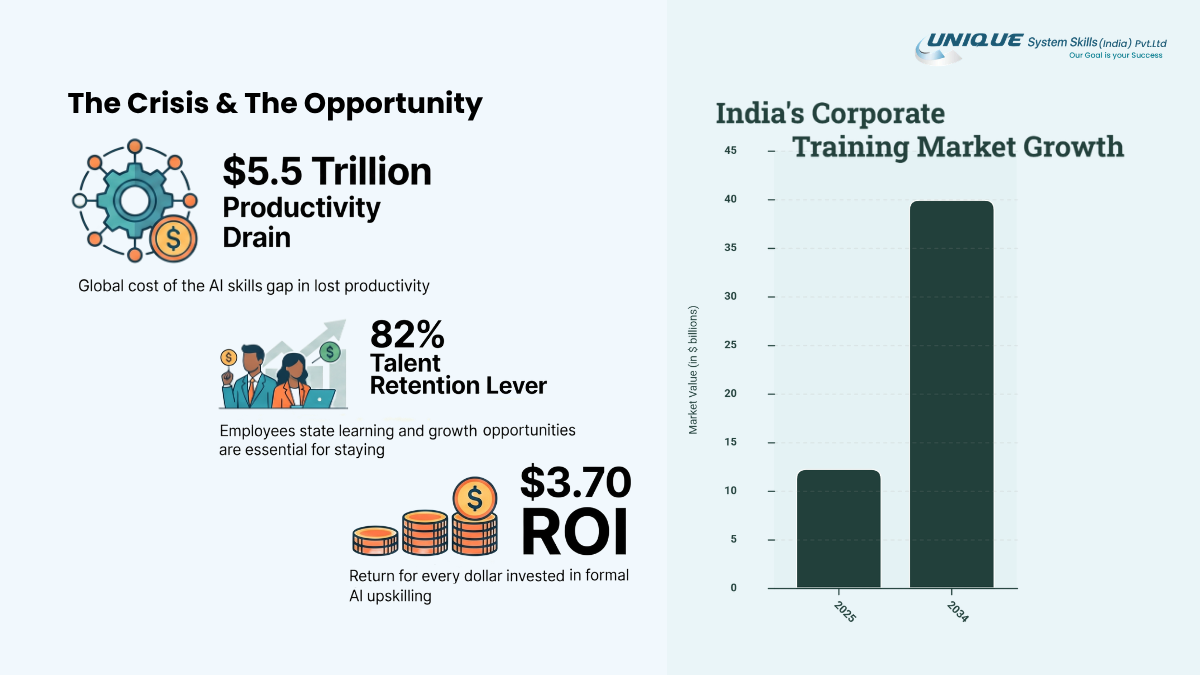
India’s Corporate Training Market Growth
With that scale in mind, it helps to look at exactly where the biggest gap sits today.
How an IT Company Training Program Drives Growth
The size of the global skills gap is genuinely hard to grasp. IDC estimates that skills shortages could cost the world economy $5.5 trillion by 2026, with over 90% of companies expected to face serious talent gaps. This is not a distant risk. It shows up right now, in delayed product launches, missed targets, and teams that cannot properly use the technology their company already paid for.
India is feeling this too, and the local numbers back it up. The country’s own corporate training market was valued at $12.2 billion in 2025 and is projected to reach $39.9 billion by 2034, growing at nearly 13% a year — proof that Indian businesses are pouring real money into closing this exact gap. This is precisely the space a well-run IT company training program is built to fill. Instead of leaving employees to figure out new tools on their own, structured training turns hesitant, casual users into genuinely skilled operators. For an individual on a team that completes a structured, hands-on program, the difference becomes a professionals who ships faster, breaks fewer things, and costs the business far less in avoidable mistakes.
For Indian companies racing to modernize, and for the people working inside them, this is exactly why investing early in a genuine IT company training program beats waiting until the skills gap becomes an emergency. Closing this gap is not only about tools, it also demands a different kind of skill entirely.
IT Management Training Programs and Leadership
A leadership gap many companies still underestimate is being technically excellent no longer automatically makes someone a good manager. As teams become more independent and cross-functional, IT management training programs now need to build judgement, adaptability, and conflict resolution just as deliberately as they build cloud or coding skills. Running a strong 21st-century team means handling disagreements between engineers and product owners, making quick calls with incomplete information, and helping a team recover after a rough release. These are skills you can learn, but they rarely show up by accident.
Companies that invest in this side of IT management training programs tend to see it show up in retention too, since employees regularly name growth opportunities as a top reason they stay with a company instead of leaving for a competitor. If you lead a technical team and have never had formal training in handling a heated disagreement between 2 senior engineers, that gap is worth naming honestly, and closing on purpose.
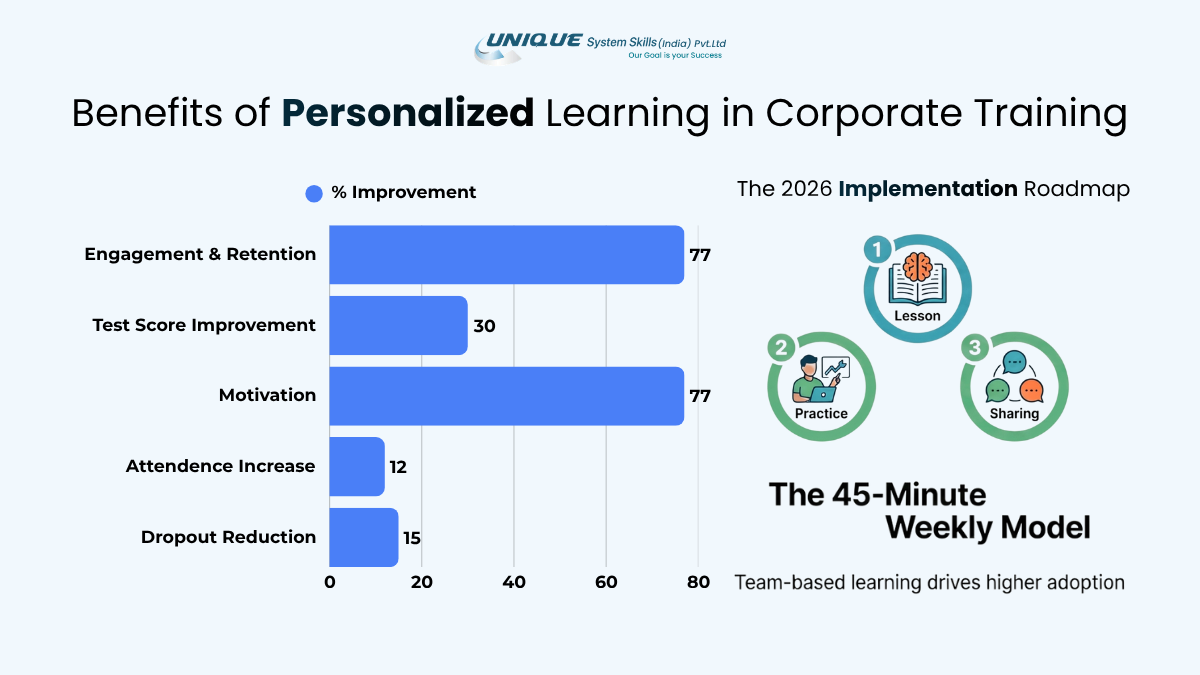
Benefits of Personalized Learning in Corporate Training
Best IT Training Programs for Prompt Engineering and Cybersecurity
One skill that now connects almost every high-value tech role in 2026 is the ability to talk to AI systems clearly. Prompt engineering has quietly become one of the most useful, transferable skills across every platform, and the best IT training programs now treat it as a core skill, not a niche extra reserved for data scientists.
This same shift is reshaping cybersecurity, where threats are increasingly AI-assisted and defenders need AI-aware responses to match. A genuinely current Cybersecurity Training Course now blends classic network security with AI-aware threat detection, because attackers are not working with yesterday’s playbook either. On the data side, professionals who understand large language models and prediction are earning a real premium over those who only know older methods, and a structured Data Science with AI training program is usually the fastest way to build that skill properly, rather than piecing it together from scattered videos.
Delivery has changed too, and this matters as much as the subject matter. Many Indian companies are now adopting Learning Experience Platforms, or LXPs, which use a learner’s role and skill gaps to recommend exactly what to study next, instead of pushing the same generic course to everyone. Alongside this, adaptive learning tools use real-time performance data to slow down, speed up, or switch topics automatically when a learner is struggling — a smarter, more personal alternative to a fixed, one-size-fits-all course. The best IT training programs in 2026 combine this smarter delivery with genuine AI fluency running through every subject, not bolted on as a single separate module. With this modern layer in place, the next challenge is turning all this learning into an actual, employable skill set.
IT Job Training Programs for the New Indian Workforce
There is a familiar, frustrating gap facing Indian graduate. A general degree teaches concepts, but employers want specific, provable skills from day one. This is exactly where hands-on, project-based IT job training programs need to step in, connecting theory to real workplace expectations instead of adding one more layer of abstract coursework.
The strongest programs make this real through genuinely live work: a Java Full Stack course where learners build and deploy real applications, an AWS with DevOps course where learners actually break and fix live cloud pipelines instead of just watching a demo, or a Data Analytics course built around real business data instead of toy spreadsheets. Even fields once seen as secondary, like a Software Testing course using modern tools like Playwright, or a Digital Marketing course covering live campaigns, now follow this same hands-on model. Building real skill is only half the job as the market also needs a reliable way to check that the skill is genuine.
Why IT Certification Training Programs Matter
In a hiring market full of self-taught claims and inflated resumes, IT certification training programs matter because they offer proof of skill that someone else has already checked. A certificate from a recognised body tells an employer that a third party has done the verification work they would otherwise have to do themselves, through a long and costly interview process.
For a hiring manager scanning dozens of resumes, that kind of clear proof saves real time, and for the candidate, it is the difference between being taken seriously and being quietly filtered out. Good IT certification training programs treat the certificate as documented evidence of a skill that was genuinely built, not the finish line itself. That naturally raises the question every business leader eventually asks: how do you actually know if any of this training is working?
The Real ROI of Corporate Upskilling
Completion rates alone prove almost nothing. They show someone clicked through a course, not that they learned something useful or applied it on the job. A proper measurement framework looks at participation, learning, behaviour change, and business results together.
A structured IT training programs can deliver a measured $3.70 return for every dollar invested, alongside real drops in error rates and real gains in task speed once training moves from theory to practice.
Here is a simple way to picture this in an IT setting: if a 50-person engineering team saves just 2 hours a week each through better tool skills after training, that is 5,200 hours recovered a year, a number any finance leader can turn directly into cost saved or output gained.
By setting clear goals before a program starts, then measuring actual behaviour change rather than just attendance, a company can treat its training as a real investment with a visible return, not a line item buried in the HR budget.
Common Mistake | Why It Hurts Results | Better Approach |
Buying software before defining the problem | The tool may not address the real skill gap | Start with business goals and a needs analysis |
Tracking only completions | Employees can finish training without changing behavior | Measure assessments, practice, and job performance |
Using one format for everyone | Different roles and skill levels need different support | Use blended and personalized learning paths |
Leaving managers out of the process | New skills may not transfer to daily work | Train managers to coach and reinforce learning |
Overloading learners with content | Too much information reduces attention and retention | Use shorter modules, practice, and spaced reinforcement |
Why Unique System Skills Is the Right Training Partner for 2026
Technical depth, leadership skills, AI fluency, hands-on practice, and verified certification is exactly what Unique System Skills has built its training approach around. As both a training provider and an active staffing partner working with 100-plus hiring companies, USS shapes its courses around what recruiters are actually testing for today, not what mattered two years ago.
A company in Pune which partnered with USS to upskill its support engineering team in AWS and DevOps fundamentals noticed an improvement within one quarter of completing the course. The team’s average incident-resolution time dropped noticeably, and two engineers were promoted into dedicated DevOps roles they had not previously been considered for. That is the kind of measurable outcome a genuine IT training programs partnership should produce.
Every program runs in small batches, with hands-on labs on real, live infrastructure rather than simulations, and a clear path from enrolment through to a real project portfolio, mock interviews, and direct placement support. Whether your organisation needs to upskill an existing technical team, or you are an individual professional planning your own next move, this is the kind of outcome-driven, verifiable training modern IT training programs should be built around.
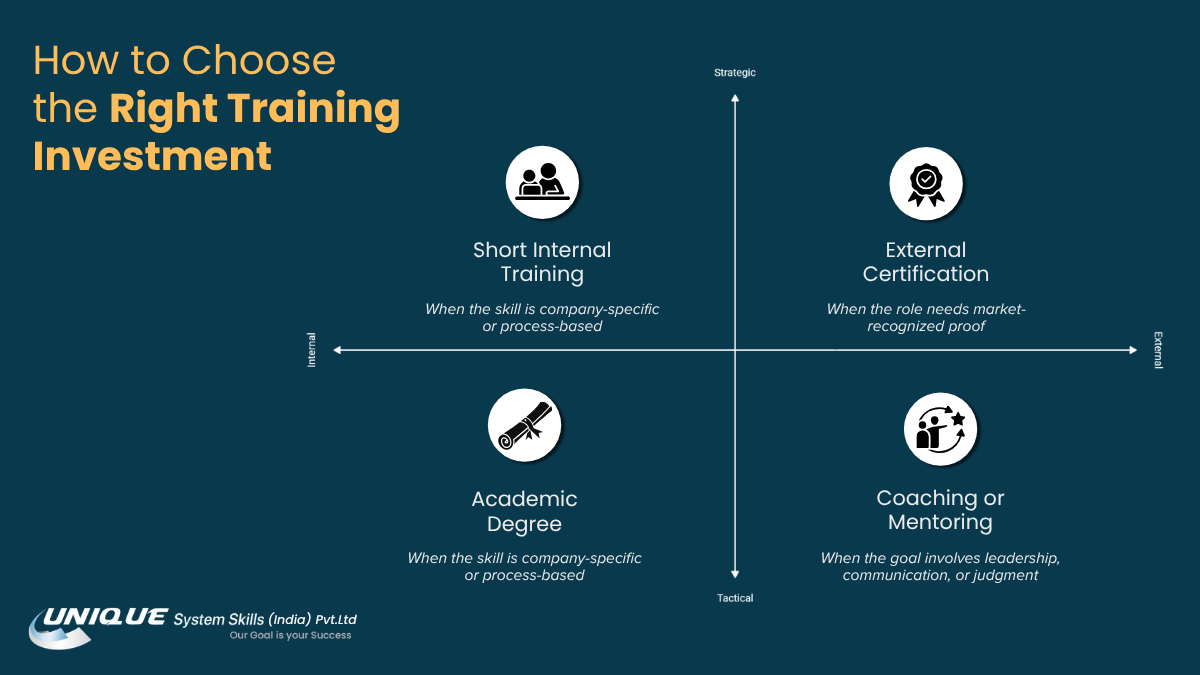
How to Choose the Right Training Investment
Conclusion: Your Next Step Starts Here
Organisations and professionals who treat continuous learning as a genuine habit, not an annual formality, are the ones best placed for what the future brings. If you are an HR leader, that next step might be reviewing your team’s current skill gaps against the roles you are hiring for. If you are an individual professional or student, it might simply be picking one course from this guide that matches where you want to go next.
With these actionable steps, investing in structured, hands-on IT training programs, measuring their impact honestly, and choosing a training partner genuinely connected to what employers need. You can close the skills gap on your own terms, instead of being caught off guard by it. The best time to build this habit was years ago. The next best time is today.
Frequently Asked Questions
Who should choose our corporate IT training programs?
At Unique System Skills, the IT training programs suit a wide range of learners. This includes HR and L&D leaders building a company-wide upskilling plan, working IT professionals looking to specialise in areas like cloud, data, or cybersecurity, and even non-technical staff who need practical AI or digital fluency. Whether you are training one team or an entire department, the courses are structured in phases so both beginners and experienced professionals can start at the right level.
Why choose us for corporate IT training?
Unique System Skills works as both a training provider and an active staffing partner, which means our IT company training program is shaped directly by what over 100 hiring companies are actually testing for right now. Training happens in small batches, on real, live infrastructure rather than simulations, and every program ends with a genuine project portfolio and structured placement support, not just a certificate.
What are corporate IT training programs?
At Unique System Skills, the Corporate IT training programs are structured learning courses designed to build specific, job-ready technical and leadership skills within a company’s workforce. Unlike generic online courses, they are built around real tools, real projects, and the exact skills a business needs to stay competitive, covering everything from cloud and cybersecurity to data, leadership, and AI fluency.
What topics are usually covered in corporate IT training?
Typical, Unique System Skills’ corporate training courses cover cloud computing and DevOps, cybersecurity and AI-aware threat detection, data science and analytics, software testing and automation, full-stack development, digital marketing, and increasingly, prompt engineering and general AI fluency. Many programs also include IT management training programs focused on leadership, judgement, and conflict resolution for those managing technical teams.
Are corporate IT training programs available online?
Yes. IT job training programs offered by Unique System Skills are both classroom-based and live with instructor-led online formats. This flexibility means teams spread across different cities, or individuals balancing a full-time job, can access the same quality of training without needing to relocate.
How do we choose the right corporate IT training program?
Start by identifying the specific skill gap you need to close, whether that is cloud infrastructure, data analysis, or security, and look for IT certification training programs that combine hands-on projects with recognised, verifiable credentials when it comes to the trainers. It also helps to choose a provider with a genuine connection to hiring outcomes, since a program that support real-corporate skills delivers far more value than one that ends in a certificate alone. Such customizable and structured is offered by Unique System Skills.