

Introduction: The Data-Driven Revolution in India
Every day, India generates more data than ever before—whether it’s from digital payments, e-commerce shopping carts, or healthcare records. This explosion is not just reshaping industries but also creating opportunities for those who can interpret and harness this data. By 2025, the data science trends in India 2025 will be driven by AI adoption, automation, and the rising demand for skilled professionals.
According to NASSCOM report, India’s data science industry is expected to grow to USD 2,551.2 million by 2033, placing the country among the world’s top hubs for innovation. For learners—students preparing to enter the workforce and professionals looking to upskill—understanding these trends is more than a choice; it’s a necessity.
AI and Data Science Trends India: The Unstoppable Rise of AI
Artificial Intelligence (AI) is no longer a futuristic concept—it’s the backbone of India’s digital revolution. India now has the second-largest AI/ML/Big Data Analytics talent pool globally, with an installed base of 416,000 professionals as of 2022. Yet, demand is outpacing supply rapidly, with 629,000 current openings and a projected gap of about 51%. By 2026, India’s demand for AI professionals is expected to exceed 1 million, signaling unprecedented career opportunities for learners.
In addition, India ranks 1st globally in AI skill penetration (with a score of 3.09) and also holds the 1st and 5th positions worldwide in AI talent concentration and AI scientific publications. These achievements highlight India’s ability not just to adopt AI but to shape its global trajectory.
For students and professionals, this means the AI and data science trends India are heavily tilted towards ethical deployment, automation, and large-scale adoption in industries like healthcare, e-commerce, finance, and government-led digital projects. The challenge is no longer if AI will be adopted—it’s how quickly you can prepare to contribute.
Emerging Technologies in Data Science: Beyond the Basics
The emerging technologies in data science are extending far beyond traditional analysis:
- Edge Computing: With the rise of IoT in smart cities and healthcare, edge devices are enabling real-time analytics at the source. For instance, a wearable device monitoring a patient’s heartbeat can alert doctors instantly—without relying on distant cloud servers.
- AutoML and Low-Code Platforms: These tools allow even non-programmers to build and deploy machine learning models. It’s like having a GPS guide you through a complex city—making the journey faster and less intimidating.
- Quantum Computing: While still in its infancy, it’s poised to solve optimization problems in finance and pharmaceuticals at lightning speed.
- Data Mesh Architecture: This decentralized approach helps large organizations scale their data management without bottlenecks.
By focusing on these areas, learners can stay ahead of the data science career trends 2025 and prepare for opportunities that go far beyond today’s job descriptions.
Python in Data Science 2025: Why It Remains the Undisputed Leader
When we look at Python trends in India 2025, one fact stands out: Python continues to dominate because it powers India’s fastest-growing AI talent base. With India holding the world’s second-largest AI/ML/Big Data workforce, Python’s role has expanded from academic projects to enterprise-scale deployments.
Given India’s 51 % demand-supply gap in AI/ML talent, enrolling in a rigorous program is essential. Institutions like UniqueSystemSkills (Pune) that emphasize applied projects may help bridge that gap faster. Recruiters aren’t just looking for theoretical knowledge—they want professionals who can apply Python libraries like Pandas, NumPy, TensorFlow, and PyTorch to solve real-world problems in areas like fraud detection, predictive healthcare, and recommendation systems.
Another strong signal is India’s 1st rank in global AI skill penetration, which reflects how widely Python is being learned and applied. This isn’t just among IT professionals—finance, retail, and healthcare specialists are increasingly adding Python to their toolkits, making it an interdisciplinary language for the future.
Learners who invest early in mastering Python will find themselves well-positioned, especially as startups and MNCs across India prioritize Python-based solutions for AI deployment. The future of Python programming in India is therefore not just about coding—it’s about being at the center of India’s transformation into an AI powerhouse.
Among programming languages, Python remains the powerhouse. In fact, more than 90% of professionals use it for data analysis and machine learning. The dominance of Python in data science 2025 is rooted in its vast ecosystem of libraries:
- Pandas & NumPy: For cleaning and manipulating data.
- Scikit-learn: For building machine learning models.
- TensorFlow & PyTorch: For advanced deep learning.
But Python’s strength isn’t just in data science. The future of Python programming in India extends to web development, automation, and AI-powered apps, making it a skill with unmatched versatility. To master libraries like Pandas, NumPy, TensorFlow, and PyTorch, many learners turn to in-depth training programs such as the Data Science with Python training institute in Pune by UniqueSystemSkills, which offers lab projects and mentorship tailored to Indian industry needs.
Of course, complementary tools like SQL remain essential for querying databases, while R retains its niche in statistical research. Still, Python’s accessibility and scalability ensure it will continue to be the backbone of data-driven innovation.
Mapping Your Career: Top Skills for Data Science 2025
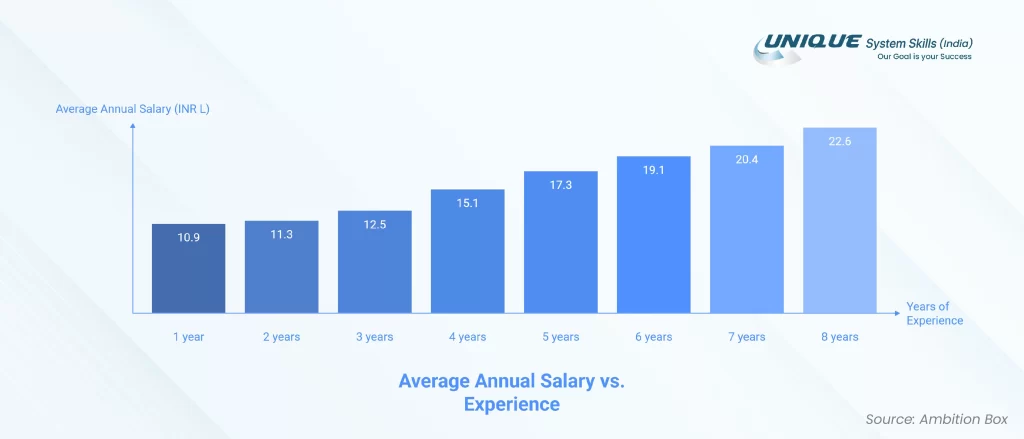
The most common question posed by every learner is: What should I learn to be employable? That’s a pretty straightforward question, and I’ve laid out what I believe to be an important inventory of top skills for a data scientist in 2025.
Technical Skills
- Programming: Python and SQL are must-have technical skills.
- Machine Learning & AI: Understanding supervised, unsupervised, and deep learning will be critical.
- Data Visualization: Software products including Tableau, Power BI, and Matplotlib allow you to communicate effectively with data.
- Big Data & Cloud: Understand how to handle large data sets if you will need to work with large data sets: Spark for manipulating large data sets, AWS/Azure/GCP can provide cloud options for scalability.
Soft Skills
Data scientists don’t work in a vacuum. Skills such as communication, problem solving, and business knowledge are every bit as important for your success as a technical skill such as programming. For example, the simple ability to explain the output of a predictive model to a business leader or decision maker could be the difference between the data generated decision influencing the real world or not.
Scope of Data Science in India 2025: Opportunities and Career Growth
India’s opportunities in data science by 2025 will be vast and increasing. According to the U.S. Bureau of Labor Statistics, job opportunities for data professionals are projected to grow by 36% by 2031, much faster than average. Data roles such as Data Scientist, Machine Learning Engineer, Data Architect, and Business Intelligence Analyst will continue to become normal jobs in many industries.
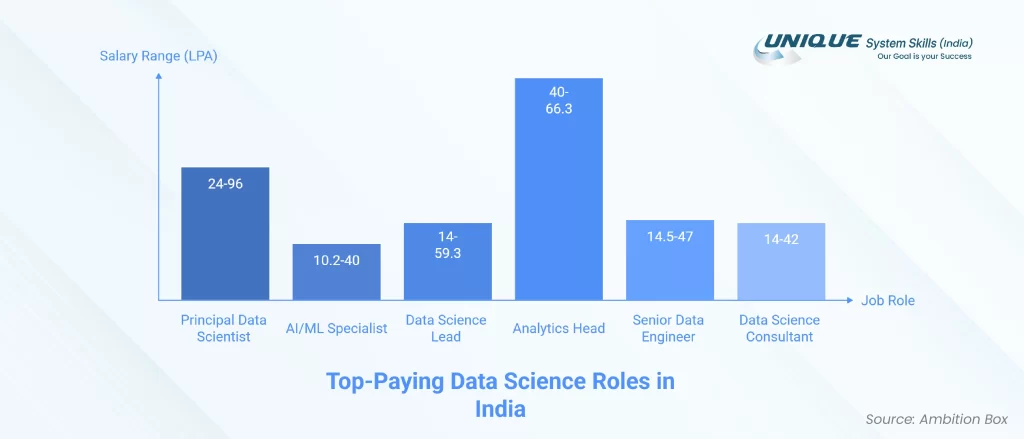
- Data Scientist: Average salary ~ ₹12 LPA.
- Machine Learning Engineer: Average salary ~ ₹9 LPA.
- Data Architect: Can earn greater than ₹27 LPA.
Industries driving this demand include ecommerce, healthcare, finance, and government smart city initiatives. For students, this means that someone will be able to build knowledge and skills today in order to be positioned in the middle of India’s data revolution. As you prepare your roadmap, consider enrolling in recognized bootcamps like UniqueSystemSkills’ Data Science with Python training in Pune. Having a structured program that aligns with India’s job market can help close the demand-supply gap.
Conclusion: Preparing for a Data-Centric Future in India
The data science trends in India in 2025 indicate a future defined by AI integration, Python familiarity, and developing technology. However, even with access to the best tools and techniques, the biggest measure of success will be adaptability and the willingness to embrace continuous learning.
Think about how it feels to be a participant in India’s digital revolution—not a user of technology, but a developer contributing to a brighter future. Do you find yourself as a learner thinking about your first certification in data science? Perhaps you’re an industry professional thinking about advanced cloud solutions? The opportunities truly are limitless.
With deliberate learning and an openness to grow, you can create a fulfilling career in India’s data economy.
