

Today, India stands at a critical point in its technological evolution; Artificial Intelligence has crossed over from conversations held in some labs around the world and into the way Indian businesses now build their products, deliver their services and essentially compete globally. While Azure remains a preferred platform for enterprise AI, modern AI roles in India increasingly operate across multiple cloud environments and rely on DevOps practices to take models from development to production.
Many Indian companies already represent us internationally across AI, including fintech startups in Bangalore, healthcare providers based in Hyderabad, and manufacturers in Pune, with AI at the backbone of many of these innovations.
This shift has made determining the correct path to follow for your education increasingly important. The Azure AI Certification Course in India provides students, recent graduates and experienced professionals a pathway to entering into top-tier AI-related careers with global acceptance, as well as being recognized by the highest industry standards.
This guide will provide you with an overview of the Azure AI certification ecosystem, qualifications for obtaining the Azure AI certification, job prospects available as an Azure AI-certified employee, and the advantages to holding the Azure AI certification long into your future career.
The Growth of Artificial Intelligence (AI) in India
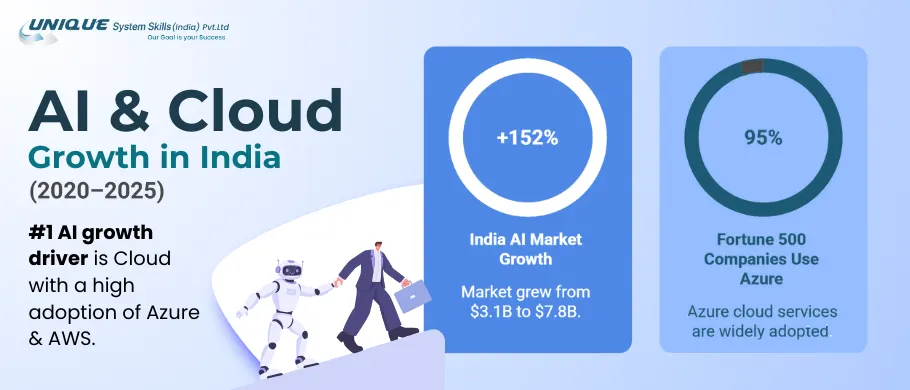
According to NASSCOM, India’s AI market will grew from $3.1 billion in 2020 to $7.8 billion in 2025. This is due to the enterprise use of AI technology by many industries, including banking, health care, retail, logistics, and government agencies.
The biggest contributor to this growth has been cloud computing. Alongside Azure, platforms like AWS play a significant role in hosting AI workloads, while DevOps frameworks ensure these AI systems are continuously deployed, monitored, and scaled in production environments.
Many businesses in India prefer to use Microsoft Azure and AWS for cloud computing, which is largely due to Azure’s multi-tiered enterprise security, ability to create hybrid cloud solutions, and compliance with international and Indian government regulations.
More than 95% of Fortune 500 companies use Azure cloud services, and India will be a critical piece of Azure’s worldwide infrastructure. This means that there will be many significant opportunities for those who train with the Azure AI certification Course in India. This is true especially when combined with cloud fundamentals and DevOps exposure to demonstrate their capability as production-ready AI engineers.
Navigating Azure AI Certification Eligibility Across Career Stages
It’s a common misconception that only hardcore coders or data scientists can pursue an AI career. The truth, however, is that Microsoft’s Azure Certification framework was designed purposely to be inclusive and progressive.
The entry-level certification is AI-900 or Azure AI Fundamentals which anyone can take including:
- Students who are about to graduate
- Graduates from non-technical fields
- Business analysts
- Individuals changing careers
While no prior cloud or DevOps experience is required, learners who understand basic cloud concepts (such as computing, storage, and APIs on Azure or AWS) often find it easier to connect AI concepts to real-world applications. You will be assessed based on your fundamental understanding of AI workloads, including Machine Learning, Computer Vision, and Natural Language Processing.
The AI-900 certification is the first step in validating foundational knowledge. The associated level certification, AI-102 or Azure AI Engineer Associate, is considered the standard within the industry for technical-based roles. For this role, Successful candidates usually have a working knowledge of Python or C#, familiarity with REST APIs, JSON, and a basic understanding of Azure services, including Storage, Compute and Networking.
In real-world roles, this knowledge is often extended to containerization, CI/CD pipelines, and cross-cloud deployments, areas commonly associated with DevOps and AWS-based environments. With such demand and potential for growth, Azure AI Certification Course in India can be utilized by beginning and seasoned professionals alike.
Why Structured Azure AI Learning Matters
With an estimated 1.5 million engineers graduating each year in India, very few possess the qualifications to actually be productive IT professionals within their respective fields/positions. Rather than a lack of ability/creativity, the majority lack “real-world” experience working with AI technologies.
Azure AI certification eligibility is intentionally accessible, as entry-level certifications require no prior coding or cloud experience. However, as professionals progress to roles such as Azure AI Engineer Associate, real-world readiness increasingly depends on understanding how AI solutions interact with cloud infrastructure and DevOps pipelines.
While Azure provides the AI services layer, AWS is frequently used for data storage, compute scaling, and application hosting, and DevOps practices ensure AI models are continuously deployed, monitored, and improved in production.
Is Azure AI Certification Worth it for Professionals from India?
When you are making a career decision, there is often a lot of uncertainty about what direction to take. And when it comes to AI, the real question is not just about learning it, but about whether those skills can be deployed, scaled, and maintained in real business environments. With increasing demand for Azure AI certification jobs in India, professionals are now evaluating certifications not just for learning value, but for long-term employability.
This is particularly true for those who are thinking about transitioning into this new upcoming field. So, if your question is: “ Is Azure AI Certification worth it for Me?” and from a long-term perspective, the answer is “Yes”.
There are three main reasons for this:
- The Numbers – Data on the Job market Report for India states that AI Jobs increased by 42% in 2 years, with an estimated 253,000 Roles in AI available, this shows that AI Skills are In Demand in the “Indian Workforce”. However, many of these roles now expect professionals to understand how AI models move from development into production, often through cloud platforms and automated DevOps pipelines.
- Global Skill Alignment – Azure certification aligns your skill set with global standards, facilitating ease of doing business with global clients, MNCs, and remote teams. In practice, this also prepares professionals to collaborate in multi-cloud environments, where Azure AI models may be deployed alongside AWS infrastructure and managed through shared DevOps workflows.
- Future-Proofing Against Automation – As automation removes repetitive job roles from the workforce, AI professionals are moving into more complex decision-making and problem-solving roles. These advanced roles increasingly require familiarity with continuous deployment, monitoring, and optimization of AI systems. For this reason, many professionals view Azure certification as a long-term career investment rather than just a short-term credential.
Exploring Azure AI Certification Jobs in India: Roles, Salaries, and Career Growth
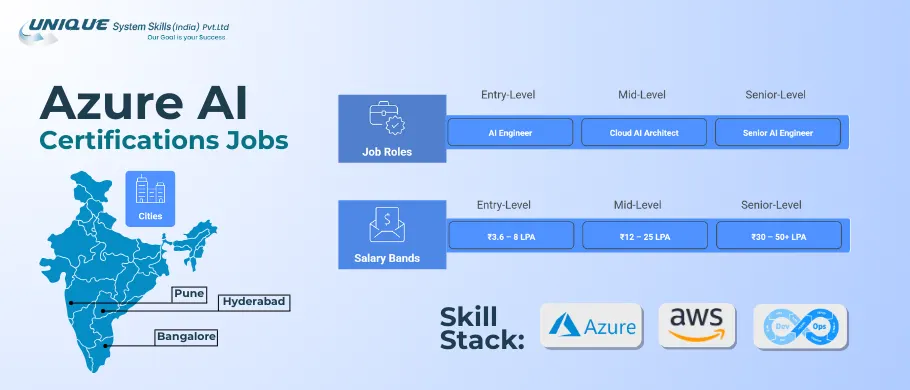
The job market in India has numerous positions available for certified people with an Azure Certification. The most likely candidates for these jobs in India include:
- AI Engineer
- Machine Learning Engineer
- Cloud AI Architect
- NLP Specialist
- AI Solutions Consultant
While these roles may carry “Azure” in the title, they frequently involve working with broader cloud ecosystems, integrating AI services with AWS-based data pipelines, and deploying solutions using DevOps and MLOps practices.
According to salary data available via Glassdoor and LinkedIn:
- Entry-level professionals can expect to earn a Salary of between ₹3.6 – 8 LPA
- Mid-level professionals usually earn between ₹12 – 25 LPA
- Senior AI architects and senior leads can earn ₹30 – 50+ LPA, particularly in Bangalore and Hyderabad
Professionals who combine Azure AI expertise with cloud deployment skills and DevOps workflows often command higher compensation due to their ability to deliver end-to-end AI solutions.
That’s why AWS, DevOps, and Azure AI Certification Course in India is increasingly thought of as a tool to accelerate your career, rather than just something optional.
How Start-Ups and Technology Leaders Use Azure AI Innovations
Indian Startup Companies are having success in utilizing Azure AI to solve real-world business challenges. Examples of such uses include:
- Utilizing AI powered Chatbots to help streamline automation of customer support functions
- Improving the detection of fraud in Fintech
- Creating a more personalized E-Commerce environment for End Clients
In many of these cases, Azure AI models are containerized, deployed on cloud infrastructure, and continuously improved through automated DevOps pipelines to support rapid business growth.
Leaders within Technology companies that know Azure AI have the opportunity to:
- Lessen operations expense
- Increase scale
- Meet compliance requirements regarding data protection legislation
Because of this strategic benefit, many founders are prioritizing hiring certified AI talent who understand Azure, AWS and DevOps.
How to Start Your Journey with AI Certification in Azure
If you’re feeling overwhelmed, don’t worry! Start small and come up with a plan for success that will help you achieve your goals. The following steps can help you:
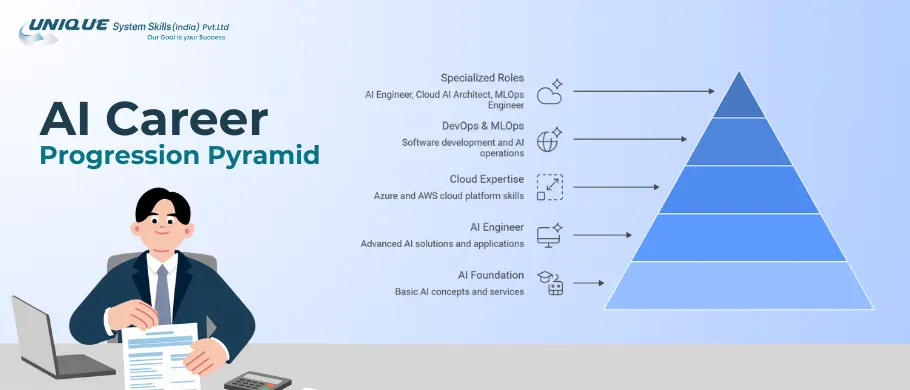
Step 1: Build AI Foundations (Entry Level)
- Start with Azure AI Fundamentals (AI-900)
- Learn how AI workloads like ML, computer vision, and NLP are used in business
- Focus on understanding what AI does before worrying about deployment
Step 2: Move Toward Applied AI Engineering
- Progress to Azure AI Engineer Associate (AI-102)
- Learn to work with APIs, datasets, and AI services
- Begin understanding how models are exposed as services and consumed by applications
Step 3: Add Cloud & DevOps Execution Skills
- Learn how AI services are deployed using containers and cloud compute
- Understand CI/CD pipelines, versioning, and monitoring core DevOps concepts
- Gain exposure to AWS fundamentals, as many organizations use AWS for scaling AI workloads
Step 4: Transition into High-Paying Roles
- Roles such as AI Engineer, Cloud AI Architect, or MLOps Engineer
- These roles value professionals who can design AI solutions end-to-end.
- This means you need to know how to go from model development to production deployment and optimization
Using these five steps creates a structured path instead of making the task of selecting an Azure AI certification course in India seem daunting.
Long-term Impact of India’s IT Workforce
India is an important technology provider on the global scene and its ability to progress up the value chain in technology will determine the country’s long-term leadership in providing innovation vs. providing services.
Investing in Azure AI certification Course in India creates a strong foundation for professional growth and contributes to building a digitally competitive workforce capable of delivering production-ready AI solutions.
As AI continues to transform industries, professionals who can combine AI expertise with cloud platforms and DevOps-driven execution will lead these changes over the next decade.
Conclusion: Your Roadmap to Success
The future of employment in India will be shaped by intelligent automation, cloud platforms, and the ability to operationalize AI at scale. Whether you’re just starting out as a recent graduate or already a working professional, you can still benefit from the Azure AI Certification Course in India.
It can give you a well-defined roadmap for future business success, especially when paired with practical exposure to cloud deployment and DevOps workflows that reflect how AI is implemented in real organizations.
By understanding who is eligible, how much demand there is in the current marketplace, and what benefits it has for individuals over the long term, you can feel confident about making an informed choice that supports both your professional goals and India’s digital future.
If you develop an effective learning plan now, one that balances AI fundamentals with real-world cloud execution, that curiosity can mature into mastery over time.