
If you have spent nights wondering whether it is too late to pivot into AI, or whether you even have the right background to start, take a breath. This hesitation is shared by thousands of capable people right now, and none of it needs to hold you back. India’s digital transformation has moved fast enough that the old rules about who gets to work in AI simply no longer apply. Understanding the real shape of artificial intelligence career paths today is the fastest way to replace that uncertainty with an actual plan.
India currently counts over 600,000 AI professionals, a number expected to approach 1.25 million within just 2 years. That is not a niche corner of tech; it is one of the fastest-growing career ecosystems in the country. So before mapping out where you fit among the many artificial intelligence career paths now open, it helps to understand exactly why this moment is different from AI hype cycles of the past.
Why You Should Pursue a Career in Artificial Intelligence in 2026
Generative AI has moved from research labs into everyday enterprise tools with startling speed, and Indian companies across every sector are scrambling to hire people who can build, deploy, and manage these systems. India’s AI market is projected to more than triple to $17 billion by 2027, according to Boston Consulting Group, and the country already holds 16% of the world’s AI talent pool, 2nd only to the United States.
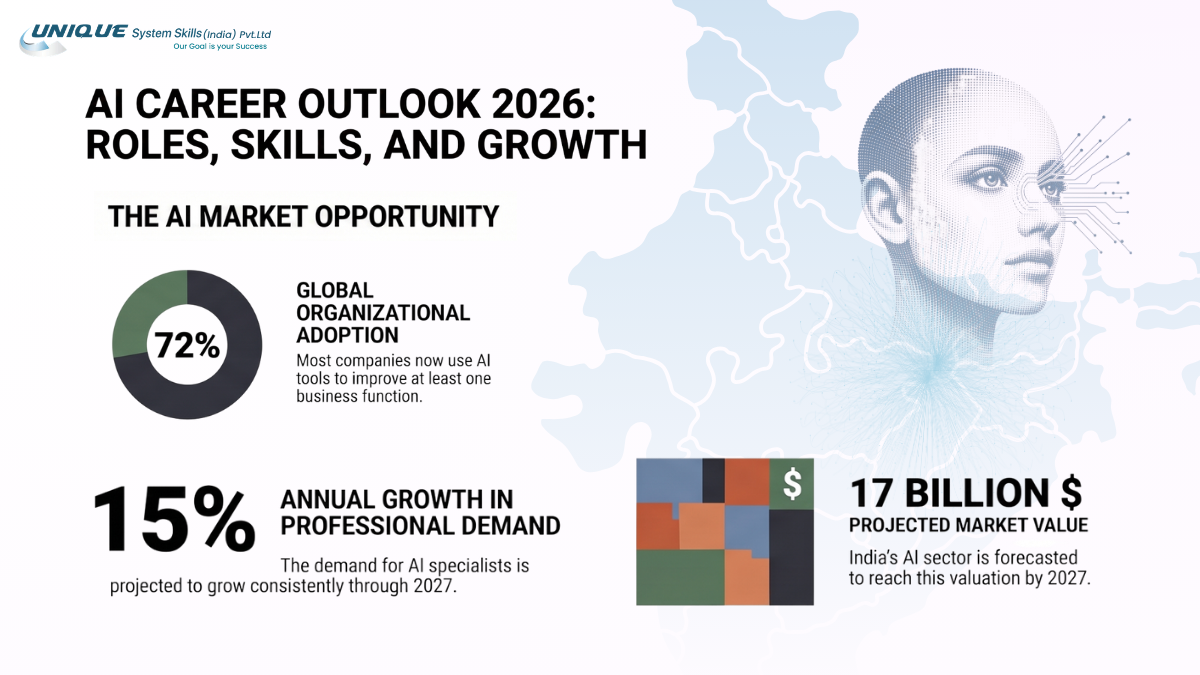
AI Career Outlook 2026
Compensation reflects this urgency clearly. Beyond the paycheck, though, the versality is equally compelling. A single skill set in AI can carry you across healthcare, fintech, e-commerce, and logistics. The underlying techniques like pattern recognition, prediction and automation solve real problems in several industries.
Few artificial intelligence career paths lock you into one narrow track the way older tech specialisations sometimes did. Within 18 months, a customer support analyst can move into a role designing automated support workflows. Once you accept that the demand and the versatility are real, the next natural question is which specific role actually fits you.
Navigating Diverse Career Opportunities in Artificial Intelligence
An AI job role sound like one thing, but it is genuinely a family of distinct roles where each one draws on a different mix of skills. Career opportunities in artificial intelligence extend from hands-on engineering roles to research-heavy positions to newer hybrid roles that sit between technical teams and business stakeholders.
The table below lays out the 6 most common artificial intelligence career paths side by side, along with current, sourced salary bands so you can compare them at a glance rather than piecing figures together from memory.
| Role | What They Actually Do | Typical Salary Range (India, 2026) |
| AI Engineer | Builds AI-powered applications — chatbots, intelligent automation tools | ₹6–11 LPA entry level; ₹25–60 LPA+ for senior/GenAI specialists |
| Machine Learning Engineer | Designs, trains, and deploys the predictive models behind AI applications | ₹6–14 LPA entry level; up to ₹35–50 LPA+ for senior roles |
| Data Scientist | Analyses large datasets to uncover business insights and build models | ₹5–10 LPA entry level; ₹10–23 LPA typical band, higher for senior specialists |
| MLOps Engineer | Keeps AI models reliable, monitored, and scalable once in production | ₹12–30 LPA, trending upward with GenAI-driven demand |
| AI Product Manager | Translates business needs into what technical AI teams should build | ₹18–35 LPA |
| AI Researcher | Develops new algorithms and architectures, usually with a PhD | ₹50 LPA and above at research labs and global tech firms |
Sources: Glassdoor, AmbitionBox, and industry salary trackers current as of mid-2026. Actual offers vary widely by city, company type, and specialization.
Salaries across all these roles tend to run highest in Bangalore, Mumbai, and Pune, where the concentration of product companies and global capability centres pushes pay well above the national average. There are also emerging niche artificial intelligence career paths worth knowing about including:
- AI Ethics Specialists ensure systems are fair and transparent.
- AI Hardware Engineers design the physical infrastructure AI depends on.
With this many entry points across such varied roles, the real task becomes figuring out how to actually maximise your own position within whichever path calls to you.
Maximize Your Professional Artificial Intelligence Career Opportunities
If you are already working in traditional software engineering, you do not need to start over. Many of the strongest artificial intelligence career opportunities go to people who transition in with existing technical foundations, adding AI-specific skills on top rather than beginning from zero. A backend developer who learns cloud deployment for machine learning models, for instance, becomes immediately more valuable than either a pure developer or a pure ML specialist alone.
A clear example of how artificial intelligence career paths often reward combined expertise over narrow specialisation.
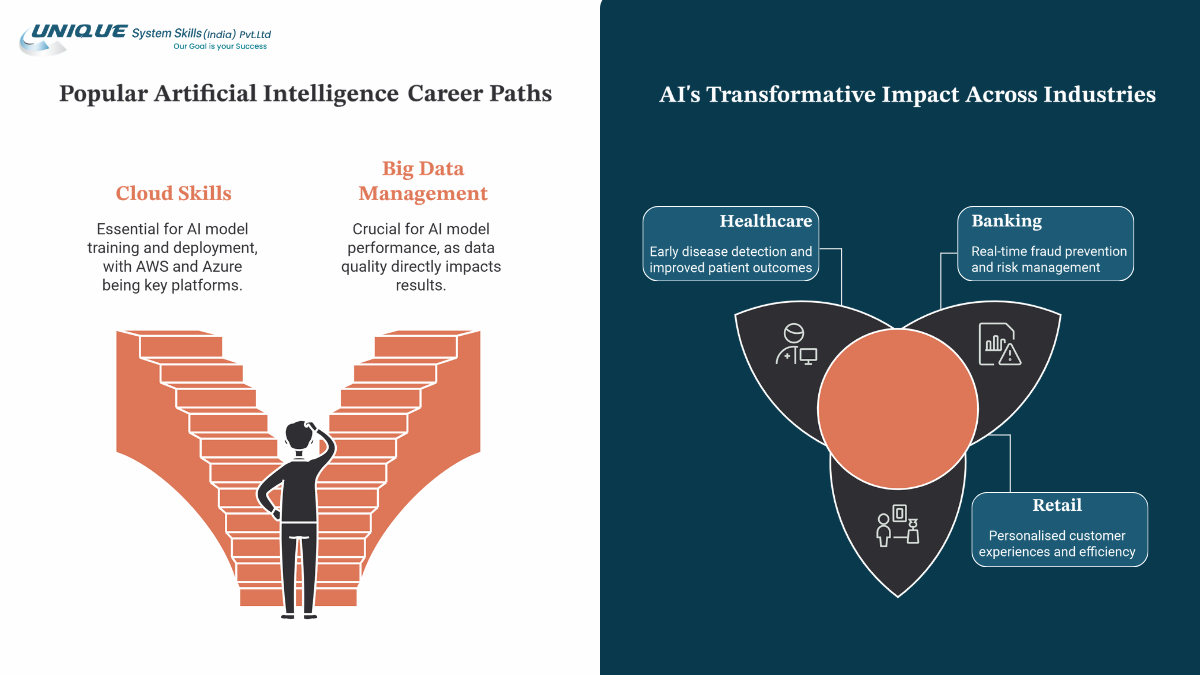
Artificial Intelligence Career Paths
Industry-recognised certifications add real credibility on top of these skills, particularly when you are trying to signal competence to a recruiter who cannot personally verify your hands-on experience.
If you already work in adjacent IT fields, this is where structured upskilling pays off fastest. A Java Full Stack background pairs naturally with AI-powered application development, a foundation in Data Science with AI builds directly toward ML engineering, and even fields like AWS with DevOps, Data Analytics, Cybersecurity, Software Testing, and Digital Marketing increasingly benefit from layered AI fluency. Once your technical foundation and complementary skills are in place, it helps to see exactly how this plays out across real industries.
Understanding the Career Scope in Artificial Intelligence Across Sectors
Seeing AI applied in concrete, real-world settings makes the opportunity far easier to grasp than any statistic alone.
- In healthcare, AI is already powering disease prediction models and medical imaging tools that help doctors catch conditions earlier than traditional methods allow, improving the patient outcomes and business metrics.
- In banking, AI drives fraud detection and automated risk assessment at a scale no human team could manage manually, protecting both institutions and individual customers in real time.
- Retail tells a similarly compelling story, with AI personalising customer journeys and optimising inventory so that businesses waste less and serve customers better simultaneously.
The career scope in artificial intelligence is not confined to tech companies in any narrow sense; it is embedded in nearly every industry now actively hiring. Someone genuinely interested in healthcare, finance, or retail can often find one of many artificial intelligence career paths that lets them combine both. With this sector-wide view in place, the natural next question is how someone earlier in their journey, even straight out of school, actually gets started.
Step-by-Step Guide: Building a Career in Artificial Intelligence After 12th
A strong career in artificial intelligence after 12th typically begins with foundational subjects like mathematics, statistics, and basic logic form the bedrock that everything else in AI is built on, so this is not the stage to rush past. From there, choosing the right undergraduate path matters. For instance, a B.Tech in AI/ML, or a solid B.Sc. in Computer Science, gives you a structured four-year foundation in logic, probabilistic models, and knowledge representation.
Formal education alone rarely closes the full gap. What makes you stand apart is live projects, with something as simple as a basic chatbot or an image classifier on GitHub. Building a hands-on proof that recruiters increasingly expect even from fresh graduates can get you hired faster. And if you are transitioning mid-career instead, the good news is that a similarly structured path exists for you too, often compressed into just 4 to 6 months of focused, phased learning that assumes no prior technical background with training institutes like Unique System Skills.
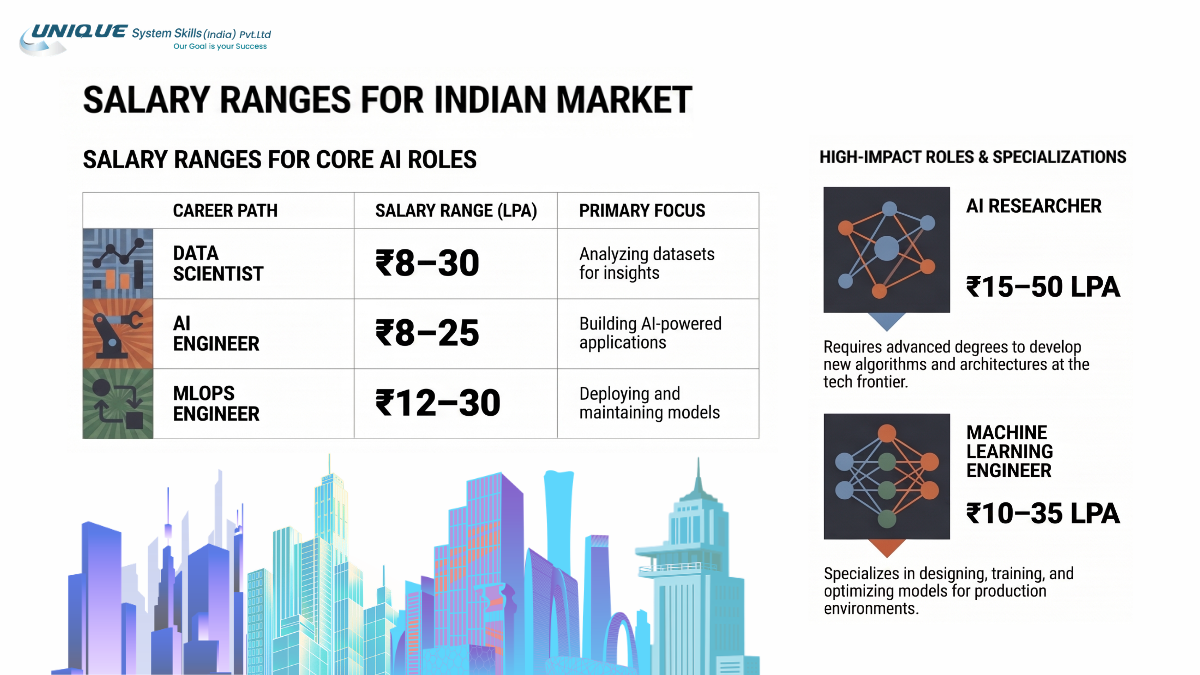
Salary Ranges for India Market
Why Unique System Skills Is Your Best Artificial Intelligence Career Path Partner
Everything covered so far is exactly what Unique System Skills has built its Artificial Intelligence Foundation Course around, offering a structured entry point into the many artificial intelligence career paths covered throughout this guide. As Maharashtra’s first USA-based IT training institute, the programme brings a global perspective to local training, structured across 11 progressive modules that move from foundational Python libraries through machine learning, deep learning, and specialised domains like Generative AI.
What sets this training apart is its refusal to rely on simulations. Learners work in live AWS cloud environments, provisioning real EC2 instances and configuring actual VPCs, so AI services stop being slide-deck concepts and become tools you have genuinely operated yourself.
The course follows an 80:20 model, with 80% of learning time spent on practical application across 10-plus industry-relevant projects, from building an image classifier to a sentiment analyser. Batches are capped at a maximum of 15 students, ensuring the kind of one-to-one mentorship that keeps complex topics like neural networks or Kubernetes orchestration from ever becoming an insurmountable wall. Because Unique System Skills operates as both a training provider and a staffing partner working directly with companies like Infosys, Capgemini, and Accenture, its 360-degree placement support is grounded in what employers are actually testing for right now, with graduates going on to secure packages as high as ₹16.5 lakhs.
Conclusion: Your Next Step Starts Here
The evidence points in one clear direction: artificial intelligence career paths in India are not a speculative bet on the future. They are a rapidly maturing, well-paying, and genuinely accessible field right now, whether you are finishing school, switching careers, or specialising further within tech.
- Build your mathematical foundation
- Choose a role that fits your strengths
- Layer in cloud and certification skills
- Prove your ability through real projects
With these steps you can move from uncertain outsider to genuinely competitive candidate faster than you might expect. Your future AI career is entirely within reach, and there has rarely been a better moment in India to start building it.
Frequently Asked Questions
How do I start a career in artificial intelligence?
Start by building a strong foundation in programming, mathematics, statistics, and basic AI concepts. Learn Python, probability, linear algebra, data handling, and machine learning fundamentals, then apply these skills through practical projects.
Students after 12th can consider degree programs such as B.Tech in Computer Science, Artificial Intelligence, or Machine Learning, or a B.Sc. in Computer Science. Career switchers can build relevant skills through structured AI courses, certifications, internships, and portfolio projects.
What are the best AI careers in India?
Some of the most popular AI career paths in India include AI Engineer, Machine Learning Engineer, Data Scientist, MLOps Engineer, AI Product Manager, and AI Researcher.
The best career option depends on your interests and skills. AI and Machine Learning Engineers focus on developing intelligent systems, Data Scientists analyze and model data, MLOps Engineers manage AI systems in production, and AI Product Managers connect technical development with business requirements.
Is AI a good career in India?
Yes, AI can be a strong career option in India for people who develop relevant technical and practical skills. AI professionals can work across industries such as technology, finance, healthcare, retail, manufacturing, logistics, and professional services.
Career opportunities and salaries vary depending on your role, experience, technical expertise, location, portfolio, and employer.
What qualifications are needed for AI jobs?
Most technical AI jobs require knowledge of programming, mathematics, statistics, machine learning, and data handling. However, the exact qualifications depend on the specific role.
Relevant academic options include B.Tech in Computer Science, Artificial Intelligence, or Machine Learning, as well as B.Sc. in Computer Science or related fields. Practical knowledge of Python, GitHub, cloud platforms, databases, APIs, Docker, and deployment tools can also strengthen your profile. Research-focused AI roles may require a master’s degree or PhD.
Can freshers get AI jobs in India?
Yes, freshers can get entry-level AI and machine learning jobs in India if they have relevant skills and practical project experience.
Freshers can explore roles such as Junior AI Engineer, Junior Machine Learning Engineer, Data Analyst, Junior Data Scientist, AI/ML Intern, and Python Developer working on AI applications. Building a strong portfolio with real-world projects can improve your chances of getting hired.
Is coding mandatory for AI careers?
No, coding is not mandatory for every AI-related career, but programming skills are usually essential for technical AI roles.
AI Engineers, Machine Learning Engineers, Data Scientists, MLOps Engineers, and AI Researchers typically require coding knowledge. Roles such as AI Product Manager, AI Governance Specialist, AI Policy Specialist, and some AI consulting positions may involve less day-to-day programming.