If you are an IT professional or student trying to figure out where Java fits in the 2026 technology landscape, you have probably have heard either of the 2: Java is stable, enterprise-grade, and in high demand or AI and cloud technology are replacing traditional development roles. The truth is more interesting than either. The full stack java developer roles and responsibilities have not shrunk in 2026, instead, they have grown significantly, absorbing AI integration, cloud-native deployment, and microservices architecture into what was already a demanding and versatile role.
India sits at the centre of this growth as the need for capable full stack java developer professionals in India has never been stronger and neither have the salaries that come with those roles. This is has led to a rise of hands-on course to master full stack development as practices in corporates.
This guide gives you a complete, updated picture of what is java full stack developer work in 2026, which skills the market is actually hiring for, what salaries look like across experience levels, and how to build a practical step-by-step roadmap from where you are now to where the industry is heading.
What Is a Java Full Stack Developer in the 2026 Market?
Understanding what is java full stack developer work today means looking past the old, simple definition. For years, the role was described as someone who can build both the frontend and the backend. That is still true. But it only tells part of the story in 2026.
A modern full stack java developer is what the industry now expects. A professional who can manage the entire life of an application on their own, from the first design decisions all the way through development, testing, deployment, and live monitoring is in demand. They build reliable, scalable systems that can handle enterprise-level traffic, connect with AI tools, and update continuously without going offline. This end-to-end ability is exactly what is causing the talent shortage. Businesses that used to need 4 or 5 specialists for different parts of a project are now looking for professionals who can handle the whole thing along with higher salary packages. Before we look at what those pay rates look like, it is worth understanding exactly which technical skills make a full stack java developer genuinely competitive right now.
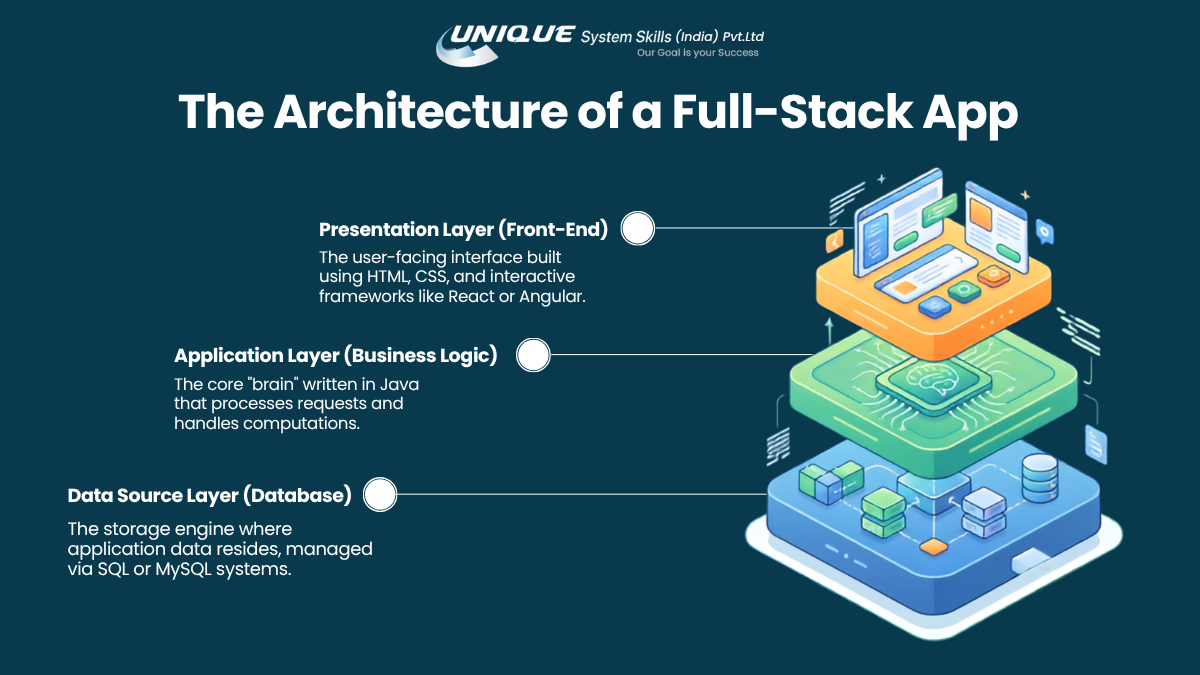
The Architecture of a Full-Stack App
Java Full Stack Developer Skills: The 2026 Tech Stack
The java full stack developer skills that employers are actively testing in interviews in 2026 have changed meaningfully from just two years ago. If your skills were last updated in 2022 or 2023, there are almost certainly gaps between what you know and what hiring panels are expecting. Here is what the current market demands across each layer of the stack.
The Front-end
On the frontend, the expectation has moved beyond basic HTML, CSS, and vanilla JavaScript. Most java full stack developer jobs at mid-to-senior level now require proficiency in React.js and Next.js for building fast, SEO-friendly user interfaces, and comfort with TypeScript (a version of JavaScript that adds type safety and makes large codebases much easier to maintain and debug). Accessibility standards and mobile-first design are now baseline requirements, not optional extras.
The Back-end
On the backend, the most important shift is the move from older Java versions to Java 21 and the upcoming Java 25 LTS. These newer versions bring virtual threads, pattern matching, and sealed classes (features that make applications significantly faster and the code cleaner and easier to manage in production). Spring Boot 3.x is the go-to framework for building microservices is a firm requirement at most mid-to-senior java full stack developer jobs, including security configurations, reactive programming with Spring WebFlux, and integration with message brokers.
The Database and the API
On the database and API layer, the market expects comfort with both relational databases like MySQL and PostgreSQL, and NoSQL options like MongoDB. Designing REST and GraphQL APIs using API-First principles is now a standard expectation rather than an advanced skill. Git version control, code review workflows, and CI/CD pipeline basics complete the technical foundation.
But there is a newer layer of java full stack developer skills that is separating good developers from exceptional ones in 2026 which involves artificial intelligence in a way that most traditional training programmes have not yet addressed.
The Rise of the Java + AI Platform Engineer
One of the biggest changes in full stack java developer roles and responsibilities in 2026 is the growing importance of AI integration. The industry is calling this new specialist the Java + AI Platform Engineer which simply means a developer who does not just build applications but builds intelligence directly into them.
Developers who use AI coding tools save an average of 10 or more hours per week on routine work including writing boilerplate code, creating documentation, and generating unit tests. But the developers capturing the most value from AI are not simply the ones who type faster using GitHub Copilot. They are the ones who understand how to embed AI capabilities directly into the products they build.
Spring AI, part of the broader Spring ecosystem, lets Java developers connect Large Language Models (LLMs) directly into enterprise Spring Boot applications. These can include OpenAI, Anthropic, or open-source models like Llama with minimal setup. Vector Databases are specialized databases that store and retrieve information based on meaning rather than exact keyword matches. They allow Java applications to power intelligent document search, context-aware customer support, and knowledge retrieval at scale. Developers who can design these integrations.
This AI layer does not replace core java full stack developer skills, it multiplies their value. And it sits on top of a broader set of day-to-day responsibilities that define what enterprise full-stack work actually looks like in practice.
Full Stack Java Developer Roles and Responsibilities in 2026 Enterprises
The full stack java developer roles and responsibilities in a modern Indian enterprise or GCC environment go well beyond writing frontend and backend code. Understanding the full scope of these responsibilities is important for both students planning their learning path and experienced professionals checking where their current profile has gaps.
Microservices architecture design is a core part of the role. Rather than building large, single applications, enterprise developers in 2026 design systems as collections of small, independently deployable services that talk to each other through REST APIs or message brokers. One widely used tool here is Apache Kafka, a distributed event streaming platform that allows different microservices to send and receive large volumes of data reliably and in real time. Each microservice handles one specific business function, can be scaled on its own, along with being updated without taking down the whole system.
Containerisation and orchestration are equally central to full stack responsibilities in 2026. Docker lets developers package an application and all its dependencies into a single portable container that runs consistently across any environment. Kubernetes then manages and scales those containers automatically in production. Developers who can build a feature and also containerise, deploy, and monitor it in a Kubernetes cluster are significantly more valuable than those who can only do the former.
Testing and quality assurance are also firmly within the java developer roles scope in 2026. Integrating automated tests including end-to-end browser testing using modern tools like Playwright, directly into CI/CD pipelines is now an expected competency at mid-level and above. Developers who can build, test, and deploy code autonomously compress product delivery timelines in exactly the way that fast-moving enterprises demand. These expanded full stack java developer roles and responsibilities translate directly into a salary landscape that reflects how scarce it is to find professionals who can genuinely deliver across all of them.
Java Full Stack Developer Jobs and Salary Trends in India — 2026 Benchmarks
The financial prospects for java full stack developer jobs in India in 2026 have climbed to levels that were not predicted even two years ago. Intense competition for talent among GCCs, fintech startups, and global enterprises all of which use India as a primary engineering hub.
- For entry-level developers with up to 2 years of experience, java full stack developer jobs now offer ₹5–10 LPA, according to Glassdoor India’s 2026 salary data for Java Full Stack Developers.
- Mid-level professionals with 5 to 8 years of experience are receiving offers in the ₹20–35 LPA range, a jump that reflects both the complexity of responsibilities at this level and the acute shortage of experienced Spring Boot and microservices engineers.
- At the senior architect and lead level (8 to 12 or more years of experience) compensation ranges from ₹40–55 LPA annually at top-tier GCCs and product companies.
This surge is being driven by a specific market dynamic. India has become the world’s largest hub for senior Spring Boot and microservices engineering outside the United States. Global companies building or expanding GCCs in Pune, Bengaluru, and Hyderabad are bidding aggressively for experienced architectural talent. The cost-to-value ratio remains highly favourable for these companies. For Indian professionals, this dynamic is creating a genuine earning opportunity that rewards exactly the skill combinations described throughout this guide.
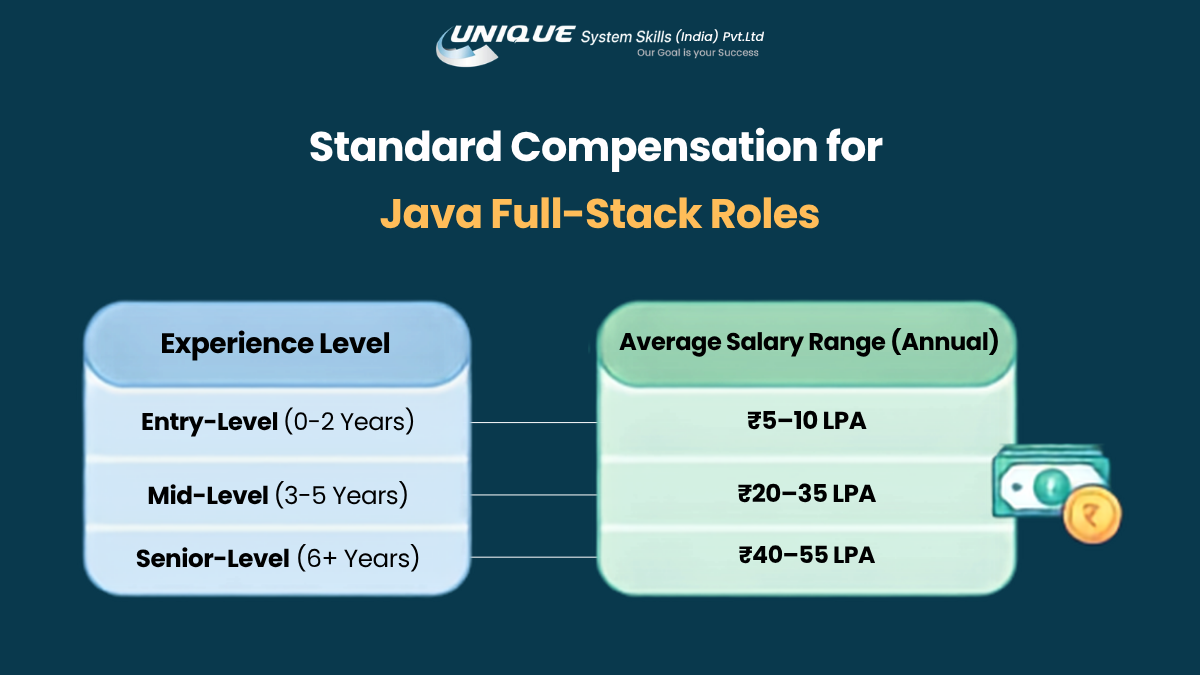
Standard Compensation for Java Full-Stack Roles
The practical question is, how do you build those skills in a structured, efficient way?
Building Your 2026 Roadmap: A Step-by-Step Path for Java Developer Roles
A clear, stage-based learning path is the most reliable way to move from where you are now to where the java full stack developer jobs market is hiring. Here is a practical roadmap built around the 2026 skill requirements:
Stage 1 — Core Java Mastery (Months 1–2):
Start with Java fundamentals, including object-oriented programming, data structures, algorithms, and Java 21 features including virtual threads and pattern matching. Every java developer role at every experience level is tested on these foundations in technical interviews, and no amount of framework knowledge makes up for gaps here.
Stage 2 — Modern Frameworks (Months 3–4):
Build proficiency in Spring Boot 3.x for backend development and React.js for frontend. Learn REST API design, Spring Security, and JPA/Hibernate for database work. Add TypeScript for safer, more maintainable frontend code.
Stage 3 — Cloud-Native and DevOps (Months 5–6):
Learn Docker for containerisation, Kubernetes basics for orchestration, and CI/CD pipeline setup using tools like Jenkins or GitHub Actions. Add AWS fundamentals (EC2, S3, RDS) for cloud deployment. These skills directly broaden the scope of full stack java developer roles and responsibilities you can take on in the workplace.
Stage 4 — AI Integration (Ongoing):
Introduce Spring AI for LLM integration, Vector Database basics for semantic search, and prompt engineering fundamentals. Even a foundational understanding of AI integration noticeably differentiates a profile in the current java full stack developer jobs market.
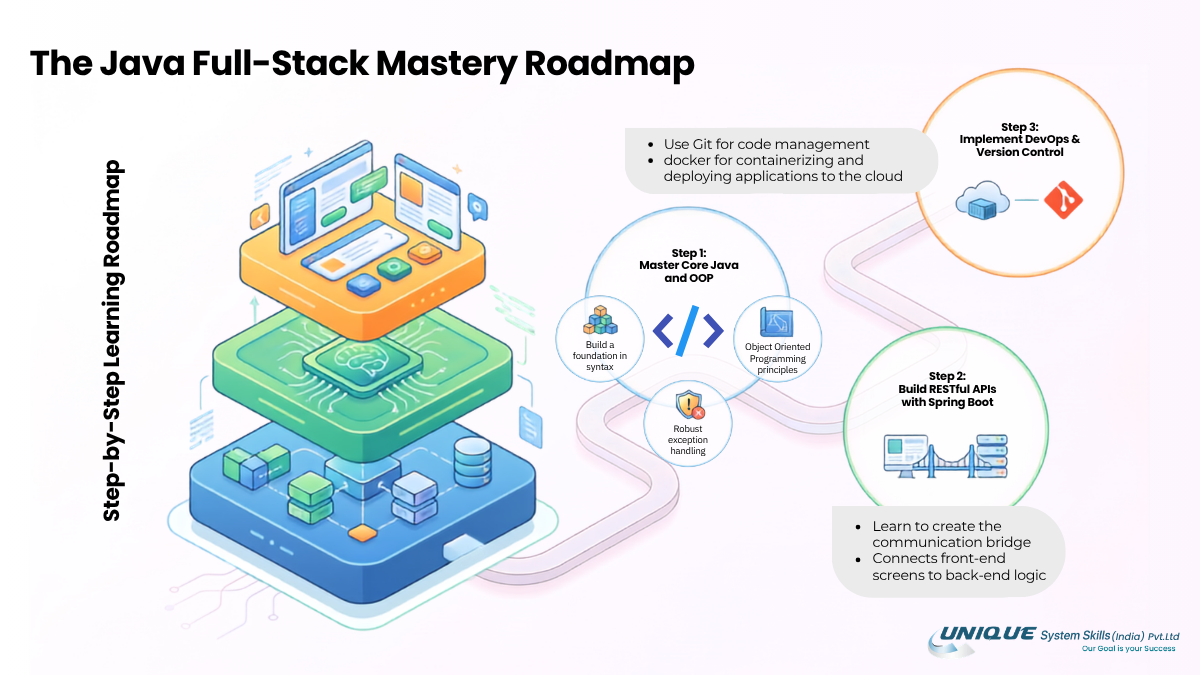
The java Full-Stack Mastery Roadmap
USS’s Java Full Stack Course is structured around exactly this progression through modern frameworks to cloud-native deployment in a 6-month, placement-focused programme built for the Pune and wider Indian market.
Bridging the Skill Gap with Unique System Skills
The 2026 IT market faces a specific challenge that makes training quality more important than ever before. Technical skills are becoming outdated faster than at any previous point in the industry’s history. In AI and cloud-native roles, skills learned just 2 to 3 years ago may already be insufficient. This is a pace of change that is 4 times faster than in traditional IT roles, according to McKinsey’s research on workforce skill decay. Generic online courses built for the 2022 or 2023 market are producing graduates whose knowledge is already behind the curve by the time they finish.
Unique System Skills (USS), with 17+ years of experience, 7,000+ professionals trained, and a network of 350+ corporate partners, addresses this through a custom-built curriculum grounded in ongoing skills gap analysis. USS maps its training content to the specific frameworks and tools its corporate partners are actively hiring for right now. This means students practice on the same tech stacks they will encounter from day one of employment.
The USS 6-engagement model is specifically designed to keep pace with how quickly the market is moving. For individual learners, USS maintains small batch sizes (maximum 15 students) that enable genuine one-to-one mentorship rather than passive instruction, and all lab sessions simulate real-world sprint cycles rather than isolated exercises. The full stack java developer roles and responsibilities covered in USS’s programme are mapped directly to what its 350+ corporate partners are currently hiring for — not what they were hiring for two years ago.
For corporate teams looking to upskill Java developers at scale, USS’s Corporate Training programme offers the same rigorous, market-aligned approach with custom delivery formats designed around team size, existing skill levels, and specific business technology goals. USS’s dual role as both a training institute and an active staffing and recruitment company means that trainers teach the skills that recruiters are actively placing candidates against. Thus, we create a direct, efficient pipeline from training completion to employment in the most stable and well-paid java full stack developer jobs in the Indian market.
The Opportunity Is Now
The full stack java developer roles and responsibilities of 2026 represent one of the most complete, intellectually rewarding, and financially strong careers available in Indian IT. The combination of a structural talent shortage, accelerating AI integration, and GCC-driven salary growth has created a market where well-prepared professionals have real leverage.
With the right roadmap and the right training support, the path from where you are today to a senior java full stack developer role paying ₹20 LPA and above is a structured, achievable journey. The opportunity clearly exists. The question is how quickly you choose to start building toward it.
What should you do next?
- Individual learners: Start with the Java Full Stack Course which is USS’s 6-month, placement-focused programme that takes you from core Java to cloud-native deployment.
- QA and testing professionals: The Software Testing with Playwright Course builds the automation testing skills that enterprise full-stack teams need.
- Companies and HR teams: The Corporate Training Programme is designed to upskill entire development teams with measurable ROI tracking built in.
FAQ
Who can become a Java Full Stack Developer?
Anyone with a solid foundation in programming logic and a willingness to learn both sides of the stack can become a full stack java developer. Most professionals start from a computer science background or a structured course covering Java fundamentals like the Java Full Stack Course. The same applied to career switchers from other IT roles who commit to building the full range of java full stack developer skills the 2026 market expects, from Java 21 and Spring Boot 3.x on the backend to React.js and TypeScript on the frontend.
Is Java Full Stack Developer a Good Career Option?
Yes, and the 2026 numbers make a clear case. Demand for java full stack developer jobs has grown rather than shrunk, with entry-level salaries starting at ₹5–10 LPA and senior architects earning ₹55 LPA to over ₹1 Crore annually at top GCCs and companies hiring graduates. Paired with a genuine talent shortage and the rise of AI-integrated development, it remains one of the most stable, rewarding paths in Indian IT.
What Is the Role of a Full Stack Java Developer in a Company?
The full stack java developer roles and responsibilities in a modern enterprise extend well beyond writing frontend and backend code. A USS-trained full stack java developer typically owns an application across its entire lifecycle, including design, development, testing, deployment, and live monitoring, while also handling microservices architecture, containerisation with Docker and Kubernetes, and embedding AI capabilities directly into the products they build.
Which Frontend Skills Are Needed for a Java Full Stack Developer?
On the frontend, a trained full stack java developer in 2026 needs proficiency in React.js and Next.js for building fast, SEO-friendly interfaces, along with genuine comfort in TypeScript for safer, maintainable code. Accessibility and mobile-first design are now considered baseline java full stack developer skills, not optional extras.
Which Backend Skills Are Important for a Java Full Stack Developer?
On the backend, the most important java full stack developer skills, centred on Java 21 and the upcoming Java 25 LTS, along with Spring Boot 3.x for microservices, including security and reactive programming with Spring WebFlux. Comfort with relational databases like MySQL and PostgreSQL and NoSQL options like MongoDB, plus REST and GraphQL API design, rounds out the backend foundation.
Is Spring Boot Important for Java Full Stack Developers?
Yes, Spring Boot 3.x is effectively a firm requirement at most mid-to-senior java full stack developer jobs today, which is why Unique System Skills builds its curriculum around it. It is the go-to framework for microservices, and employers expect hands-on experience with security, reactive programming, and integration with brokers like Kafka, making it one of the most non-negotiable java full stack developer skills today.